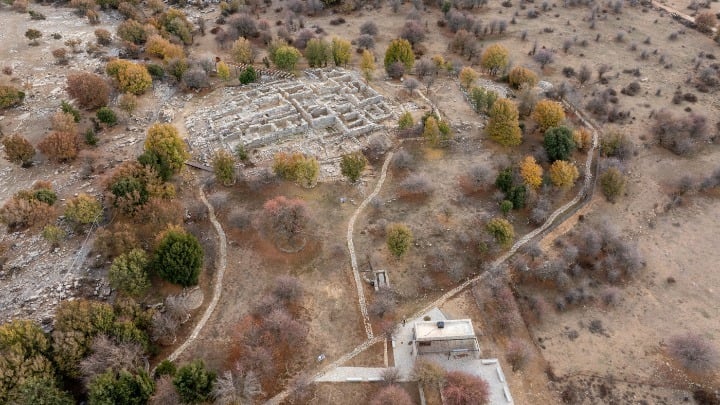
An unorthodox and structurally unusual architectural practice by the Minoans—a civilization known for the meticulous care of its constructions—has been uncovered during the 2025 excavation season at the Palace of Archanes, according to an announcement by the Greek Ministry of Culture.
This discovery not only raised questions but ultimately served as a testament to the technical ingenuity of the Minoan builders.
The mystery of the slanted wall

The archaeological investigation, directed by Dr. Effie Sapouna-Sakellaraki and recommenced in 2023, aimed to complete the picture of the three-story structure of the Archanes mansion, which flourished in its revealed form until around 1450 BC.
This year’s focus was on a slanted, double wall that had closed off a large section of the palace courtyard in a paradoxical way. Its poor construction—built from unworked stones—created many questions.
Systematic archaeological research, aided by specialized scientists, proved the wall’s existence was critical for the building’s survival: its purpose was to protect the palace from natural disasters, specifically from a landslide of the rock face above it.
This protective function explains why the southern section of the first wall was not meticulous, as it was not visible to the eye. However, the sophistication and aesthetic sensibilities of the Minoan architects would not permit such an unsightly feature.
Their ingenious solution was to construct a second, outer wall adjacent to the first. This facing wall, visible from the palace courtyard, was expertly built using finely carved porous stone, matching the aesthetic of the rest of the palace structure.
Evidence of continuous habitation
Above this expertly crafted wall, the excavation revealed typical Mycenaean-period strata containing numerous goblets (kylikes) and later findings from historical periods. Finds characteristic of the site’s continuous use include:
- A Hellenistic-period trefoil-mouth oenochoe (wine jug) with two relief heads (3rd century BC).
- A clay head fragment, likely attached to another object.
Significant discoveries were also made in the southeastern section of the excavation, where an opening was revealed that connected the Central Courtyard to the eastern part of the palace. Stone slabs divided this area into two sections.
The “fetish shrine” clue

A large trapezoidal stone with sockets (tormoi), indicating the former presence of a parapet that was destroyed by a later Mycenaean-era wall, was added over these slabs.
A particularly interesting find from this area is a natural stone bearing anthropomorphic features. The object had fallen from an upper floor and is likely related to the existence of a “fetish shrine,” similar to one found at Knossos.
A look at the elite wing
More generally, the new excavation period in 2023 and 2024 has provided significant new information on the palace’s function. The announcement notes that the northernmost part of the palace so far explored revealed a two- and three-story “elite wing,” featuring:
- Luxurious rooms connected by corridors.
- Numerous gypsum-slab door jambs (parastades).
- Fragments of frescoes.
- Walls covered with mortar.
- Schist slab flooring.
- The characteristic decorative mortar strips, common throughout most areas of the palace that framed the floor slabs, were also found in situ.
Historical context of the Palace of Archanes
The palace is located in the center of the modern town, in the area of Tourkogeitonia. It was destroyed by an earthquake around 1700 BC but was rebuilt and flourished until its final destruction in 1450 BC. Excavations have shown that the site was continuously inhabited thereafter.
The site was first noted by Sir Arthur Evans due to important finds (now in the Ashmolean Museum) believed to have come from the Minoan cemetery at Fourni Hill, which was later excavated by Yiannis and Effie Sakellarakis. That cemetery yielded five tholos tombs, numerous funerary buildings, and cist graves from the Mycenaean period.
Evans also observed large wall surfaces in the town itself and excavated a circular aqueduct within the palace area. Subsequently, Yiannis Sakellarakis, conducting surface surveys and investigating the basements of modern houses, discovered that they were built atop strong Minoan walls—a fact missed by many earlier researchers who were searching for Evans’s rumored “summer palace.”
Sakellaraki’s mapping of these remains led to the precise identification of the Palace of Archanes’ center, which has yielded a wealth of architectural and luxurious mobile finds.
Related: 4,000-Year-Old Minoan Houses, Built Centuries Before Palaces, Hid Clever Designs