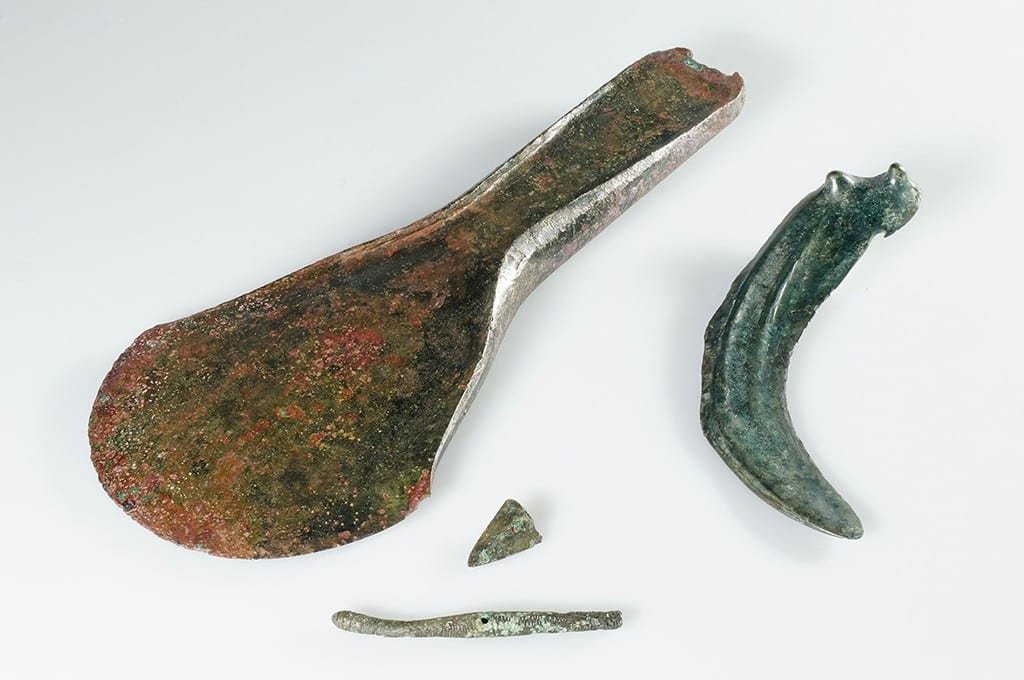
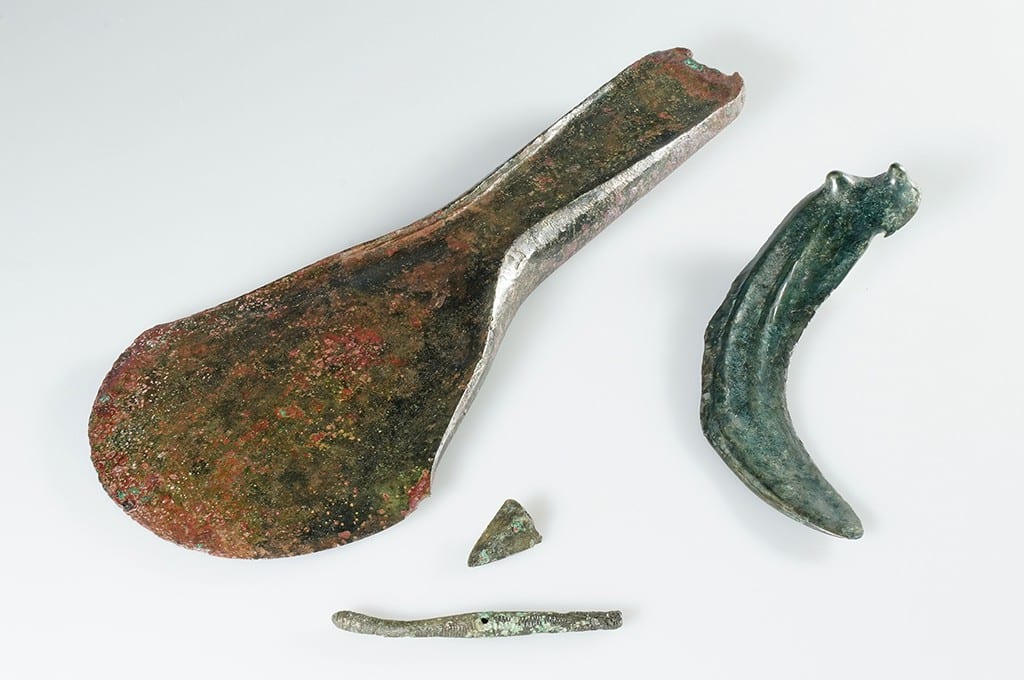
A 3,500-year-old bronze axe and a bronze garment pin have been found in Switzerland, beneath the Schlossfelsen outcrop above Burg im Leimental, a village near the French border.
Archaeology Baselland reported the discovery after a systematic survey carried out in summer 2024 in the Leimental valley. Volunteer surveyor Sacha Schneider, working with the canton’s archaeology team, used a metal detector during an organized prospection and identified the objects on the steep terrain.
The axe measures about 22 centimeters (8.7 inches). Researchers described it as massive because it is solid bronze, heavy for its size, and made with notably careful workmanship. The garment pin was found nearby.
Bronze axe discovery in Switzerland and earlier finds
Schlossfelsen has produced Bronze Age material before. A bronze sickle was recovered there in 1858, a find later recorded by local historian Auguste Quiquerez in his chronicle of the Bernese Jura. Archaeologists said the sickle, the new axe, and the pin all date to the Middle Bronze Age, around 1500 B.C.
Researchers classified the axe as a flanged form known as the Grenchen type. The name comes from a cache uncovered in 1856 during work at a spring in Grenchen.
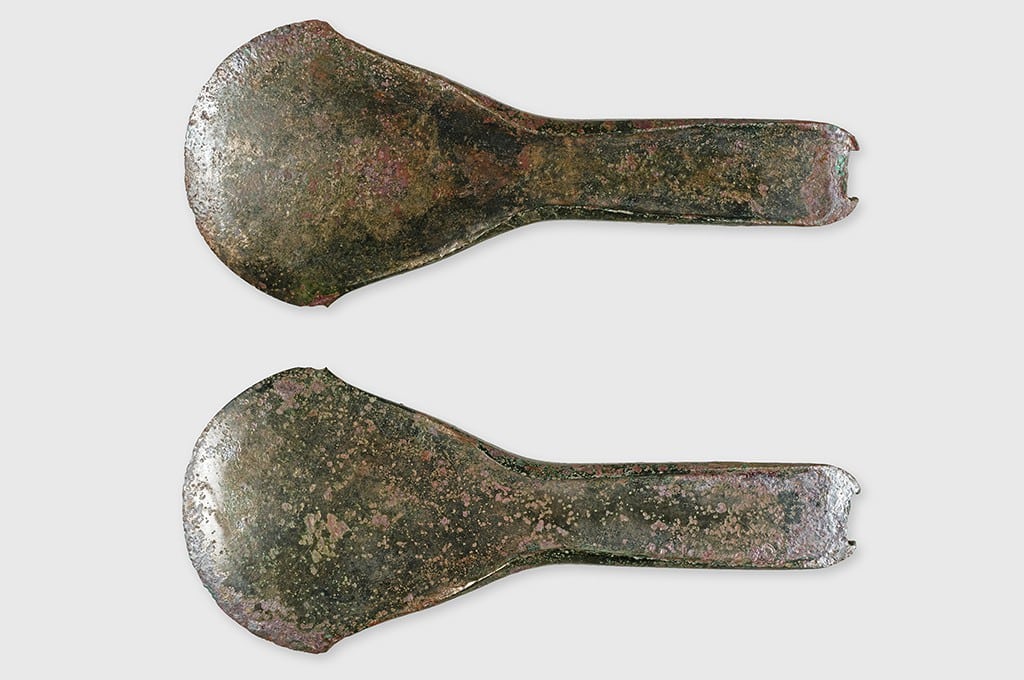
That deposit included four axes, four sickles, and a fragment of a sword. Archaeologists said the Burg find strengthens evidence that this design spread across the Jura region during the Middle Bronze Age, pointing to regional links and exchange.
The discovery also ties into a wider Bronze Age practice of deliberate metal deposits. Archaeologists said communities often placed groups of bronze objects, sometimes in large numbers, into the ground.
Many researchers interpret such hoards as offerings to deities. Individual items left in specific settings, including rock fissures or watery places, are also commonly seen in the same way.
Bronze Age hoards and regional context
In Burg, the axe was recovered from a soil-filled crevice in the rock. Archaeologists said that the setting could fit a single offering. But because multiple bronze objects have been documented at Schlossfelsen, they said it remains possible the site once held a larger hoard that was later looted or gradually scattered.
Researchers also pointed to the area’s position in a fertile landscape with routes leading toward the Rhine and Rhône valleys, including the Burgundy Gate. Finds in nearby Rodersdorf show a Middle Bronze Age settlement.
Another Grenchen-type axe was found in 1968 during the construction of a swimming pool in Aesch. A larger Bronze Age hoard was uncovered in 1998 in Biederthal, France, about one kilometer (0.6 miles) from Burg.
The bronze axe from Switzerland and the pin are now displayed at Basel’s Historical Museum in the Barfüsserkirche as part of the Schatzfunde (Treasure Finds) exhibition, alongside recently discovered Celtic gold and silver coins from Arisdorf.