A historian has identified Galileo’s handwritten notes in a rare 16th-century copy of one of history’s most influential astronomy books. The discovery includes marginal comments and a handwritten biblical passage, offering new insight into how the scientist studied earlier theories of the universe.
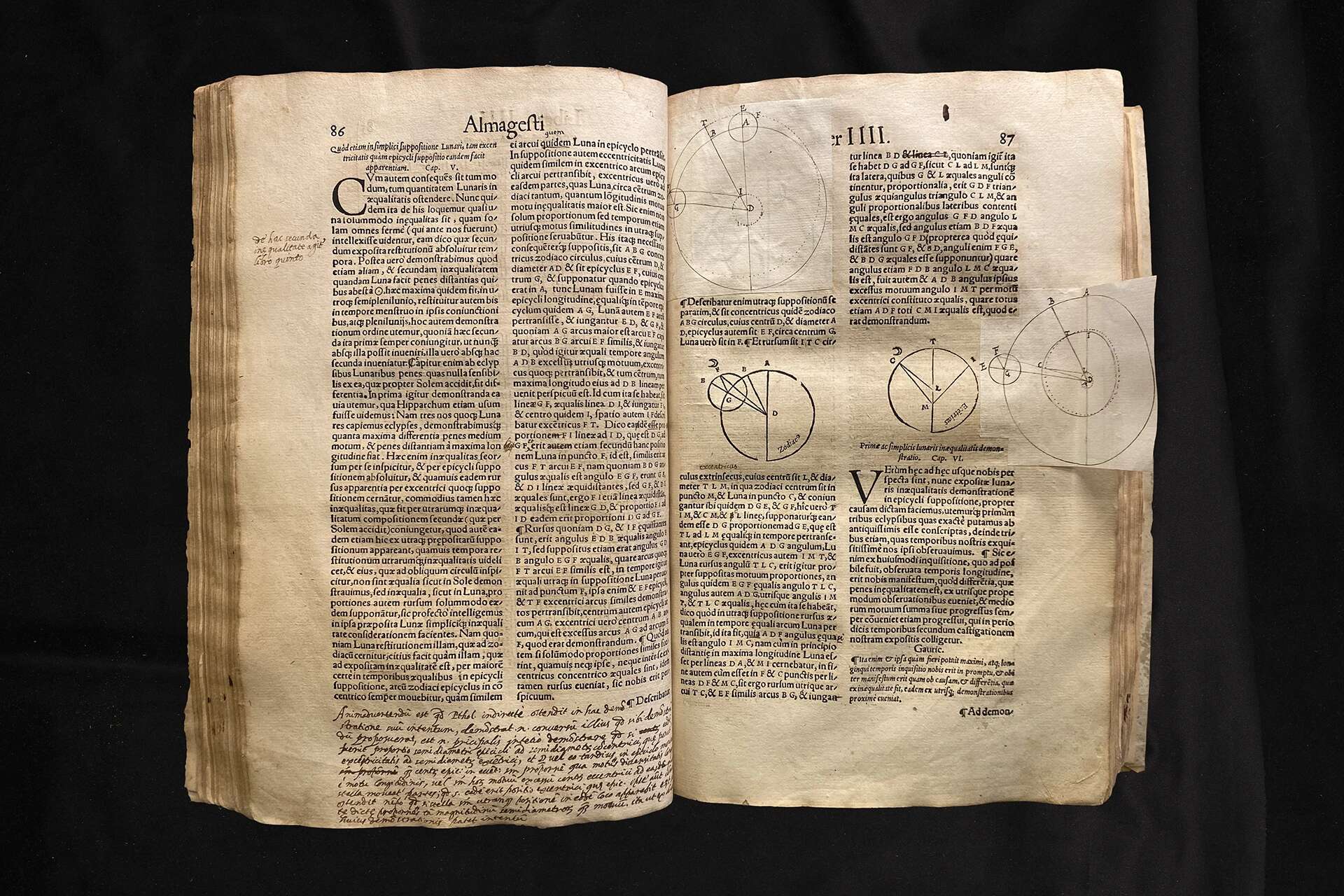
Historian Ivan Malara made the discovery in January while examining a 1551 Latin edition of The Almagest at Italy’s National Central Library of Florence. The work, written in the second century by ethnically Greek astronomer and mathematician Ptolemy, describes a geocentric system that places Earth at the center of the cosmos. The model shaped Western astronomy for more than 1,400 years.
While reviewing several early printings of the book, Malara noticed a blank page that contained a handwritten copy of Psalm 145. The handwriting resembled that of Galileo Galilei. As Malara continued examining the volume, he found dense notes in the margins that appeared to match the astronomer’s script.
Scholars confirm Galileo’s handwritten notes in historic astronomy book
Malara later concluded that Galileo likely wrote the annotations around 1590, years before his famous telescope observations of the Moon and Jupiter. The notes suggest that the young scientist studied Ptolemy’s work closely before developing ideas that later supported a sun-centered model of the universe.
HISTORIA DE LA CIENCIA 🔭📜
Se han hallado notas manuscritas de Galileo Galilei en un ejemplar del siglo XVI del Almagesto.
Este descubrimiento es una ventana única a la mente del genio 🧠 antes de que iniciara la revolución científica. Es fascinante ver cómo el hombre que… pic.twitter.com/o7WRRzgASb— Jose Ramos Vivas (@joseramosvivas) March 4, 2026
Malara contacted leading Galileo scholars to verify the finding. Michele Camerota, a historian at the University of Cagliari, reviewed the evidence and stated that the attribution to Galileo appears secure.
Specialists connected with the Galileo Museum and the Florentine library also compared the handwriting, abbreviations, and annotation style with known Galileo manuscripts and found strong similarities.
Discovery offers insight into Galileo’s early scientific thinking
Some comments in the margins closely resemble arguments Galileo used in his own writings from the same period. The biblical passage also gained context through historical references.
Malara found that another 16th-century copy of The Almagest contains a note stating that Galileo prayed before studying the text. A letter written in 1673 by mathematician Alessandro Marchetti also described Galileo praying before reading the book.
The annotations show that Galileo once examined Ptolemy’s geocentric model in detail. Today, the scientist is widely known for defending Nicolaus Copernicus’ heliocentric theory, which states that Earth and other planets orbit the sun. His support for that view led to conflict with the Catholic Church and resulted in his house arrest in 1633.
Historians say the discovery suggests Galileo had a strong understanding of the mathematical arguments behind earlier astronomy.
Malara plans to publish a detailed study of the annotations in the Journal for the History of Astronomy, where the research will examine Galileo’s handwritten notes and their role in shaping his scientific thinking.