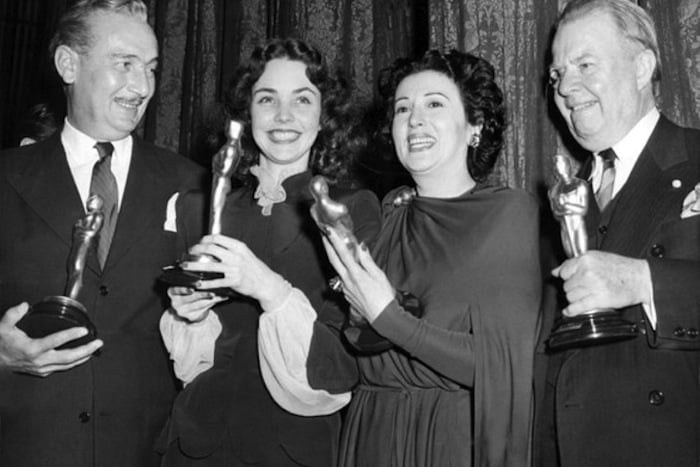
Katina Paxinou was the first Greek actress to conquer Hollywood on her own terms, excelling in both theater and cinema across Europe and distinguishing herself as a world-class tragedian.
Born Aikaterini Konstantopoulou on December 17, 1900, in Piraeus, she was the daughter of flour industrialist Vassilis Konstantopoulos. Her artistic journey began in music; she studied classical singing at the Geneva Conservatory, followed by further studies in Berlin and Vienna. She made her debut at the Piraeus Municipal Theatre in 1920, taking the lead role in Dimitris Mitropoulos’s opera Sister Beatrice.
After an early marriage to industrialist Ioannis Paxinos—with whom she had two daughters, one of whom tragically died young—Paxinou pivoted from opera to drama. In 1929, she joined Marika Kotopouli’s troupe, debuting in Henri Bataille’s The Naked Woman. During this time, she met and fell in love with Alexis Minotis. Though she divorced Paxinos to marry Minotis, she chose to keep her first husband’s surname for her professional career.
In 1931, she and Minotis joined Emilios Veakis’s cooperative troupe, performing masterpieces by Eugene O’Neill, Strindberg, and Chekhov.
Katina Paxinou: National acclaim and international stardom
From 1932 to 1940, Paxinou became a staple of the National Theatre of Greece, establishing herself as the leading actress of the Greek stage. She toured London, Frankfurt, and Berlin, earning acclaim for her portrayals of Sophocles’ Electra, Shakespeare’s Gertrude, and Ibsen’s Mrs. Alving.
The outbreak of WWII led her to the United States, where she conquered Broadway and transitioned into cinema. Her film career was selective but impactful, consisting of only 11 films. Most notably, her role as the fearless, prophetic Pilar in For Whom the Bell Tolls (1943) earned her the Academy Award for Best Supporting Actress in 1944. She also received the Cocteau Prize at the Biarritz Film Festival in 1949 for Mourning Becomes Electra.
Return to Greece and later years
Returning to Greece in 1950, Paxinou reunited with the National Theatre. She spent the following decades performing across the globe, including a celebrated run of Lorca’s The House of Bernarda Alba in New York and Athens. Her repertoire grew to include the great tragedies of Euripides (Hecuba, Medea, The Bacchae) and modern classics by Dürrenmatt and Bertolt Brecht. Her final great success came in the 1971–1972 season, playing the title role in Brecht’s Mother Courage.
Interestingly, she appeared in only one Greek film, The Island of Aphrodite (1969). Legend has it that director Alekos Sakellarios wanted her for the classic comedy The Aunt from Chicago, but producer Philopemen Finos refused, fearing audiences wouldn’t accept a “tragedy queen” in a lighthearted role.
Legacy and honors
Beyond acting, Paxinou was a talented translator of Eugene O’Neill and a composer, even writing the score for the National Theatre’s production of Oedipus Rex. Her contributions to the arts were recognized internationally with honors including:
- The Golden Order of King George I (Greece)
- The Commander’s Cross of the Order of Merit (West Germany)
- Officer of the Order of Arts and Letters (France)
- The Isabella d’Este Award
Katina Paxinou passed away in Athens on February 22, 1973, at the age of 72, leaving behind an unparalleled legacy in the history of the performing arts.
Related: Greeks Nominated for Oscars Go as Far Back as 1935