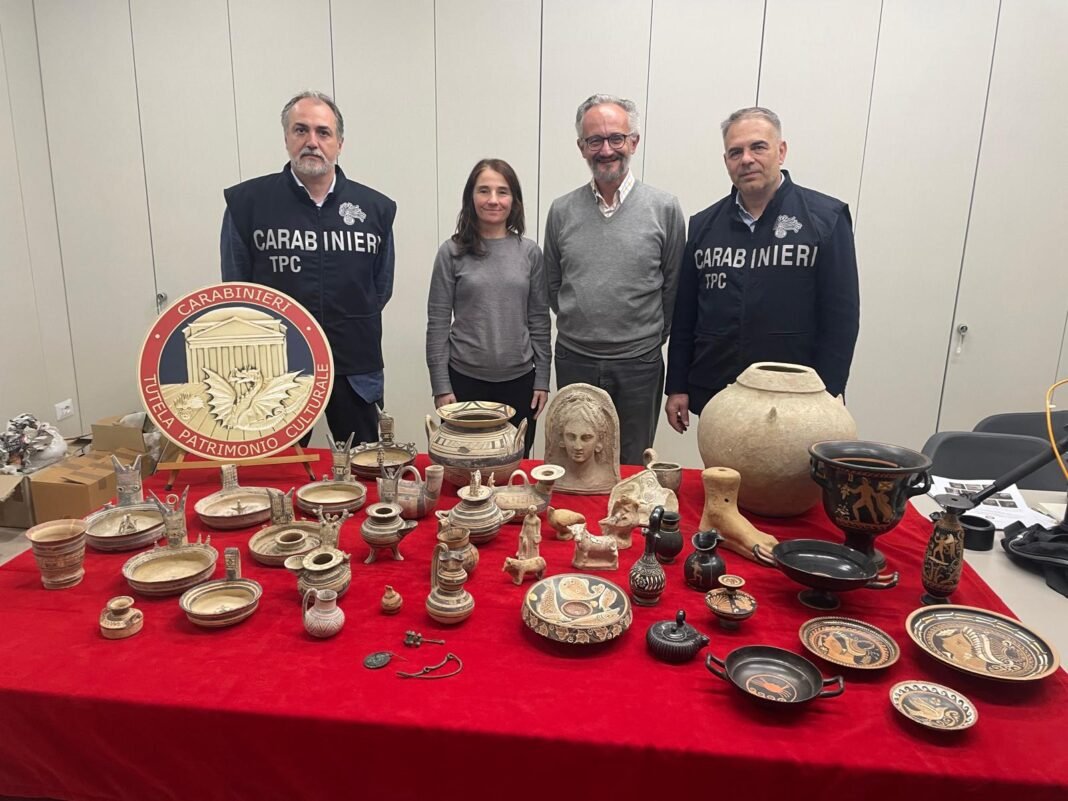

Italian authorities have completed a major cultural heritage operation that brought 98 ancient artifacts back into public care.
Many of these items are rare examples of Magna Graecia craftsmanship, and all were seized during an investigation led by the Carabinieri’s Cultural Heritage Protection Unit (TPC) in Florence.
Prosecutors in Pisa triggered the inquiry after discovering a private collection belonging to a deceased individual. The objects lacked the documentation required to prove legal ownership, prompting authorities to act.

Spotlight on Ancient Greek and Daunian artifacts
Experts identified 44 of the recovered items as particularly important because of their artistic beauty and archaeological value. These artifacts—including vessels, figurines, and ritual objects—date from the 7th to 3rd centuries BC and come from southern Italy, from the region known as Magna Graecia, long settled by Greeks, and from Daunia, where local Italian traditions also left their mark. The detailed craftsmanship suggests they once played a role in funerary and religious ceremonies.
On November 17, 2025, officials transferred these 44 objects to the Regional Directorate for Archaeology, Fine Arts, and Landscape for Barletta-Andria-Trani and Foggia, the region believed to be their origin. The remaining pieces, also in excellent shape, now belong to the Soprintendenza offices serving Pisa and Livorno.

The investigation artifacts and Italy’s heritage laws
The recovery began after the Soprintendenza for Pisa and Livorno alerted authorities to the presence of undocumented archaeological items. A subsequent technical and scientific analysis classified the artifacts into three main ancient cultural contexts:
- Etruscan
- Daunian-Apulian
- Samnite-Campanian
Under Article 91 of Italy’s Cultural Heritage and Landscape Code, all archaeological finds discovered after 1909 automatically become property of the State unless the owner can prove lawful acquisition, inheritance, or receipt of an official reward granted for accidental discoveries.

The legacy of Magna Graecia and Ancient Greek artifacts
Magna Graecia—Latin for “Great Greece”—refers to the network of Greek colonies that flourished in southern Italy beginning in the 8th century BC. Drawn by fertile land and strategic ports, settlers from cities like Athens, Corinth, and Sparta founded thriving communities along the coasts of what are now Calabria, Basilicata, Apulia, and Campania. Cities such as Taranto, Sybaris, and Cumae became centers of trade, philosophy, art, and political innovation.
These colonies were more than outposts; they carried Greek culture deep into the Italian peninsula. Magnificent temples, intricate pottery, distinctive dialects, and democratic principles shaped their identity and left a lasting imprint on Roman civilization. Magna Graecia contributed to the spread of the Greek alphabet—later adapted into Latin—and nurtured some of antiquity’s great thinkers, including Pythagoras, who founded his influential school in Croton.
The region eventually came under Roman control, but its cultural legacy endured. Today, artifacts from Magna Graecia offer a powerful link to a time when Greek ideas and craftsmanship reshaped the Mediterranean world—an influence still felt in language, art, and architecture across Europe.