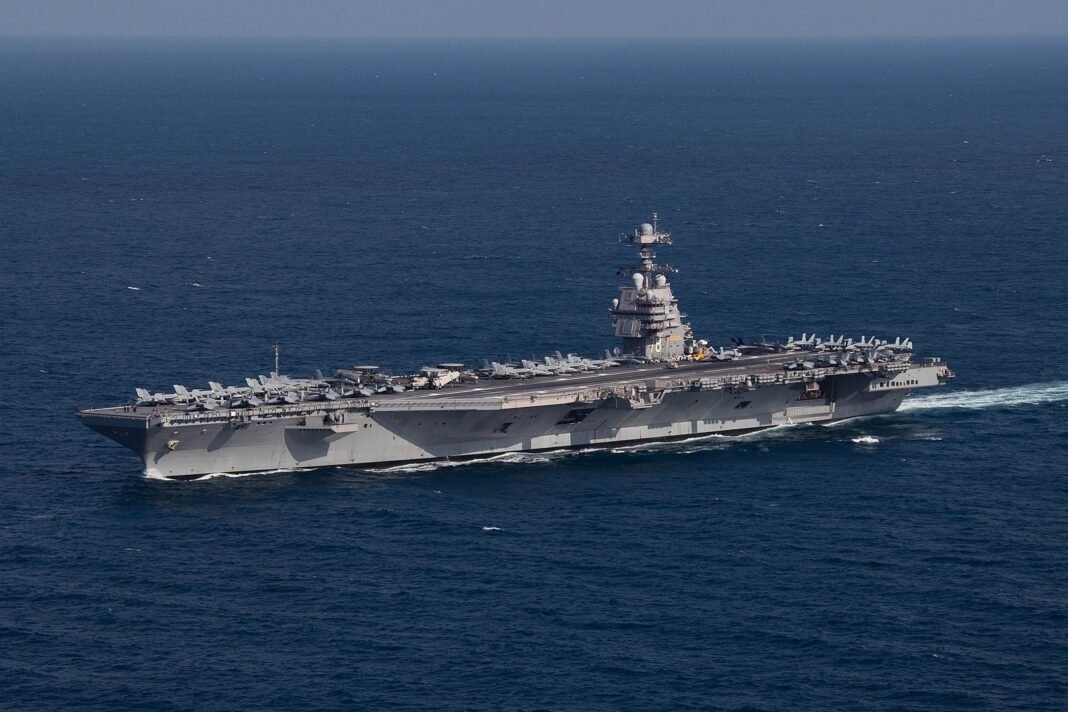
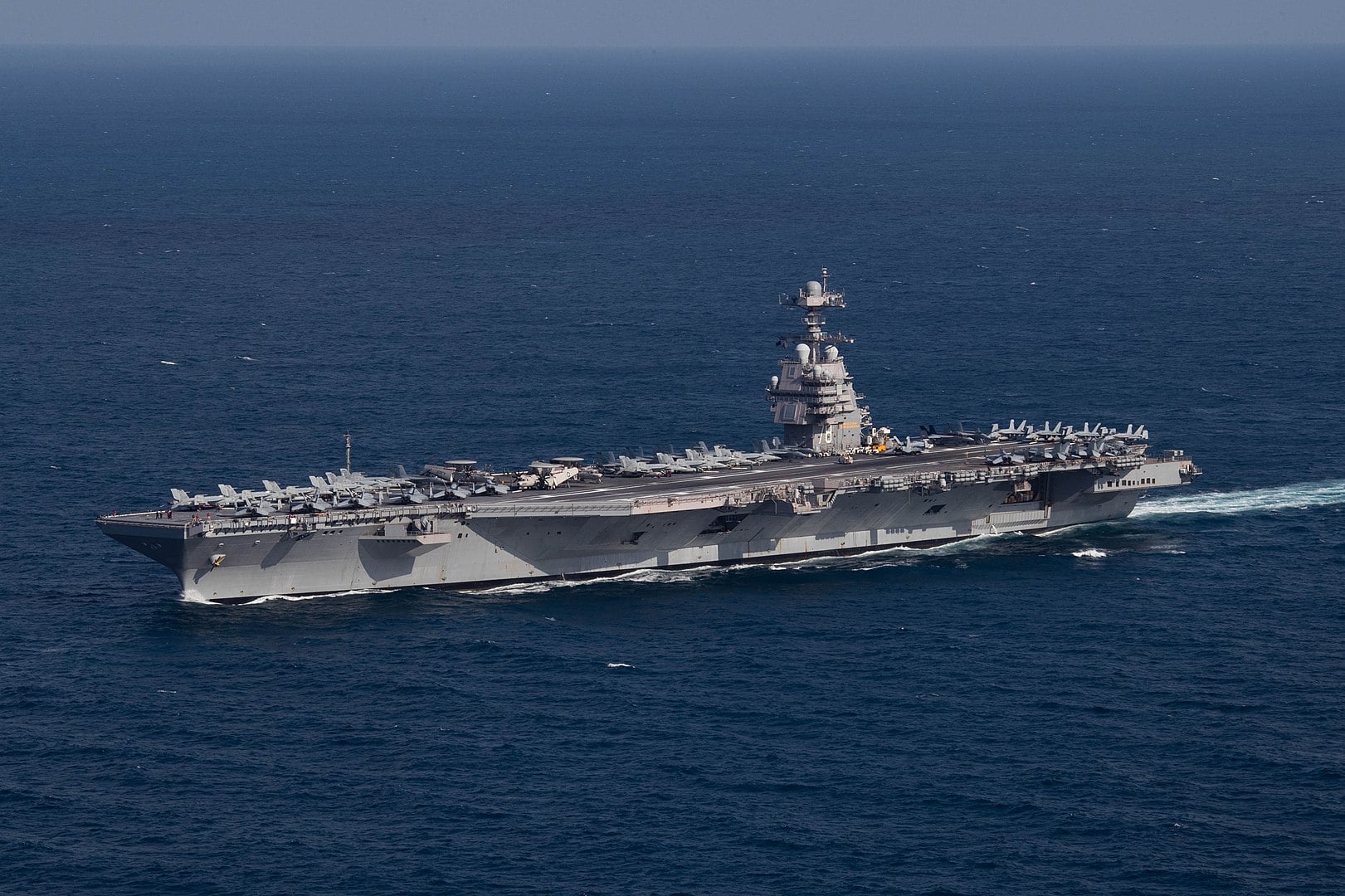
As the USS Gerald R. Ford, the world’s largest aircraft carrier, anchors in the deep waters of Souda Bay, many fear that Crete could become the target of an Iranian strike. While the arrival of such massive U.S. military hardware is often framed as a sign of regional stability, it has ignited a fierce debate: Has Crete’s strategic importance transformed it from a Mediterranean haven into a primary target for an Iranian counterstrike?
A “launchpad for war”
The presence of the Ford strike group, which arrived on February 23, 2026, represents a massive concentration of Western firepower. For the U.S. Navy, Souda Bay is an indispensable logistical hub. For local activists, however, it is a liability.
Manolis Papadomanolakis, president of the Pan-Cretan Peace Committee, has led recent anti-war mobilizations in Chania, arguing that Greece’s “military facilities” are being integrated into offensive war plans. In his recent interview with Thema Kritis 103.1, he did not mince words about the gravity of the situation.
“Once again, our country—and specifically Crete—is being turned into a war launchpad,” Papadomanolakis stated during a rally in Chania. He emphasized that the current buildup is not for routine exercises but for “active participation in war planning,” placing the responsibility squarely on the Greek government’s shoulders for its “unconditional alignment with Euro-Atlantic interests.”
One of his most striking arguments centers on the physical safety of the local population. He warned:
“This policy has nothing to do with our safety. On the contrary, by providing these facilities, we are turning ourselves into a potential target for retaliation. We must send a loud signal from every workplace, neighborhood, and school: the ‘killers of people’ are not welcome here.”
The sentiment among protesters is clear: by hosting the tools of a potential strike against Tehran, Greece is effectively entering the line of fire.
The reality of a possible Iranian strike on Crete
The question of vulnerability is no longer theoretical. Technical data regarding Iran’s current missile arsenal suggests that Crete is well within the “red zone” for a retaliatory strike.
The distance from western Iran to the naval facilities in Crete is approximately 2,100 kilometers. Iran’s Khorramshahr-4 (Kheibar) ballistic missile is specifically designed for such distances, boasting a range of 2,000 to 3,000 kilometers. This missile can carry a 1,500kg warhead at hypersonic speeds, making interception a significant challenge even for advanced air defense systems.
Furthermore, the Sejjil—a solid-fueled missile that can be prepped and launched in minutes—and the Paveh cruise missile, which is designed to skirt radar detection by flying at low altitudes, further complicate the security landscape for the island.
Deterrence or provocation?
Iranian military doctrine has long emphasized “reciprocal retaliation.” Tehran has issued explicit warnings throughout early 2026 that any nation allowing its territory to be used as a staging ground for “hostile acts” against Iran will be held accountable.
While the Patriot PAC-3 batteries stationed on the island provide a layer of protection, military analysts suggest that a “saturation attack”—where dozens of missiles and drones are launched simultaneously—could overwhelm existing defenses. This leaves the people of Chania in a precarious position, caught between their role as a vital NATO partner and the reality of being a high-value target in a potential Middle Eastern conflagration.
As the USS Gerald R. Ford looms large in the bay, the question of Crete’s vulnerability remains the most pressing issue for the local community. For many, the “unsinkable aircraft carrier” of the Mediterranean is starting to feel less like a fortress and more like a lightning rod.