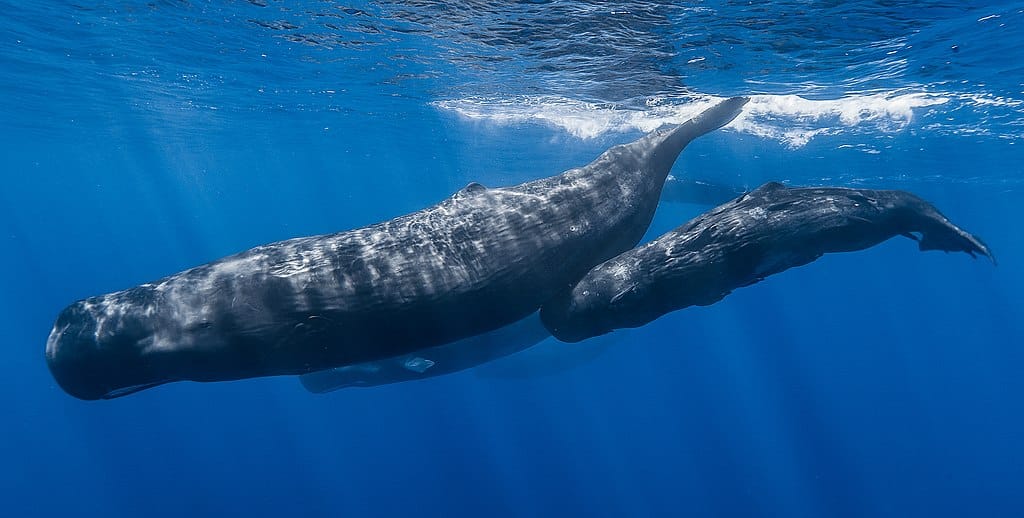
They peacefully roam the deep waters of all oceans and those of the Mediterranean Sea. Despite their colossal size, which often surpasses 10 meters, sperm whales are docile creatures.
They are typically shy and afraid of humans, as they gracefully swim through the seas, making complicated and magical clicking sounds to communicate with each other and locate their prey. Though they have survived the enormous pressures of the darkest depths for millions of years, today there’s one thing they cannot survive: human activity.
Entanglement in fishing nets and plastic pollution are only two of the human activities threatening sperm whales worldwide. In the Eastern Mediterranean in the Hellenic Trench though, collision with passing vessels is considered the number one threat for sperm whales in the region. Now, based on the latest field research of a pioneering whale-tracking system called SAvE Whales, which was developed and tested in Greece with the aim of minimizing the threat of ship strikes, these majestic, endangered animals have a renewed hope that they can continue to roam the Greek seas for years to come.
The numbers on the declining sperm whale population are staggering. According to the American Cetacean Society, prior to whaling, sperm whales may have numbered 1.1 million worldwide. Today, their number is perhaps around 330,000. In the Mediterranean they are listed as “endangered” by the International Union for the Conservation of Nature (IUCN).
The entire Hellenic Trench is an important habitat for sperm whales and has been recognized as an important marine mammal area by the scientific community. The Eastern Mediterranean sperm whales sub-population is estimated at only 200 (or less) individuals.
Being the first system of its kind globally, SAve Whales stands for “System for the Avoidance of ship strikes with Endangered Whales” and serves as an autonomous alert system that transmits real-time, accurate information on the presence and position of sperm whales to passing vessels 365 days a year, 24 hours a day, seven days a week.
In short, the system uses solar-powered, high-tech buoys and/or cabled bottom stations equipped with hydrophones that receive the clicking sounds of the sperm whales. Then, they process them and send filtered data to a land-based analysis center, where computer models are used to detect and precisely localize the animals and finally forward the vocalization fixes to nearby ships, all in real time. SAve Whales was developed, deployed and successfully tested for the first time between 2019-2021 in the sea area southwest of Crete for research purposes.

Ioli Christopoulou, Policy Director and Co-Founder of The Green Tank, a non-profit environmental think tank and one of the project’s partners, said recently the research pilot phase in Crete constituted a milestone in cetacean conservation. “At the same time,” she adds, “several challenges for its full-scale implementation were identified, including selection of the location to be applied, durability for year-round operation through varied weather conditions, energy consumption and data transmission systems.”
The latest system testing in the southern Greek seas
Three years later, in the summer of 2024, the system was ready to be tested again, this time in the Strait of Kythera.
“The Strait of Kythera, that is the sea area between the southeastern tips of the Peloponnese (Cape Tainaron and Cape Maleas) and the islands of Kythera was selected for the installation of the SAvE Whales system because it is an important sperm whale habitat,” Christopoulou says, “where dense marine traffic occurs and other mitigation measures (namely re-routing) cannot be implemented. Vessels crossing from the Western Mediterranean and the Adriatic Sea towards the Aegean and the Black Sea and vice versa have to go through the Strait of Kythera.”
The research built on the decades-long experience of the Pelagos Cetacean Research Institute, one of the project’s two scientific partners, which has been recording the presence of whales in the region. Pelagos and FORTH (Foundation for Research and Technology- Hellas), the project’s second scientific partner, collected data on sperm whale sightings and movements to have a better understanding of their presence and behavior in the area.
They tested the autonomous underwater sound recorder while assessing the soundscape in the area (background noise from the passing vessels or the presence of snapping shrimps can mask sperm whale vocalizations). The scientific teams also estimated underwater noise levels and compared the data from the acoustic stations and visual observations. Understanding the sound profile of the area means that the tracking system will be able to identify sperm whale clicks and single them out from other acoustic signals -which is one of the challenges in such large sea areas.

The combined data and findings from the Strait of Kythera will help to properly design the upscaled SAvE Whales System, which is expected to become fully operational in 2028, and adjust it to the specifications of the Kythera Strait. According to The Green Tank, the plan is for the system to have been tested and assessed for a whole year before handed over to NECCA (National Environment Climate and Change Agency). At the same time, training on the operation and maintenance of the system is also planned.
In April 2024 at the 9th Our Ocean Conference in Athens, Greece, Greek authorities confirmed their interest and commitment to the SAvE Whales system. In June, the Greek Ministry of the Environment and Energy, along with NECCA, Ocean Care and The Green Tank signed an MoU for the effective development and full operation of the system in the Kythera Strait. The project will is being carried out by the scientific teams of Pelagos Cetacean Research Institute and FORTH. The Greek Ministry of the Environment has pledged 2.3 million euros ($2.39) for the project and Ocean Care another 700,000 euros ($726,000).

Why SAvE Whales is critical in the Hellenic Trench
According to Pelagos Cetacean Research Institute data, of the 30 stranded sperm whales recorded from 1992 to 2021, collision with vessels was the cause of death for thirteen of them. For an additional three individuals, ship strikes seem to be also the main cause of death. In other words, the death of more than half of the stranded sperm whales is attributed to collisions with vessels. But only a small number of whales is washed ashore so the exact magnitude of the threat may be underestimated.
Throughout almost 30 years, Alexandros Frantzis, the Scientific Coordinator and President of Pelagos Cetacean Research Institute has developed an almost personal relationship with those gentle giants.
“Sperm whales and cetaceans in general live in an area because it provides them with enough food for their survival during their life cycle,” he told Kathimerini in an interview. “They cannot abandon that area, even if some conditions in their habitat deteriorate, even if that leads to their health degradation (for example, noise and pollution) or a risk of death (for exampl,e collisions). If they leave, they will not be able to sustain themselves in terms of food and so their population will collapse.”
Sperm whales are the third-largest animal on the planet, with the largest brain that has ever been recorded. As avid divers, these supreme hunters can hold their breath longer than the average whale, for about 90 minutes. They have found an ideal home in the Greek seas, where females and their young live in social groups that can reach pods of up to 13 individuals, while males live a more solitary life.
With their population already in decline and under threat from human activities (also from underwater noise originating from passing ships, sonar used for seismic research and/or military exercises, reduced fish supply due to overfishing) the protection of sperm whales in the Hellenic Trench may be also coming down to one thing: each collision with a ship that is avoided means saving the life of another endangered sperm whale.