


As the 2026 Mediterranean cruise season commences, Greece’s premier island destinations, Santorini and Mykonos, find themselves at a critical crossroads. While both islands remain top-tier global attractions, the current landscape is defined by a complex interplay of geopolitical instability in the Middle East and the domestic introduction of a €20 (about $23) per-passenger levy.
While Mykonos shows remarkable resilience with stable arrival projections and a pivot toward high-net-worth travelers, Santorini is grappling with a double-digit decline in bookings and the strategic withdrawal of major carriers.
Cruise tourism prospects for Santorini
For Santorini, 2026 is a year of adjustment. According to Giorgos Nomikos, President of the Thira Port Fund, the island is seeing a tangible dip in numbers due to “exogenous factors.” Data from the island’s Berth Allocation System reveals a 18.27% drop in arrivals (595 scheduled for 2026 vs. 728 in 2025) and a 15.10% decrease in passengers.
The government’s imposition of a €20 per-passenger levy initially caused MSC Cruises to withdraw. Nomikos noted that much of the decline—roughly 137,000 passengers—is linked to this exit. An additional seventeen arrivals were canceled due to the ongoing conflict in the Middle East, accounting for 19,000 lost passengers.
However, a recovery is in sight. Nomikos told Greek Reporter that “MSC has returned with a request for 17 arrivals, representing approximately 70,000 passengers,” a request the Port Fund has already accepted. Despite the volatility, Nomikos remains focused on “ensuring maximum activity for Santorini, always under the terms of sustainability and balance.”
The Mayor of Santorini, Nikos Zorzos, expressed caution regarding the future, noting that geopolitical developments remain unpredictable. On the subject of the new levy, he argued that the revenue should stay local. “Our view is that these funds should be directed to local government for the implementation of infrastructure projects, as we have repeatedly emphasized,” he stated.
Mykonos: Resilience and high-end growth
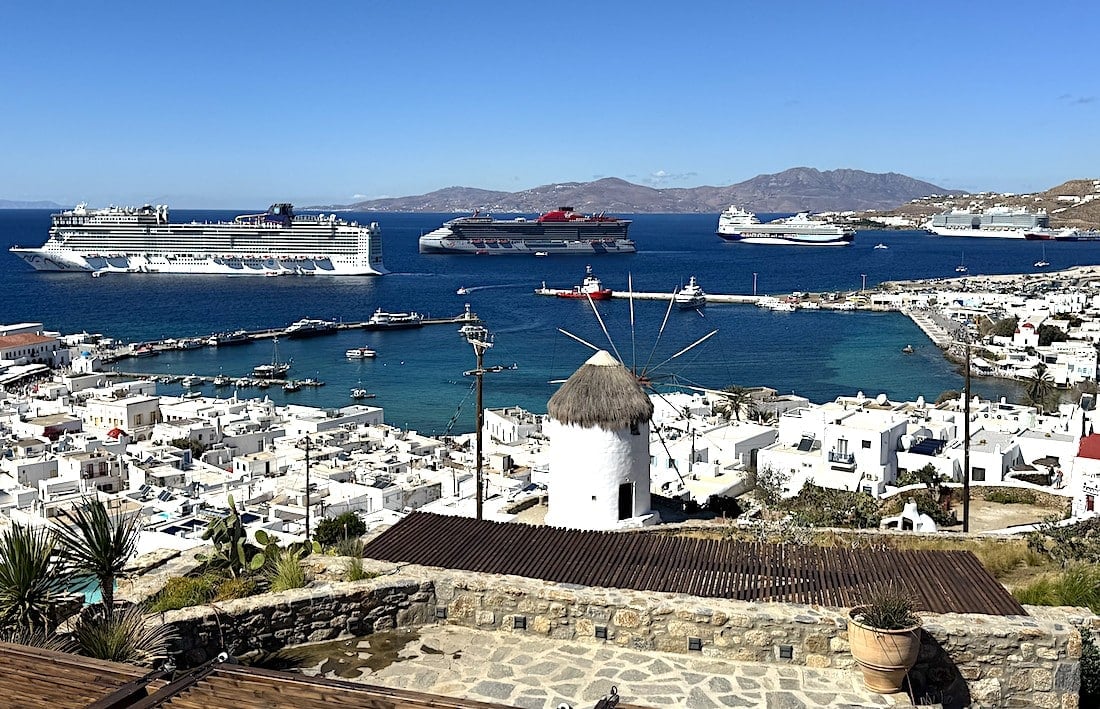
In contrast to Santorini, Mykonos expects to maintain or slightly exceed its 2025 performance. Athanasios Kousathanas-Megas, President of the Mykonos Port Fund, told Greek Reporter that 2026 arrivals are projected at 763 ships with 1.22 million passengers—figures nearly identical to last year’s successful season.
He noted that, aside from Celestyal Cruises, which faced logistical hurdles with ships trapped in the Persian Gulf, most major lines have maintained their Mykonos itineraries. Kousathanas-Megas pointed out a competitive disadvantage regarding the €20 fee. Last year, some ships bypassed Mykonos for Chania, where the fee was only €5.
“It is understandable that instead of landing in Mykonos and paying four times the amount, they would prefer other places like Chania…the government should reconsider and move toward a uniform price for all ports,” he maintained.
Early success and high-spend tourism
The season officially opened with the arrival of the Arethusa and Silver Muse, bringing high-income travelers from the US, Canada, and Australia. The Mayor of Mykonos, Christos Veronis, remains optimistic:
“Mykonos lives from the cruise industry; it has a culture of cruising and shows no signs of decrease…the arrivals since March 20th brought high-quality visitors and very expensive cruises.”
Mayor Veronis also noted that Mykonos businessmen are “merchants” who are prepared to adjust prices slightly to maintain the island’s competitive balance.

