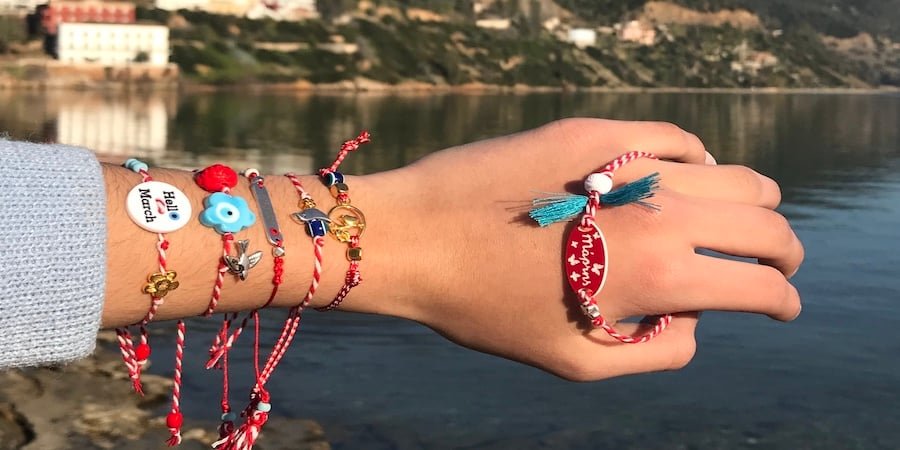
Walk through Greece in early March, and you’ll immediately notice Greek martis bracelets—small red-and-white threads tied around nearly everyone’s wrist. At first glance, it might seem like a simple superstition.
The story goes that the bracelet protects the wearer from the early spring sun. That might sound a little far-fetched, as March isn’t exactly scorching, but people don’t wear it for sun protection. They wear it as a living connection to the past, a tangible link to the ancient traditions of the region.
Thousands of years ago, participants in the Eleusinian Mysteries tied a thread called a kroke around their right hand and left foot. Despite iPhones, the internet, and the general chaos of modern life, this custom has endured, a testament to how firmly Greek culture preserves its ancient roots.
The colors themselves carry meaning. In antiquity, red and white symbolized a balance between nature and the divine: white for purity and new life and red for passion, blood, or the sun’s warmth. Wearing a martis bracelet today is a quiet re-enactment of rituals that once celebrated Persephone’s return from the underworld, a subtle way of marking the end of winter.
The Greek martis bracelet: A thread through time
What strikes many people is how stubborn the tradition is. Greek martis bracelets survived the Byzantines, the Ottomans, and continue to thrive in the 21st century. Even when religion shifted from the twelve ancient Greek gods to Christianity, the tradition of the dual-colored thread persisted. People still cherished that small talisman, a tangible feeling of protection, deeply rooted in their heritage.
It should be noted that this is not exclusively a Greek tradition. Across the Balkans, the custom is widespread. In Bulgaria, it is a major ritual called “Baba Marta,” meant to appease “Grandma March” so she does not make the weather miserable. Variations can also be found in Romania, Moldova, and North Macedonia. It serves as a shared regional shorthand for “we survived winter and are ready to welcome spring.”
This small but beautiful tradition connects people. Whether in a tiny village or stuck in traffic in a large city, seeing that thread on someone else’s wrist links you both to a shared ancient history. It bridges the gap between a schoolchild today and an initiative from three thousand years ago.
The conclusion of the ritual is particularly poetic. The bracelet is not simply removed and discarded; it is kept until the first swallow of spring appears. Once the bird is spotted, the bracelet is taken off and tossed onto a rosebush, allowing the swallows to incorporate the thread into their nests. In a world that constantly rushes, this grounded tradition encourages slowing down, observing the sky, and waiting for the small wonders of nature.
Spring is coming!