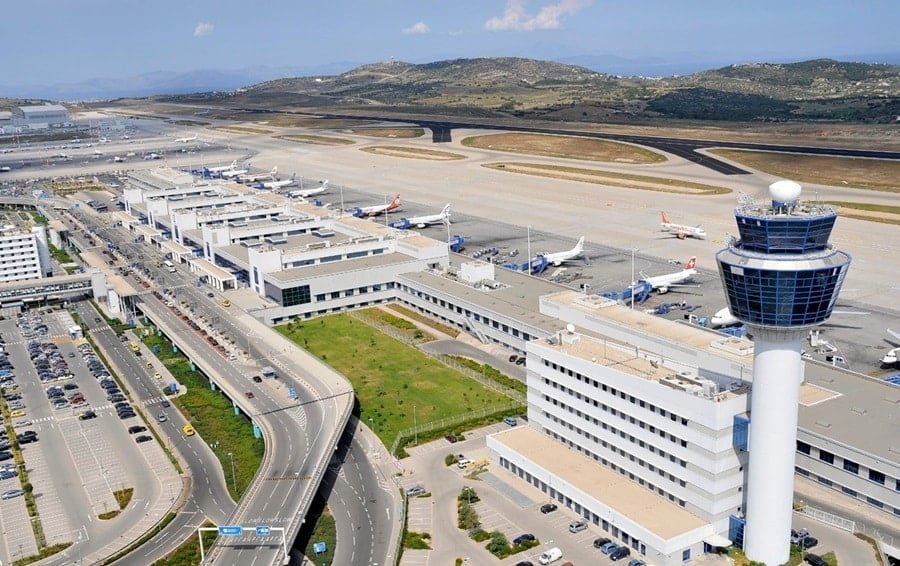
The Association of Greek Air Traffic Controllers (EEKE) issued a scathing warning on Thursday, revealing that technical infrastructure at Athens International Airport has reached a breaking point.
According to the association, air traffic controllers recently lost contact with a primary radar unit, forcing them to manage one of Europe’s busiest terminal areas with severely compromised equipment.
Greek Air Traffic Controllers say only one out of three radar feeds work
The latest malfunction involved a total disruption of the data link to Merenta Hill, a strategic location in Attica that houses critical radar and frequency equipment for Athens Approach.
- Controllers were reportedly left with only one of the three required radar feeds.
- The data link interruption also knocked out backup radio frequencies, leaving staff with no redundancy in the event of a total communication failure.
- This is the second such failure at Merenta Hill in six months, following a similar incident in August. The association accused the Civil Aviation Authority (YPA) of failing to fulfill previous promises to modernize the aging data links.
“The only safeguard that worked was the Air Traffic Controllers, who were forced to guide aircraft to safe landings using malfunctioning equipment,” the association stated. “This cannot continue.”
The January “total airspace shutdown”
Thursday’s warning follows the unprecedented chaos of early January 2026, when the Greek government was forced to take the extreme measure of closing the country’s entire airspace for several hours.
While the Merenta Hill incident was a localized radar failure, the January crisis was a total systemic collapse.
In early January, the primary and secondary radio frequency networks across the Athens Flight Information Region (FIR) failed simultaneously. This meant that pilots in the air could not hear or speak to controllers on the ground.
For safety, a “Ground Stop” was issued nationwide. No flights were permitted to take off from any Greek airport, and incoming international flights were diverted to neighboring countries like Italy, Turkey, and Bulgaria.
Reduced capacity ahead?
Frustrated by what they describe as “administrative apathy,” the Association of Greek Air Traffic Controllers has announced they will now take “all necessary measures.”
This likely includes reducing airspace capacity, a move that would intentionally limit the number of aircraft allowed in Greek skies at any given time to ensure that the remaining equipment is not overloaded.
For travelers, this could mean significant delays and flight cancellations throughout the spring season as the “battle for safety” continues.
Related: Greece Moves to Modernize Air Traffic Control Following Blackout