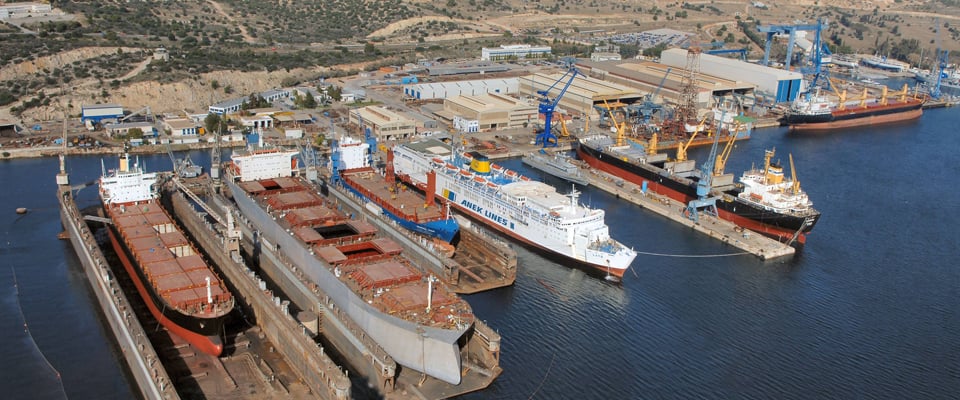
After decades of silence, the railway tracks inside Greece’s iconic Elefsina Shipyards are being brought back to life. Once abandoned and largely forgotten, they are now set to host rail wagons again, marking a significant shift for the wider debate on Greece’s reindustrialization. Thirty years after rail activity faded from the site due to various reasons, the return of rolling stock is framed as part of a forward-looking industrial strategy for the country.
The turning point is the establishment of ONEX Rolling Stock & Integrated Systems (RSIS), a new subsidiary of the ONEX Group. With Elefsina as its base, the company expands the group’s footprint beyond shipbuilding into railway rolling stock and integrated rail systems. Production is expected to begin in 2026, according to the plan outlined by the group.
The initiative is backed by investments exceeding €20 million over two years and includes the creation of at least 100 new jobs, primarily for technicians and engineers. The project aims to form a new industrial pillar at a time when rail infrastructure is returning to the centre of European transport policy, driven by sustainability goals and the push for greener logistics.
The importance of Elefsina shipyards
Elefsina was selectedfor symbolic reasons but also for its existing capabilities. The facilities include more than 57,000 square meters of covered space, heavy machining workshops, large-scale metal construction capacity, precision welding, industrial painting, final assembly lines, load testing and quality control. Alongside these technical assets, the site carries an industrial legacy that predates its exclusive association with shipbuilding.
In the mid-1980s, Elefsina Shipyards were involved in the construction of hundreds of freight rail wagons of the best European standards. At the time, Greece was seeking to strengthen domestic heavy industry and reduce dependence on imports. The shipyards’ production lines and specialised workforce enabled the manufacture of frames, structures and metal subsystems for rolling stock.
While activity declined in the following decade and documentation from the 1990s is limited, the technical know-how was never entirely lost.
The investors now aim to rebuild on that foundation. The plan includes a regional rolling stock production line, a maintenance, repair and overhaul (MRO) center, and the positioning of Elefsina as a stable national industrial partner for international manufacturers. Through SKD and CKD co-production models, with final assembly in Greece, the company seeks tighter control over quality, costs and timelines, while gradually increasing domestic industrial content.
Geography is another key advantage. Direct access to the Thriasio Plain and the national rail network of Greece allows rolling stock to be loaded and transported by rail, reducing logistics costs by an estimated 15–20%. This also supports combined transport solutions, lowers the environmental footprint and opens up prospects for rail-based energy transport to Central European markets.
In the domestic market, the venture aims to fill a long-standing gap by offering independent maintenance services to private operators, refurbishment of passenger wagons, overhauls of traction units and rapid support for freight fleets. Training Greek technicians and engineers is also a central pillar, building on experience already gained at the Elefsina and Syros shipyards.
Three decades on, the return of wagons to Elefsina’s tracks is an attempt to restore industrial might for the country that once seemed lost, now re-emerging as a realistic option for the future of Greek transport and manufacturing.