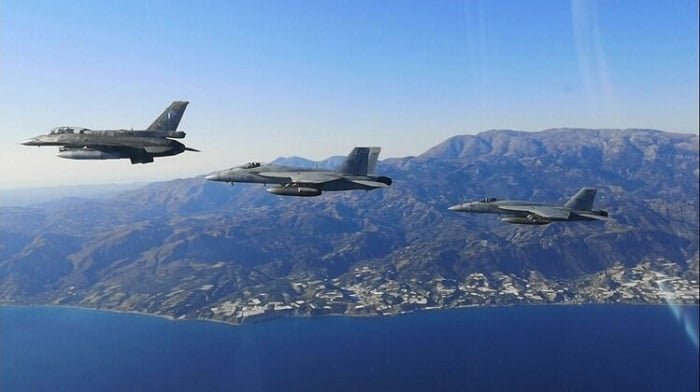
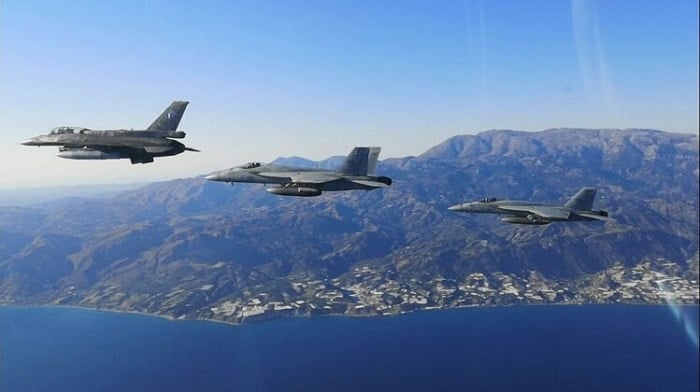
Senior Air Force commanders from Greece, Israel, and Cyprus convened for a high-level, confidential meeting in Nicosia recently to deliberate on deepening trilateral security cooperation.
According to Israel’s KAN News, the Commander of the Israeli Air Force, Major General Tomer Bar, met with his Greek and Cypriot counterparts to refine operational coordination. The discussions reportedly centered on counterbalancing regional military expansion and deterring threats to the established maritime order in the Eastern Mediterranean.
Participants exchanged strategic assessments of the evolving security landscape and explored avenues for tighter integration, including specialized joint exercises and heightened combat readiness.
These talks coincide with broader deliberations in Athens, Nicosia, and Tel Aviv regarding the unprecedented step of establishing a joint rapid reaction force.
As reported by the Greek newspaper Ta Nea, defense analysts and military leadership are currently evaluating scenarios previously deemed “operationally ambitious.” These efforts reflect growing concerns in Athens over the modernization of regional military capabilities, particularly in naval and aerial domains.
Proposed force structure of a joint rapid reaction force
- Personnel: A “Joint Rapid Reaction Brigade” comprising approximately 2,500 personnel.
- Contributions: Greece and Israel would each commit 1,000 troops, with Cyprus providing a contingent of 500.
- Air Support: Each nation’s air force would dedicate a squadron to support the unit’s operations.
- Infrastructure: The force would utilize a network of strategic naval and air bases across the Levant, specifically leveraging facilities on Rhodes, Cyprus, and in Israel.
- Naval Assets: Greece intends to contribute a frigate and a submarine, while Israel would deploy a new-generation corvette and a submarine.
Israeli security analyst Shai Gal emphasized that critical infrastructure in the Eastern Mediterranean remains vulnerable within a maritime zone defined by competing doctrines, such as Turkey’s “Blue Homeland.” Gal noted that the strategic center of gravity has shifted from land to the sea, where “energy and data lifelines linking Europe are concentrated.”
Drawing a parallel to the Baltic Sea and the sabotage of the Nord Stream pipeline, Gal warned that the protection of the proposed Great Sea Interconnector (GSI) cable should be treated with the utmost urgency. He argued that the trilateral alliance must develop coordinated response mechanisms now, rather than waiting for a comparable “strategic shock” to catalyze action.
Related: Greece Approves Purchase of Rocket Systems From Israel