

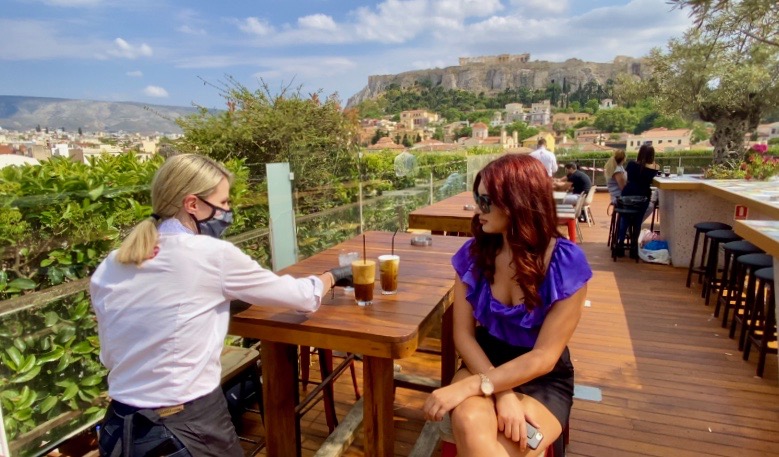
A newly published study titled “The Café Economy” by the Hellenic Observatory at the London School of Economics (LSE) reveals an uncomfortable truth about the transformation of Greece’s economy following the bailout era.
The study, co-authored by Michalis Nikiforos, Vlassis Missos, Christos Perros, and Nikolaos Rodousakis, analyzes how Greece has morphed into a “Café Economy.” This code term describes the massive expansion of the Accommodation and Food Service Activities (AFSA) sector, which includes all tourism-related activities: restaurants, bars, hotels, entertainment, short-term rentals, and more.
By using the “Café Economy” label, the researchers draw attention to “the elephant in the room” that is often ignored: Despite grand promises of a new “development model,” Greece over the last fifteen years appears trapped in a growth model built on “feet of clay.”
Greece: Uneven tourism growth and collapsing productivity
The researchers examined how, after years of austerity and structural reforms that liberalized labor and product markets, tourism-related activities grew disproportionately compared to other sectors. This uneven growth has been a key factor in the drastic reduction of overall economic productivity.
Instead of the promised productivity increase via the bailout reforms, the Greek economy experienced the opposite: a sharp drop in labor productivity and a significant redistribution of employment toward low-productivity sectors, particularly AFSA.
The authors argue that the main drivers of the productivity collapse were a reduction in aggregate demand and a sharp decline in real wages.
- Labor Productivity fell by 16% between 2009 and 2024 and remains below pre-crisis levels.
- Real Wages dropped even more steeply, falling by 26% to 35% overall, and by as much as 60% in the tourism sector.
This phenomenon signifies a violent redistribution of income against labor. The shift of employment to the AFSA sector accounts for approximately one-third of the overall decline in labor productivity. This was compounded by the loss of hundreds of thousands of jobs in productive sectors like manufacturing and a shortfall in high-tech and innovation employment.
Historical regression to a ‘dual’ model
The study explains that Greece’s development model is becoming “dual,” a form of historical regression typically characterizing less developed or transition economies. In this dual model, growth relies on low-productivity sectors that absorb unemployment through cheap labor made possible by wage compression.
The researchers conclude that the three bailouts implemented from 2010 to 2018, instead of enhancing competitiveness, triggered a deep recession from which the Greek economy has not fully recovered. They point out that even the IMF issued an apology for underestimating the negative impact of sharp fiscal contraction.
The over-educated and underpaid workforce
The LSE research highlights the dramatic changes in the AFSA workforce from 2009 to 2023:
- Employment in the AFSA sector increased rapidly by 87%.
- Gross Value Added grew by 11%.
The AFSA sector became the largest employer in the Greek economy, characterized by low wages and an increase in precarious or part-time work.
The workforce in tourism is more educated but underemployed, with many university graduates working in low-skilled positions. Eurostat data confirms this: Greece has one of the highest rates of “overqualified” young graduates in Europe (after Spain), with over 86% of young graduates in tourism/hospitality employed in jobs below their qualifications.
The double-edged sword of Greece’s café economy
The study, “The Café Economy,” outlines both the benefits and significant drawbacks of this development path:
The Positive: External Balance
The tourism sector made a crucial contribution to improving the current account balance. The trade surplus in travel services improved by five percentage points between 2009 and 2023, accounting for roughly half of the total current account deficit reduction during that period.
The Negative: Structural Vulnerabilities
Over-reliance on tourism and a low-productivity, low-wage, labor-intensive service economy has created serious structural weaknesses:
- Social and Environmental Degradation: The disproportionate growth contributes to environmental and cultural degradation, phenomena often grouped under the label of “overtourism.”
- Housing Crisis: The increase in short-term rentals and foreign real estate investment is driving up rents, making them unaffordable for local workers.
- Dependence: As the café economy swells at the expense of other sectors, dependence on external demand and its seasonal fluctuations increases, making whole regions vulnerable to changes in tourism traffic.
The researchers warn that low wages reduce the incentive for innovation and technological progress, ultimately undermining the economy’s competitiveness.
Policy implications
The Greek experience challenges the notion that market liberalization automatically increases efficiency. The authors caution that the greater dependence on low-productivity sectors (AFSA) creates a development dilemma: they support demand and foreign exchange but undermine long-term productivity and social sustainability.
“A successful path for Greece will require policies that not only restore demand but also strategically promote high-productivity sectors, support technological upgrading, and ensure inclusive growth. Without such a shift, the ‘café economy’ risks being not a temporary adjustment but a long-term equilibrium of stagnation.”
The study urges a careful reassessment of structural reforms in light of real economic and institutional conditions, advocating for policies that prioritize inclusive, high-productivity development.


