The profound historical significance of the unification of the Ionian Islands with Greece’s national fabric 162 years ago was honored on Thursday in Corfu. Attending the commemorative events, the President of the Hellenic Parliament, Konstantinos Tasoulas, emphasized that the anniversary carries a modern message calling for a renewed, collective effort to ensure the prosperity and security of Greece.
“The Union of the Ionian Islands strengthens the geopolitical foundation of the Greek state, honors the struggles of the Ionian people, and reminds us all of our duty today,” Tasoulas stated. “Inspired by those historic struggles, we must dedicate even greater efforts toward the progress of the Ionian Islands, as well as the prosperity and security of Greece against any threat.”
Following the commemorative parade, Tasoulas paid tribute to Ioannis Kapodistrias, the first Governor of modern Greece, by laying a wreath at his monument.
Reflecting on the historical context of the unification, Tasoulas added:
“Today, we celebrate and honor the historic 162nd anniversary of the Union of the Ionian Islands with Greece. The integration of Corfu and the wider Ionian region into the national fabric took place at a time when our clear national ideology was the Megali Idea (Grand Idea). This vision dominated the political life of the country for decades—a national ideology firmly rooted in unshakeable ethnic and historical foundations.”
After nearly six centuries of Venetian rule, the Ionian Islands fell successively under French, Russo-Turkish (as the “Septinsular Republic”) and finally British control (as the “United States of the Ionian Islands”).
British rule of Ionian Islands
It was at the Congress of Vienna in 1814 and 1815 which granted the United Kingdom full sovereignty over all of the Ionian islands, after the British navy defeated the French.
The Ionian Islands then was given a bicameral legislature, titled the “Parliament of the United States of the Ionian Islands,” and composed of a Legislative Assembly and a Senate, something very similar to what the USA has.
The United States of the Ionian Islands was formed as a federation, with each one of the seven main islands constituting one member-state in the federation. This was depicted not only in the coat of arms of the island federation, but also on its coinage.
In order to maintain its sovereignty on the islands, the UK appointed a ”Lord High Commissioner of the Ionian Islands,” who was traditionally chosen by the British monarch.
The capital of the United States of the Ionian Islands was Corfu, where the chambers of the Assembly and the Senate were established.
The union with Greece
As was only natural, the islanders gradually but steadily began to demand a political union with their motherland, the Kingdom of Greece. Skirmishes took place on most of the islands between the Greeks and the British throughout the decades of British rule, with the British Army often intervening to impose order.
The final years of British rule were actually quite difficult for the islanders. The British decided to make Greek the official language of the States, something that surprisingly had not been the case in the past.
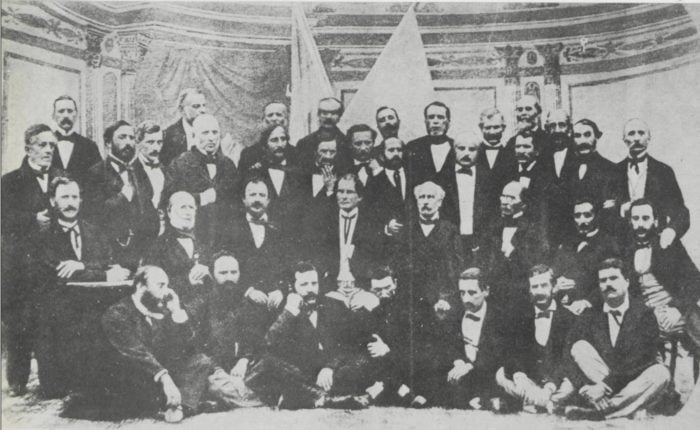
The party of the Radicals demanded union with Greece, and many of its MPs, including Detoratos Typaldos, Frangiskos Domeneginis and Telemachus Paizis among many others, signed the proposed parliamentary bill which called for the union of the United States of the Ionian Islands with Greece nearly fifteen years before the union actually occurred.
The United Kingdom, as it has done throughout the history of the British Empire, responded with force and violence to the growing movement for independence and union with Greece.
Persecutions, arrests, imprisonments and exile were their common practices to suppress the growing desire of the local people to join with their Greek motherland.
Eventually, on March 29, 1864, after nearly a decade of turbulence, the United Kingdom decided to offer the Ionian Islands as a present to the newly-enthroned King George I of Greece, who was a dyed-in-the-wool Anglophile.
Thus, on May 21, 1864, by proclamation of the Lord High Commissioner, the Ionian Islands were officially united with Greece, beginning the new, modern chapter in their long history.