

Following drone strikes by Iranian forces against the British airbase at Akrotiri, Cyprus—and explicit threats from the Islamic Revolutionary Guard Corps (IRGC) to target the island with ballistic missiles—the Greek government has moved to activate the Common Defense Doctrine between Greece and Cyprus. The Iranian threats are reportedly a response to the use of British bases in Akrotiri and Dhekelia by U.S. aircraft.
Greece’s military deployment in aid of Cyprus defense
By decision of the Government Council for National Security (KYSEA), Greece has initiated a significant military deployment:
Naval Assets: The Hellenic Navy has deployed the FDI HN frigate Kimon (an advanced stealth-capable vessel) and the MEKO-class frigate Psara. These vessels are en route to the southeast of Cyprus to establish an air-defense perimeter. The Psara is equipped with the Greek-manufactured “Centaur” anti-drone system.
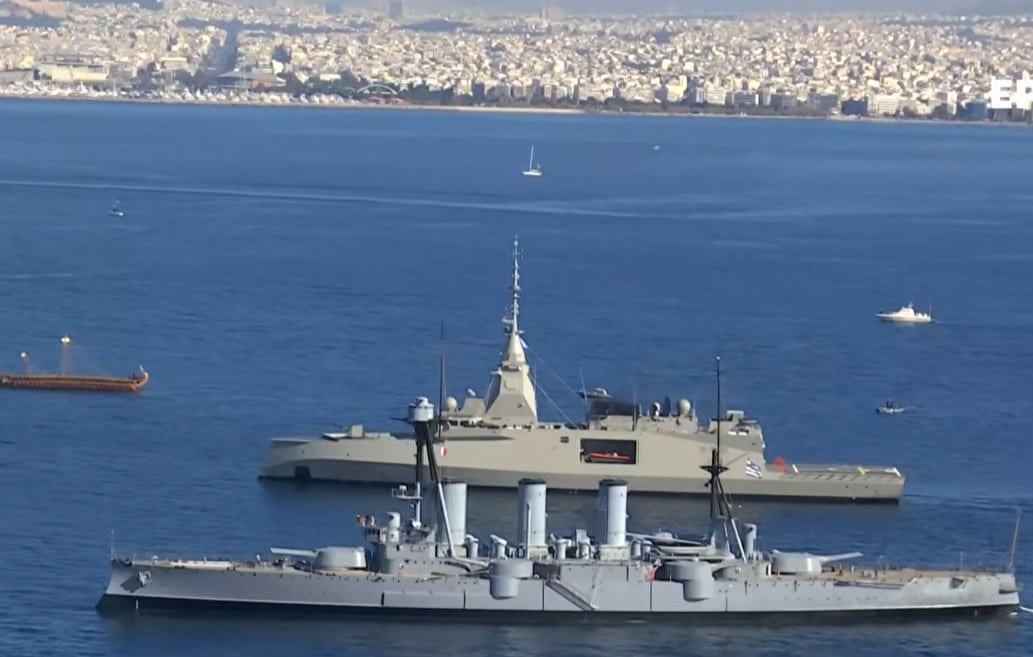
The FDI frigate Kimon represents a significant upgrade to these capabilities, boasting 32 vertical launch cells for Aster 30 anti-aircraft missiles (with a range of 150 km) and the Sea Fire radar, which has a 500 km range and can track over 800 targets simultaneously. This combination creates a formidable “area defense umbrella.”
Air Assets: Two pairs of F-16 Viper fighter jets, supported by a C-130 transport aircraft, have been deployed from the 112th Combat Wing in Crete to the airport in Paphos, Cyprus.
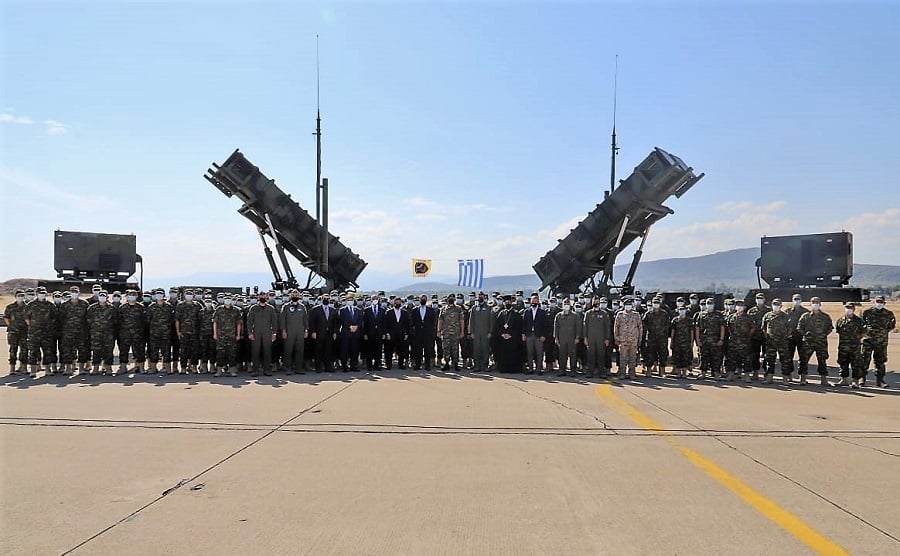
Patriot missiles: The deployment of a Patriot missile battery to Karpathos acts as a critical “linchpin” in Greece’s defensive strategy, effectively closing the geographic gap between the Greek mainland and Cyprus. The Patriot system is designed for high-altitude interception, specifically targeting ballistic missiles and high-performance aircraft. This complements the medium-to-long-range naval air defense (Aster 30) provided by the frigates.
Greece stands by Cyprus
Defense Minister Nikos Dendias, following an emergency meeting of the Defense Council (SAM) at the Pentagon, stated: “Throughout the duration of the current crisis, Greece will contribute in every possible way to the defense of the Republic of Cyprus, to counter threats and illegal actions on its territory.”
Minister Dendias is traveling to Nicosia with the Chief of the Hellenic National Defence General Staff, General Dimitris Houpis, to coordinate directly with President Nikos Christodoulides and the Cypriot Defense Minister.
Government officials have clarified that this deployment is purely defensive. While it does not constitute direct Greek involvement in U.S. or Israeli military operations against Iran, the mobilization places Greece firmly at the center of the Middle Eastern theater of operations.
While concern in Athens regarding ballistic missile threats to the Souda Naval Base in Crete remains, officials note that the distance provides a strategic buffer. Greek air defense, integrated with allied U.S. and Israeli systems, is currently on high alert, with established protocols to detect and intercept potential long-range threats.
What is the Greece-Cyprus Common Defense Doctrine?
The doctrine is a strategic framework established in the 1990s to integrate the defense of Greece and Cyprus. It is predicated on the principle that the two countries share a common defense perimeter. In practice, this means:
Strategic Unity: An attack on the sovereign territory of the Republic of Cyprus is viewed as a threat to Greece, triggering an automatic Greek military and diplomatic response.
Operational Integration: It facilitates shared intelligence, joint training, and the interoperability of Greek and Cypriot forces.
For decades, the doctrine was largely symbolic, used primarily for deterrence and military exercises. Its activation in March 2026 marks a historic shift from deterrence to defense. Athens has moved from “signaling” (deterrence) to “positioning” (active defense). By placing frigates and F-16s on the island, Greece is no longer just threatening a response; it is physically blocking an attack.
The doctrine has historically been focused on the threat from Turkey. The current crisis forces a reimagining of this doctrine to cover modern, asymmetric threats like drone swarms and ballistic missile attacks emanating from the Middle East.
By making this a “Unified” effort, Greece ensures that any aggressor—whether Iran, proxies, or others—is fighting a NATO member (Greece), not just an isolated Mediterranean nation. This serves to “internationalize” the security of Cyprus, providing it with a level of protection that, historically, it struggled to maintain alone.

