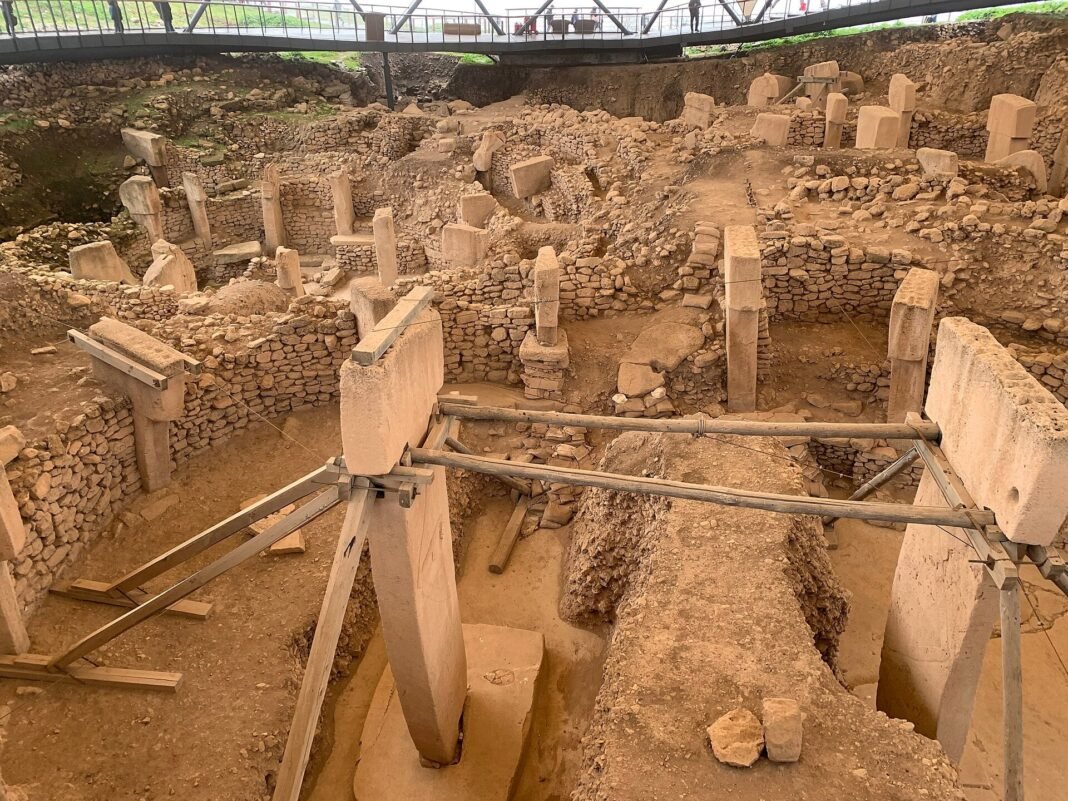

Archaeologists working in southeastern Turkey have uncovered new evidence that expands the known reach of one of the world’s earliest monumental cultures. The find is reshaping how researchers understand the Neolithic transition in Upper Mesopotamia. Stone structures featuring Göbeklitepe-style T-pillars have been identified in the Samsat district of Adıyaman. The remains surfaced after falling water levels in the Atatürk Dam reservoir exposed land that had remained underwater for decades.
Discovery triggered by retreating waters
The site lies near Kızılöz village, where receding waters revealed stone features along the shoreline. After a report from residents, teams from the Adıyaman Museum Directorate conducted on-site inspections. Archaeologists quickly recognized the significance of the remains.
Based on surface context and architectural form, researchers believe the structures date to about 11,000 years ago. This places them in the Pre-Pottery Neolithic period, a time marked by early settlement, experimentation with farming, and the rise of communal ritual spaces.
Pillars echo Göbeklitepe’s design
The newly identified stones are carved in a clear “T” shape and appear to have been deliberately placed within stone-built settings. Their form closely resembles the pillars found at Göbeklitepe, one of the most famous early ritual centers in the world.
Although no carved animal reliefs or human features have yet been documented at the Adıyaman site, archaeologists say the size, shape, and placement of the pillars point to shared architectural ideas and symbolic traditions.
Evidence of shared ritual architecture
According to Prof. Dr. Sabahattin Ezer of Adıyaman University, the remains display key traits seen at Göbeklitepe and other Taş Tepeler sites around Şanlıurfa.
Archaeologists in southeastern Turkey have uncovered Göbeklitepe-style T-pillars near Adıyaman after falling dam waters exposed the site.
The find suggests early monument building spread across Upper Mesopotamia, not just one hilltop. pic.twitter.com/uYCOCYG79c
— Tom Marvolo Riddle (@tom_riddle2025) January 28, 2026
These features include small-scale enclosures, stone slabs arranged around shallow pits, and centrally placed T-shaped pillars. Archaeologists consider this layout a hallmark of early ritual architecture. The repeated pattern across sites suggests a shared building tradition and belief system across the region.
Extending the Taş Tepeler horizon
In recent years, the Taş Tepeler Project has documented several major Neolithic sites, including Karahantepe, Sayburç, Sefertepe, Kurttepesi, and Çakmaktepe. Until now, most were concentrated near Şanlıurfa.
The Adıyaman discovery pushes this cultural horizon northwest into the Euphrates basin. Researchers say this broader distribution supports the idea of a dense and interconnected prehistoric landscape rather than isolated ceremonial centers.
The Euphrates as a corridor of contact
The site’s position near the Euphrates River adds to its importance. During the Neolithic period, the river served as a major route for movement, communication, and resource exchange. Archaeologists say this setting strengthens arguments that Taş Tepeler sites formed a network of ritual centers linked through travel and shared practices.
At Göbeklitepe, T-shaped pillars are widely interpreted as stylized human figures, often carved with arms, hands, belts, and animals. The Adıyaman examples are smaller, but their central placement follows the same symbolic logic. Researchers believe they served similar communal or ceremonial roles.
Preservation at risk as excavations begin
Mustafa Çelik, deputy director of the Adıyaman Museum Directorate, said the site was originally buried beneath 2 to 3 meters (6.6 to 9.8 feet) of soil. Over time, fluctuating water levels eroded the sediment, exposing the structures. While this enabled the discovery, it also placed the remains at risk.
Rescue excavations are now underway to document and protect the site before water levels rise again. Archaeologists say such dam-related finds highlight the vulnerability of submerged heritage and the need for systematic surveys in reservoir zones.
A growing picture of early cooperation
Artifacts recovered from the site are now displayed at Perre Ancient City, allowing the public to engage with one of humanity’s earliest monument-building traditions. Further excavations are planned, and researchers believe Adıyaman may reveal additional structures beneath the surface.
Each discovery adds weight to a conclusion reshaping prehistoric studies: complex symbolic behavior and monumental architecture were not isolated breakthroughs, but regional achievements rooted in cooperation across Upper Mesopotamia.