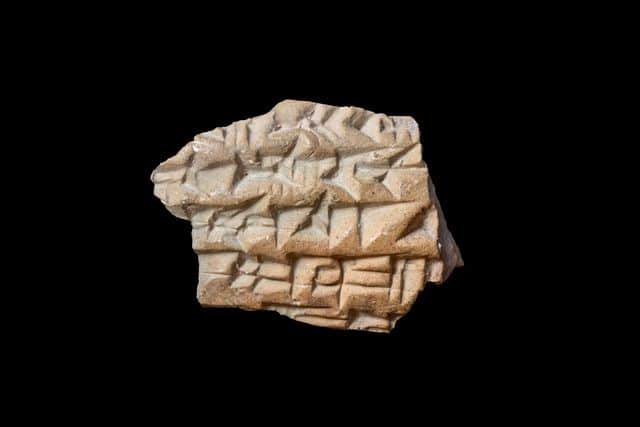

Archaeologists have uncovered the first Assyrian inscription ever found in Jerusalem, dating back to the First Temple period. The tiny fragment, just 2.5 centimeters (about 1 inch) across, carries an Akkadian cuneiform inscription — and marks a rare moment where biblical history, imperial politics, and archaeology meet.
The artifact was unearthed near the Western Wall of the Temple Mount during excavations led by the Israel Antiquities Authority (IAA) in cooperation with the City of David Foundation.
Fragment reveals link to Assyrian royal court
Experts believe the inscription was once part of a royal seal impression attached to an official document sent from the Assyrian capital to Judah. Scholars say the text may have referred to a delayed tribute payment — a reminder of the political strain that marked relations between King Hezekiah’s Judah and the Assyrian Empire.
The find offers a rare glimpse into the tense diplomacy of the late 8th century BCE, when Judah was a vassal kingdom under Assyrian domination.
The inscription was first identified during wet sifting at Davidson Archaeological Park, confirming its authenticity. Moria Cohen, a worker at the Emek Tzurim National Park sifting project, recalled the discovery as “a once-in-a-lifetime moment,” realizing the fragment bore real cuneiform writing.
A message from the Assyrian heartland
The inscription includes a clear date — “the first of the month of Av” — and mentions a “chariot officer,” literally “the one who holds the reins.” This title, known from Assyrian records, referred to a royal courier or official responsible for delivering state communications.
Archaeologists believe the soil containing the fragment originated from a collapsed First Temple structure west of the Temple Mount, one of the closest known areas with remains from that period.
Petrographic analysis revealed that the clay did not come from Jerusalem but from the Tigris Basin, home to Assyria’s great cities — Nineveh, Ashur, and Nimrud (Kalḫu). Researchers say this confirms that the document was produced in an Assyrian administrative center and later sent to Jerusalem.
Based on its script and style, scholars believe the seal impression may date to the reign of one of Judah’s kings — Hezekiah, Manasseh, or early Josiah — during the rule of Sennacherib or his successors.
A small fragment with great significance
Although the inscription is incomplete, it reveals the scope of Assyria’s administrative control and its communication system that spanned the ancient Near East. Researchers interpret it as evidence of Jerusalem’s integration into the empire’s bureaucratic network, where sealed messages, taxes, and orders traveled between imperial capitals and regional centers.
According to Dr. Anat Cohen-Weinberger of the IAA, the clay’s mineral composition differs from that of Jerusalem and matches the geology of northern Mesopotamia. A chemical analysis by the Geological Survey of Israel is underway to pinpoint its precise source.
Researchers described the discovery as a small fragment with great significance. It offers the first tangible proof of official — and possibly strained — communication between Jerusalem and Assyria, confirming the city’s role as a political and administrative hub under imperial rule.