A research from Italy reveals that the Etruscans employed remarkably advanced metallurgical techniques to forge weapons and tools, selecting materials and production methods with precision that reflected both practical and cultural priorities.
A study led by Marta Porcaro from the Department of Earth Sciences at Sapienza University of Rome examined metal artifacts unearthed from Pyrgi, an ancient port city that served Caere, one of Etruria’s major urban centers.
The findings, published in the Journal of Cultural Heritage, show that the Etruscans were capable of manipulating copper-based alloys in ways that suggest deep knowledge of smelting, alloying, and casting.
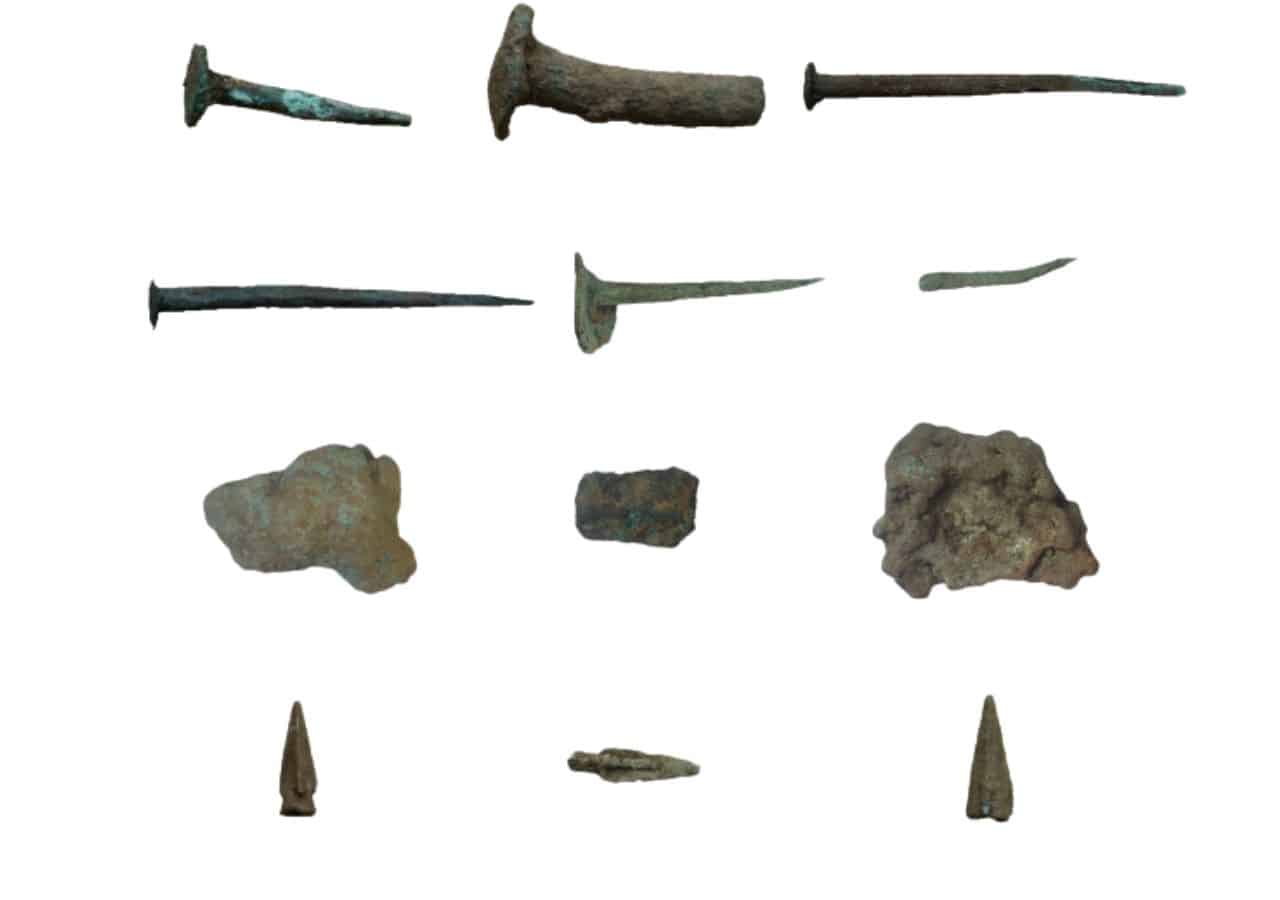
Twelve artifacts were analyzed, including nails, bronze arrowheads, and aes rude, an early form of currency. Each object revealed unique clues about how Etruscans forged tools for construction and weapons for combat.
The nails and aes rude were mostly made from nearly pure copper, while the arrowheads used a complex bronze alloy combining copper, tin, and lead. This specific mix improved the weight and impact force of the weaponry and shows clear evidence of being cast through a fast-cooling process.
Forged artifacts reveal strategic alloy use in weapons
Porcaro explained that the structural patterns of the arrowheads indicated rapid solidification, which would have enhanced their performance in battle. The high lead content was likely added intentionally to improve casting and penetration.
Using scanning electron microscopy and chemical analysis, the team found microscopic inclusions of elements like lead, bismuth, sulfur, tellurium, and selenium inside the artifacts.
These particles point to the use of polymetallic sulfide ores and provide insight into the ores’ origins and the incomplete smelting methods used. Porcaro noted that these elements, though present in low quantities, serve as chemical markers of the raw materials and smelting practices in ancient times.
Etruscans forged and preserved their tools and weapons
The research also found no solid evidence that Aes Rude was routinely melted down to make nails. Only one artifact showed possible overlap, but its shape suggested it may not have been a true aes rude piece. Instead, the production processes for construction and currency items appeared to be distinct.
Corrosion studies revealed that while many objects formed protective layers of cuprite and malachite, others showed signs of active degradation.
Nail 9787, for example, showed signs of ongoing corrosion due to chloride-based compounds. Electrochemical tests indicated that environmental factors, such as brackish soil near Pyrgi’s sanctuaries, contributed to this damage.
The results offer a detailed look into how the Etruscans crafted and preserved vital tools and weapons, and how their metallurgical choices reflected both function and resource management.