

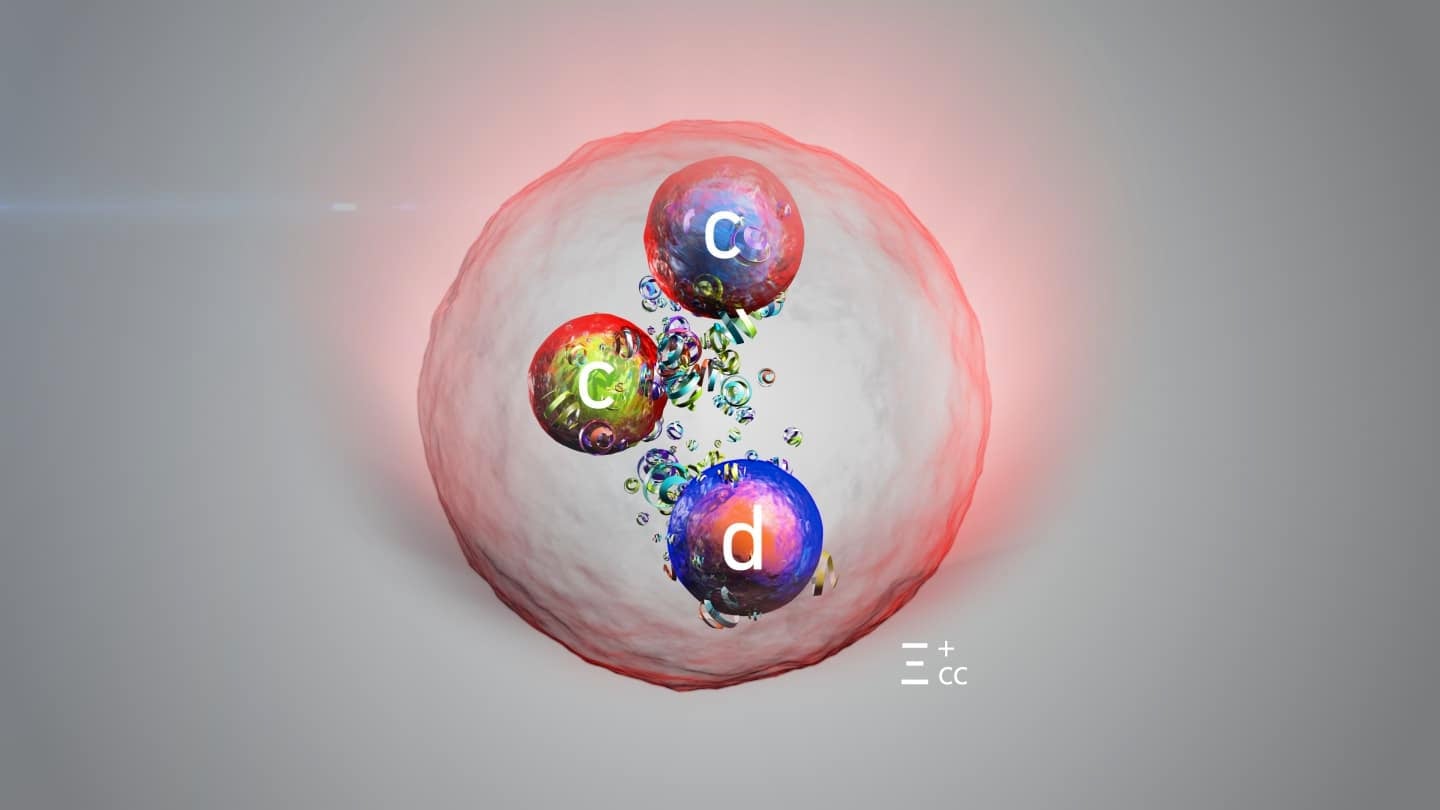
Scientists at CERN (European Organization for Nuclear Research) have identified a new heavy baryon that could deepen understanding of how matter is held together. The discovery comes from the LHCb experiment at the Large Hadron Collider, one of the most advanced machines ever built to study the fundamental structure of the universe.
The newly observed particle belongs to a class known as baryons. These particles are made of three quarks, the basic building blocks of matter. In this case, the baryon contains two heavy charm quarks and one lighter down quark. This structure is similar to that of a proton, but with a key difference. A proton contains two lighter up quarks instead of charm quarks. Because charm quarks are much heavier, the new particle has about four times the mass of a proton.
Quarks and hadrons form the basis of matter
Quarks come in six types, or “flavours”: up, down, charm, strange, top, and bottom. They do not exist freely in nature. Instead, they combine to form larger particles such as mesons and baryons, which together are known as hadrons. Most hadrons are unstable and exist only for a very short time, making them difficult to study.
To detect such short-lived particles, researchers rely on high-energy collisions inside the Large Hadron Collider. In these experiments, protons are accelerated to near the speed of light and smashed together. The collisions produce a wide range of particles, including rare and unstable ones. These particles quickly decay into more stable forms. Scientists then study the decay products to reconstruct the properties of the original particle.
Data analysis confirms a high-confidence discovery
Using data collected during the third run of the collider, the LHCb team identified the new baryon with a statistical significance of 7 sigma. In particle physics, a 5 sigma result is considered the standard for a confirmed discovery. A 7 sigma result provides even stronger confidence that the finding is real.
The particle is closely related to another baryon discovered by LHCb in 2017. That earlier particle contained two charm quarks and one up quark. The new particle replaces the up quark with a down quark. Despite this small difference, researchers say the new particle behaves very differently. It has a predicted lifetime up to six times shorter, due to complex quantum effects. This makes it even harder to observe.
Detector upgrades enable more precise observations
The discovery marks an important milestone for the LHCb experiment. It is the first new particle identified since major upgrades to the detector were completed in 2023. These improvements have enhanced the experiment’s ability to track and analyze particle interactions with greater precision.
According to Vincenzo Vagnoni, spokesperson for the LHCb Collaboration, the result will help scientists test and refine quantum chromodynamics. This theory describes how the strong force binds quarks together to form matter. It also governs more complex and less understood structures, such as tetraquarks and pentaquarks.
CERN leadership points to future discoveries
“This major result is a fantastic example of how LHCb’s unique capabilities play a vital role in the success of the LHC,” said Mark Thomson, Director-General of CERN.
Researchers say continued experiments at the Large Hadron Collider are likely to reveal more rare and exotic particles. Each discovery helps build a clearer picture of how matter behaves at its most fundamental level.

