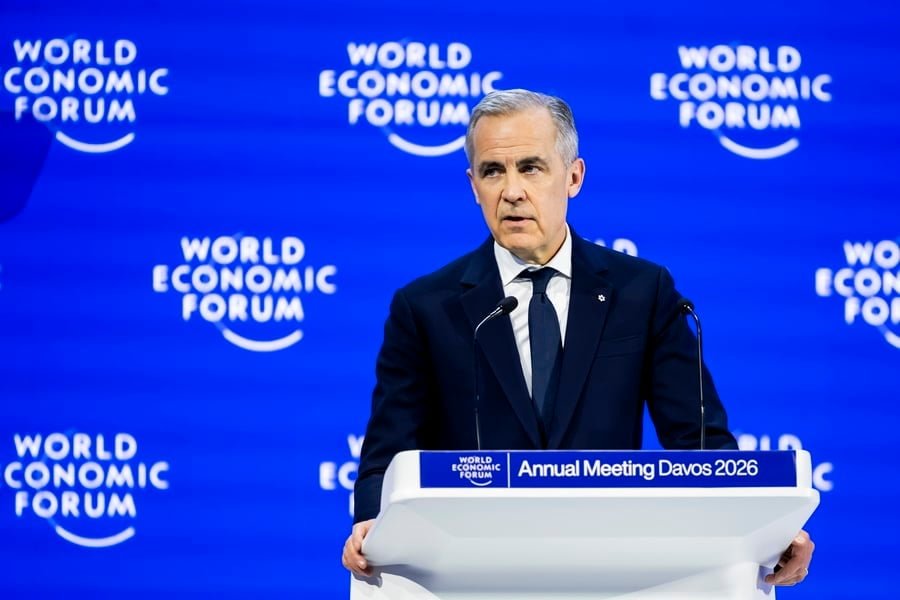
Speaking at the World Economic Forum in Davos, economist and former Bank of Canada Governor Mark Carney invoked Ancient Greek historian and general Thucydides to emphasize the strategic crossroads facing today’s international system.
Carney used the reference to highlight a key dilemma for modern states, especially middle powers: whether to continue “living inside the lie” of a faltering international order or to accept the costs of greater honesty, strategic autonomy, and difficult decisions.
A warning to middle powers: Cooperate or risk marginalization
Carney argued that middle powers cannot operate in isolation. He urged closer coordination, warning that those absent from decision-making tables risk having outcomes imposed on them by others.
He also noted that major powers increasingly use economic coercion to advance political and geopolitical goals.
Economic tools becoming geopolitical weapons
In one of the sharpest points of his speech, Carney highlighted how leading states now use economic interdependence not as a stabilizing force but as leverage. He noted a shift in how powerful countries deploy economic tools:
- Economic integration as a weapon
- Tariffs to apply pressure
- Financial infrastructure as coercive leverage
- Supply chains as points of vulnerability
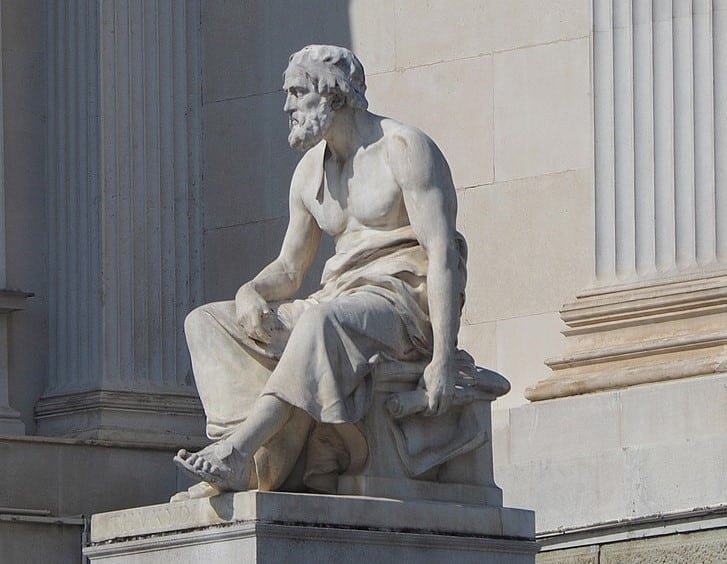
Carney cited Greece’s Thucydides through the Melian Dialogue
The reference Carney invoked comes from the Melian Dialogue, one of the most famous episodes in Thucydides’ History of the Peloponnesian War.
The story takes place in 416 BC, when Athens sent troops to Melos and dispatched envoys to compel the island to join the Athenian empire. Until that point, Melos had remained neutral, despite sharing Dorian heritage with Sparta.
A debate held under threat
Thucydides presents the exchange as a structured argument. The Athenians invite discussion, laying out their case, while the Melians are free to challenge and respond.
Yet the terms of the “debate” are brutally clear: if the Melians win rhetorically, Athens could still destroy them. If they concede, they lose their freedom. With these high stakes, the dialogue unfolds.
Power versus principle
The Athenians build their case on dominance and precedent, stressing their military superiority and recalling major victories against Persia at Salamis and Plataea. They also highlight that several other city-states already align with Athens.
The Melians respond from a moral perspective, defending their autonomy as essential, appealing to ethical conduct, and suggesting that the gods may favor a just cause. Their position reflects the belief that diplomacy and trade should uphold moral principles, not rely solely on force.
The outcome in Greece, as told by Thucydides
Thucydides records a grim conclusion: power overwhelms ethics. Athens destroys Melos; the men are executed, and women and children are enslaved.
The decision served a dual purpose: to punish defiance and to warn other independent states of the consequences of resistance.