
Archaeologists in Israel have discovered rare Byzantine-era gold coins and a delicate ring at a remote site in the northern Judean Desert, offering new evidence of the Christian monastic life that once flourished in the region.
The Civil Administration’s Archaeology Unit announced the findings last week, stating that the artifacts were uncovered during excavations at Hyrcania, an ancient fortress roughly 10 miles (17 kilometers) southeast of Jerusalem in the West Bank.
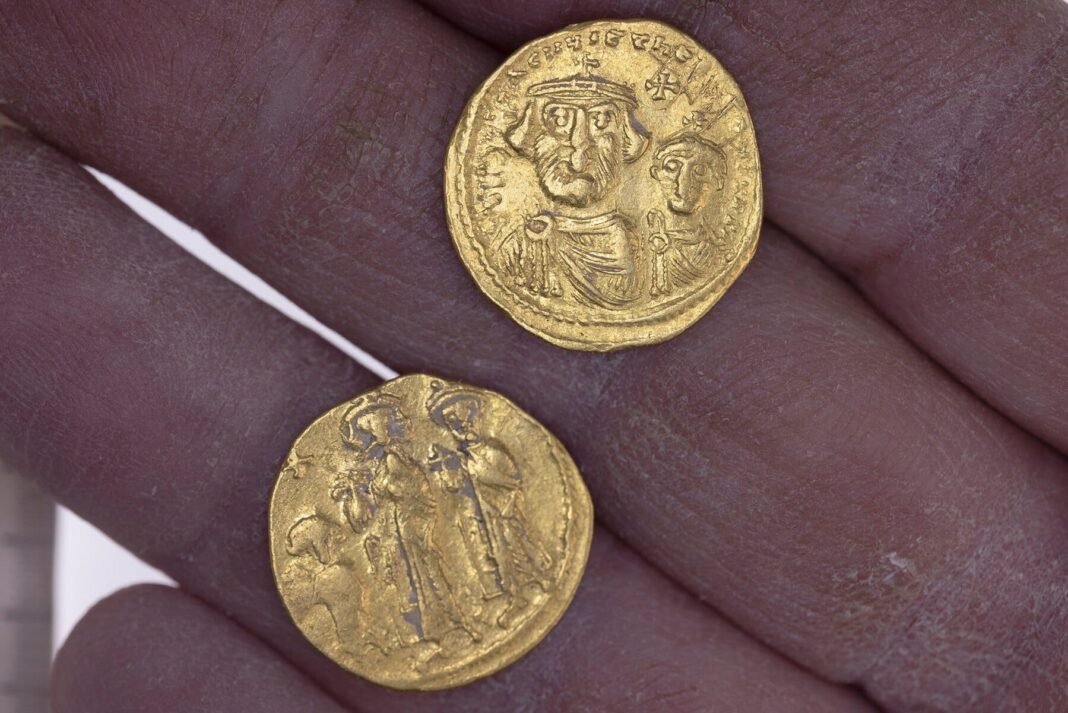
The two gold solidus coins feature the image of the Byzantine Emperor Heraclius, who reigned from 610 to 641 A.D., on one side and crosses on the other. Researchers believe the coins and the gold ring illuminate the Christian religious landscape of the area between the 4th and 7th centuries.
The Byzantine coins found in the Judean Desert show early Christian tradition in the region
“The finds uncovered at Khirbet Hyrcania reflect an important chapter from the Byzantine period and the early Christian tradition in the region,” said Binyamin Har-Even, head of the Civil Administration’s Archaeology Unit.
The excavation, conducted in cooperation with the Hebrew University of Jerusalem, was part of a preservation campaign launched following reports of antiquities looting at the site.
a Christian monastery was established in the Judean Desert by Saint Sabbas, one of the founders of desert monasticism, which operated for hundreds of years.
The finds uncovered at the site include two gold solidus coins bearing the image of the Byzantine Emperor Heraclius pic.twitter.com/CthKvaMPFx
— Jewish Zionist (@SpoiltheG5) December 24, 2025
Hyrcania has a layered history. Originally established by Hasmonean rulers in the late Hellenistic period, it served as a fortress guarding the eastern border of Judea. It was destroyed by the Romans, rebuilt by King Herod the Great, and eventually abandoned.
The location was resettled by Christian monks in the 5th century
In the 5th century, the isolated location was resettled by Christian monks. Historical records indicate that Saint Sabbas, a pivotal figure in Judean Desert monasticism, ascended what he described as a “terrifying mountain” and established a monastery there in 492 A.D.
The site functioned as a dependency of the Great Laura of Saint Sabas, a major monastic center nearby. The Hyrcania monastery remained active until it fell into disuse in the late 8th or early 9th century.
Har-Even noted that the unit is committed to safeguarding historical heritage from all periods. “Our work is intended to protect the past, enable its study, and make it accessible to everyone,” he said.