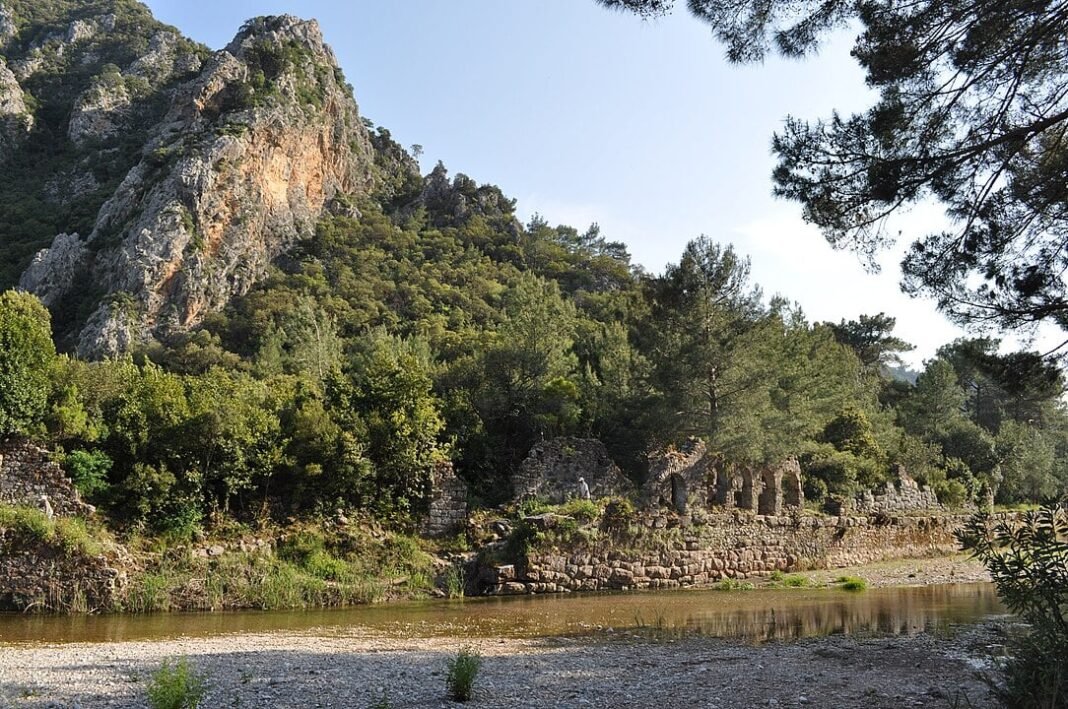

Archaeologists have unearthed a large Byzantine bath complex and richly decorated church in the ancient Greek city of Olympos (Greek: Ὄλυμπος), situated in the present-day Kumluca district of Antalya, southwestern Turkey.
Researchers say the structure, measuring nearly 200 square meters (2,150 square feet), was part of a bishop’s residence, revealing how religious leaders of the time also held administrative and social responsibilities. The discovery sheds new light on how faith and public life intertwined in one of the Lycian League’s most powerful cities.
Ancient Greek origins, Byzantine layers
Situated within the Beydağları Coastal National Park, Olympos has been the focus of systematic excavations since 2006. Originally founded by Greeks during the Hellenistic period, the city became one of six leading members of the Lycian League and held three votes in the federal assembly—reflecting its strong political and economic standing in antiquity.
Excavation Director Gökçen Kurtuluş Öztaşkın said ongoing excavations cover structures from the Hellenistic, Roman, and Byzantine eras, uncovering layers of cultural transformation across centuries.
“This year, we concentrated on necropolis areas, baths, domestic structures and churches,” Öztaşkın said. “At the city’s entrance, we uncovered the floor of what we call Church No. 1. The entire surface was covered with mosaics made using the opus tessellatum technique, featuring broad geometric patterns.”
Mosaics and inscriptions in Greek
Both the main hall and a side chamber of the church feature geometric and botanical motifs, along with inscriptions written in Greek. One inscription at the entrance reads: “Only those on the righteous path may enter here.”
📍 Antalya’nın Kumluca ilçesindeki Olympos Antik Kenti’nde 1 Nolu Kilise zemininde yeni mozaik alanları ile kilise girişinde üzerinde yazıt olan mozaik zemin keşfedildi.
Yazıtta “Buraya sadece doğru yolda olanlar girebilir” ifadesi yer alıyor. Ayrıca kiliseye bağış yapan… pic.twitter.com/HUCpfyxh6K
— arkeolojihaber ® (@arkeolojihaber) June 19, 2025
The church and the adjacent bath complex offer new insight into Byzantine urban life, where public and private spaces often overlapped under ecclesiastical influence.
“Domestic baths are usually modest in scale,” Öztaşkın said. “Yet here, we encountered an unusually large example, nearly 200 meters, with a fully preserved heating system, furnace section, wall heating channels and wall coverings. For the Late Antique period, this is a rare find.”
A bishop’s civic and spiritual duty
The architectural scale and design led researchers to conclude that the residence belonged to a Byzantine bishop, who by the fifth and sixth centuries A.D. acted not only as a spiritual leader but also as an administrative authority in city life.
“The bath was not solely for private use,” Öztaşkın explained. “It had entrances opening both to the street and to the residence. On certain days, the bishop allowed townspeople to use it free of charge, as a form of public service promoting hygiene and health.”
Restoring ancient Olympos
The excavation team has also made progress in restoration work. Last year, archaeologists recovered two sarcophagi broken into 370 fragments.
“Our conservators painstakingly pieced them together, like assembling a giant puzzle,” Öztaşkın said. “They were reerected on site for display. By the end of the year, we will have restored a total of four sarcophagi to their original form.”
As excavations continue across Antalya, the finds at Olympos are helping researchers reconstruct the story of a Greek city that evolved into a Byzantine spiritual hub, where bishops bridged faith and governance—embodying the dual role of religious and civic leadership in the ancient world.