

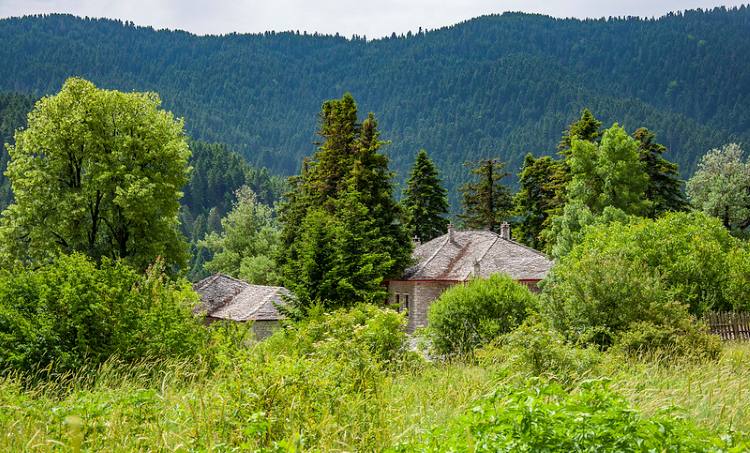
An amazing variety of ancient Greek healing herbs can be found today in the “Asclepius Path” on Mount Kerketion, where, according to Greek mythology, the ancient Greek god of medicine, Asclepius, used to collect them.
Looming 1,901 meters tall (6,237 feet) over the Thessaly fields, Mount Kerketion—also called Mount Koziakas today—is the place where one can find 2,700 kinds of healing herbs.
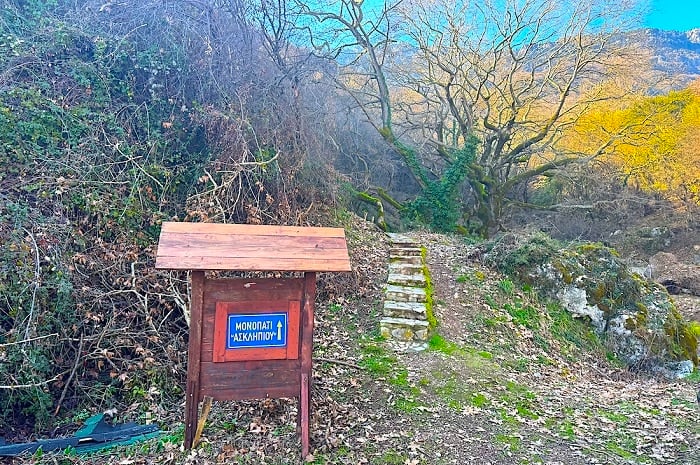
The mysterious Asclepius Path can be found in the low slopes of the mountain that look like a fir tree forest, where the trunks seem to sway.
It is a beautiful route steeped in lore. This is where, according to mythology, the native ancient Greek god of medicine, Asclepius, climbed often to collect healing herbs to prepare medicines to cure his patients.
The mountains of Thessaly, from the mythical home of the gods Mount Olympus to Mount Kerketion, to Mount Pelion, home of Chiron the Centaur, tutor of Heracles, Theseus, Jason and Achilles, have a strong connection with medicine. The father of modern medicine, Hippocrates, also traveled to Thessaly, specifically to Larissa, to practice his science. Today, myth and fact blend magnificently in the Thessalian land.

The Asclepius path
Mount Kerketion is included in the National Catalog of the European Network NATURE 2000 (NATURA 2000), in accordance with the European Union Directive 92/43 for the protection of habitats. This certification has made it a popular visitors’ spot, especially in the spring and summertime when everything is green.
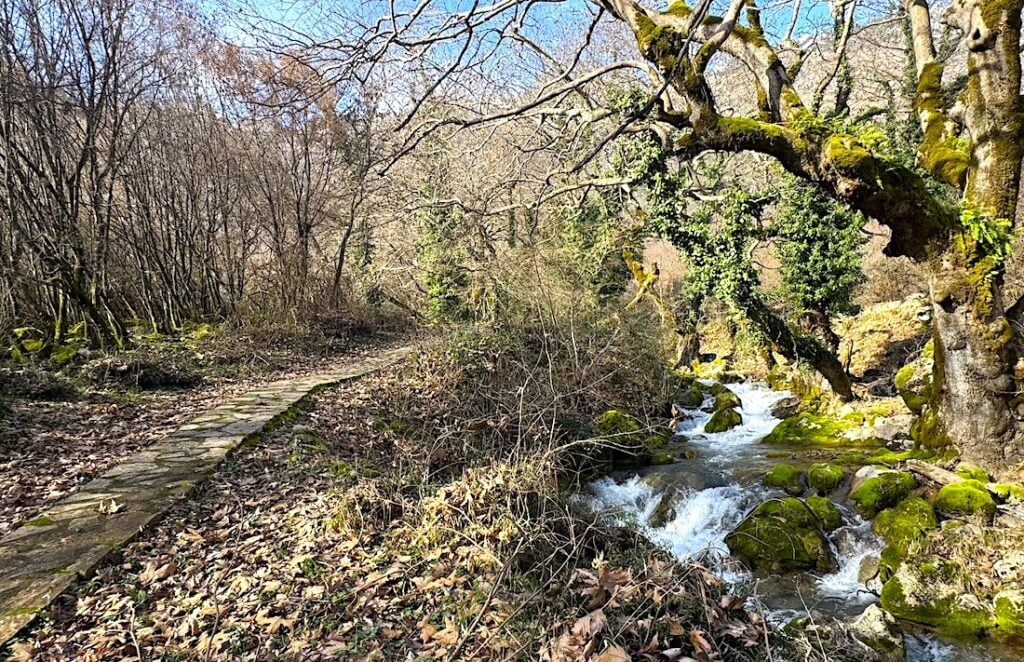
The Asclepius Path is a beautiful route through rich nature, under ancient plane trees and alongside the clear and gurgling waters of Kefalopotamos that flow from the heart of Kerketion before passing through the villages of Gorgogyri and Xyloparoiko, reaching Trikala and then pouring into the Pinios River. The waters of the river, rushing in winter and calm in summer, are pleasantly impressive, like the changing colors of each season.
The tour guide and custodian of the famous path with the healing herbs, Angelos Patsiatzis, tells us that, “The municipality has carved about 44 kilometers (27.3 miles) of paths for bike riding, hiking and jogging.”
“The name ‘Asclepius Path’ is chosen by the local municipality because in ancient Greek mythology this is the mountain where the god of medicine was collecting the ancient Greek healing herbs,” he explains.
The history of the famous path is intertwined with the plethora of ancient Greek healing herbs that grow in abundance on the famous mountain.
“For many years now,” Patsiatzis says, “the residents of the villages around the city (Trikala) made a living out of collecting herbs. Botanologists from around the world have researched the area and have found and recorded 2,700 different herbs. This is the first mountain in the world that has such a great variety of herbs. If I remember correctly, the second is a mountain in Pakistan that has 2,400 herbs.”
The healing herbs were the livelihood of the locals for decades. “They were collecting tilia (basswood), oregano, Greek mountain tea, wild rose, thyme, vitouni, cornel and many others and they were selling them to merchants coming from Evia and Athens. That was their main trade.”
The ancient roots of Thessaly are still evident in the area, a line of history that starts with the ancient myths and continues through Byzantium. “There was a settlement nearby dated to the 3rd century BCE. There are some ancient ruins left from then. Also, close to Gorgogyri there were twelve watermills from the Byzantine times.”
Asclepius, the god of medicine
Asclepius was the son of Apollo and the Trikkaian princess Coronis. His mother died in labor and when she was laid out on the pyre, Apollo cut the unborn child from her womb. Asclepius was raised by Chiron the Centaur who taught him the art of medicine with ancient Greek healing herbs.
In the Iliad, Homer mentions him only as a skillful physician and the father of two Greek doctors at Troy, Machaon and Podalirius. In later times he is called a hero and eventually worshiped as a god. His cult began in Thessaly but spread to many parts of Ancient Greece. He was supposed to cure the ill in their dreams. The practice brought people from all over Greece to his temples in Epidaurus, South Greece.
In 293 BC his cult spread to Rome, where he was worshiped as Aesculapius.
In art, Asclepius was frequently depicted standing, dressed in a long cloak, with bare breast. He usually held a staff with a serpent coiled around it. This staff is a universally recognized symbol of medicine and health. A similar emblem, the caduceus, with the winged staff and the intertwined serpents, is not related to medicine at all. It actually represents the magic wand of Hermes, or Mercury, the messenger of the gods and the patron of trade.


