Archaeologists in Mexico say they have identified what may be the largest Aztec ceremonial offering ever documented at the Templo Mayor, after new research linked three recently studied deposits to three others found in earlier decades.
The combined evidence points to a single large-scale ritual carried out during the rule of Motecuhzoma Ilhuicamina, the ruler of Tenochtitlan.
Researchers from the Templo Mayor Project presented the findings on Thursday during the Archaeology Today lecture series organized by El Colegio Nacional.
Leonardo López Luján, who leads the project at Mexico’s National Institute of Anthropology and History, said the six deposits appear to have been placed at the same time around the great temple, forming a complete circle for the first time in the history of excavations there.
Six ritual deposits linked to one ceremony
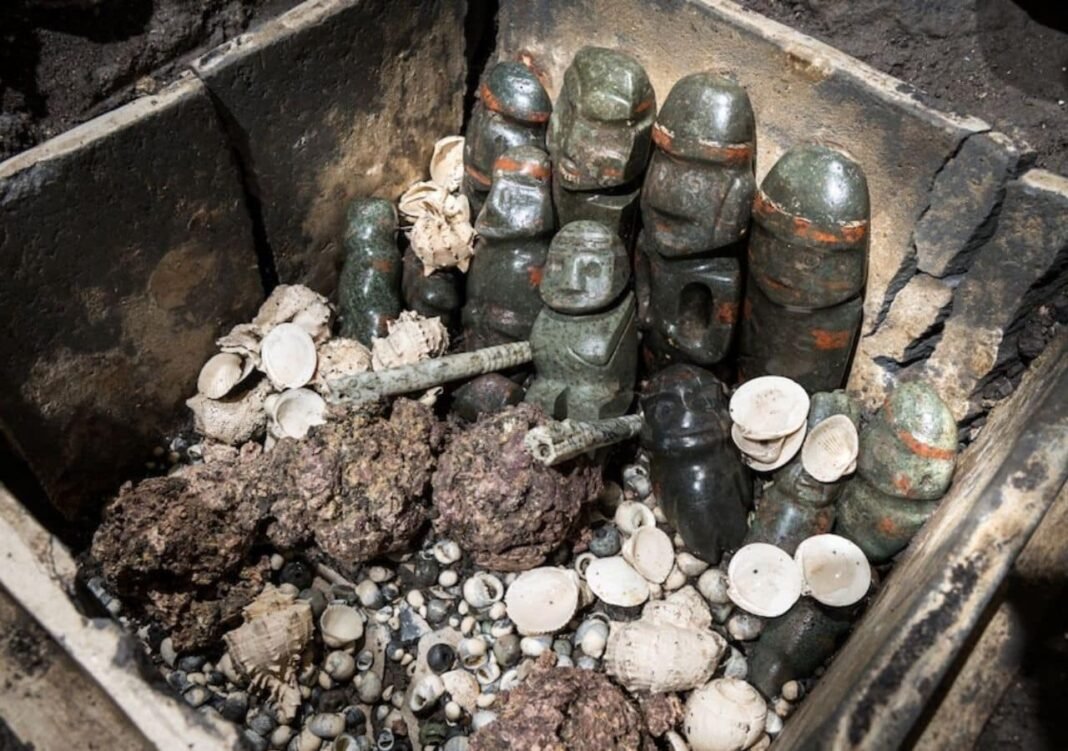
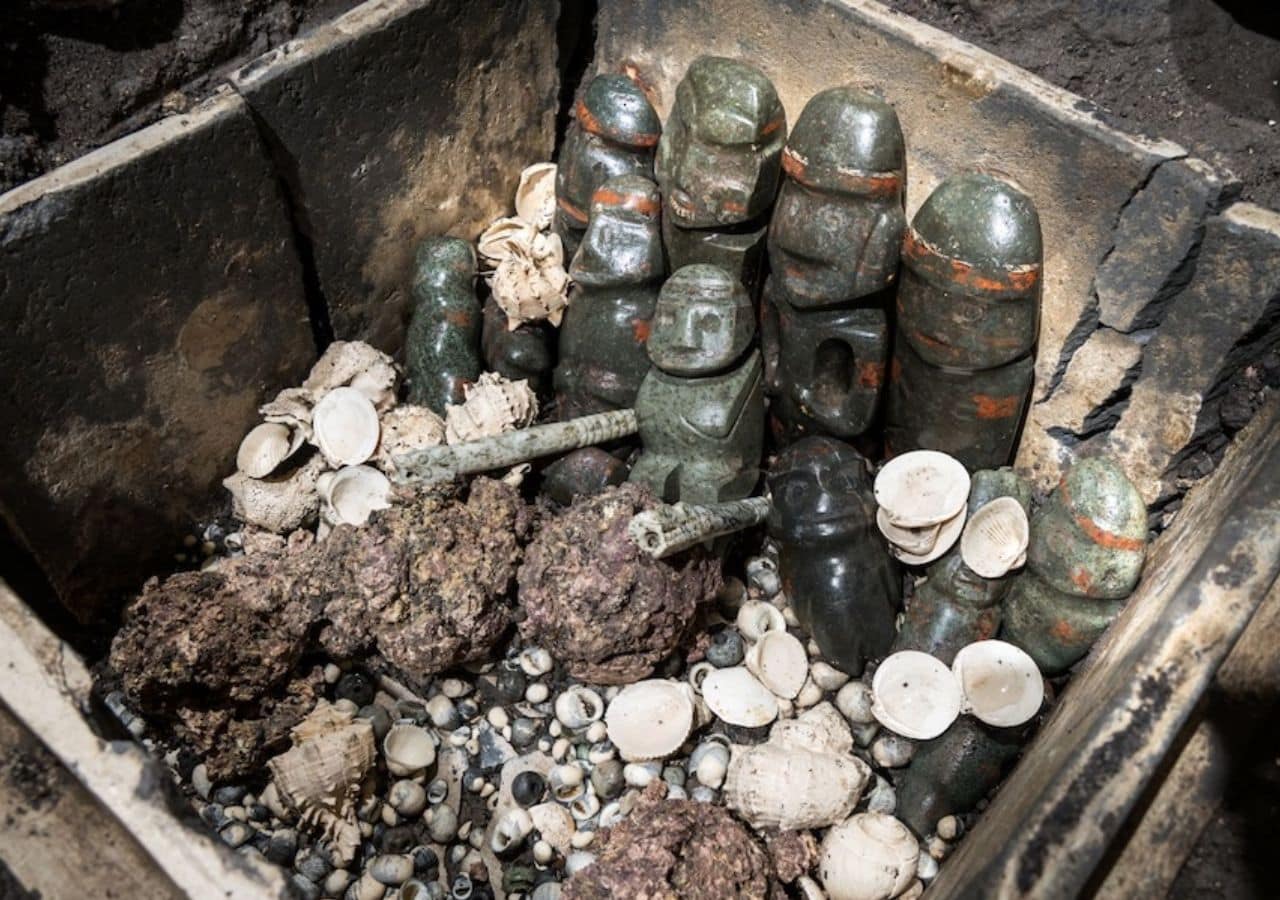
The discovery grew out of work on Offerings 186, 187, and 189, which were found in 2023. Together, they contained 43 Mezcala-style greenstone figurines. Those findings were later compared with Offerings 18, 19, and 97, discovered on other sides of the monument in 1978 and 1991.

Field archaeologists Alejandra Aguirre Molina and Antonio Marín Calvo said all six deposits belong to Stage IVa of the Templo Mayor, dated from 1440 to 1469. That was the period when Motecuhzoma Ilhuicamina was in power. They said similarities in date, material, and placement show the deposits were part of one event, not separate rituals.
Marín Calvo said Stage IVa is the only one of the temple’s seven building phases in which the surrounding platform survived almost intact. It still preserves serpent-head decoration and braziers on each side.
Evidence points to the largest Aztec ceremonial offering
With all six stone boxes now identified, specialists said the offering would have required a major operation. The deposits included 83 anthropomorphic greenstone figures and heavy sculptures weighing between about 600 and 1,000 kilograms (1,323 to 2,205 pounds), likely moved with ropes, levers, and wooden rollers.
López Luján said that the level of Mezcala material does not appear elsewhere at the Templo Mayor and likely reflects war spoils brought from Tlaxco and Tlaxmalac in what is now northern Guerrero.
Project conservator Adriana Sanromán Peyron said the stone chests were protected from the sun and kept under controlled humidity for months after discovery. Conservators cleaned the sculptures with swabs and stabilized red and white pigments used by the Mexica to adapt the images with traits linked to Tlaloc.
Biologist Belem Zúñiga Arellano said more than 4,000 shell remains were also recovered, many from Atlantic species. Some still preserved an outer organic layer, suggesting the shells were transported alive in salt water to the Aztec capital.
Researchers said the materials from the largest Aztec ceremonial offering will be kept at the Templo Mayor Museum for future study and a possible exhibition.