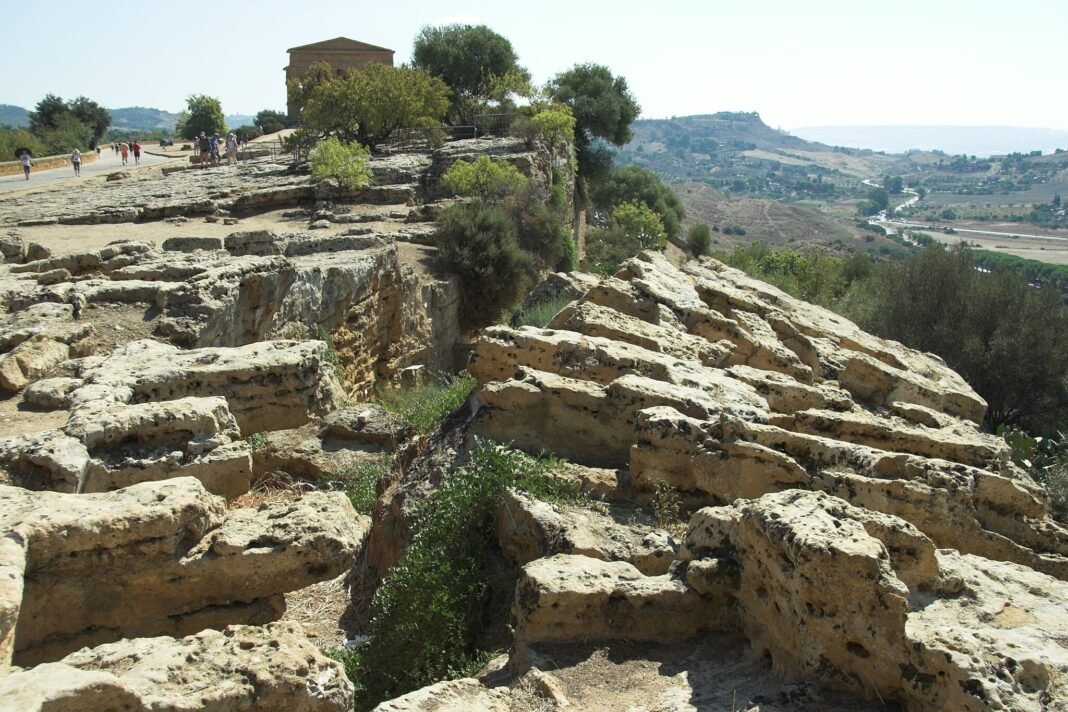
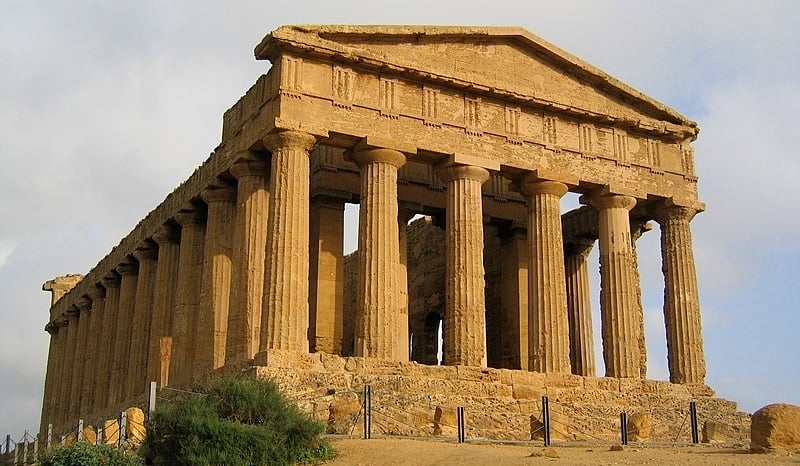
A major ancient Greek discovery in Agrigento, Italy, is entering a new phase of excavation as archaeologists resume work at the city’s historic Gymnasium. The site, located in southern Sicily, is one of the most important educational complexes of the ancient Mediterranean world.
The seventh excavation campaign is being carried out by the Archaeological Park of the Valley of the Temples in collaboration with Freie Universität Berlin and Polytechnic University of Bari. The international team is focusing on the Ancient Greek origins of the complex and its transformation under Roman rule.
Ancient Greek Gymnasium: A center of education and civic life
The Gymnasium stands in the ancient Greek city of Akragas (Greek: Ἀκράγας), known today as Agrigento. While the city is widely recognized for its temples, the Gymnasium offers insight into daily life beyond religious monuments.
In the ancient Greek world, gymnasia were more than athletic spaces. They served as centers for physical training, intellectual education, and civic preparation. Young men gathered there to study rhetoric, train in sports, and take part in social life. Archaeologists say the complex in Agrigento ranks among the most imposing of its kind in antiquity.
Earlier discoveries reveal scale and importance
Previous excavation seasons uncovered significant structures that reshaped understanding of the site. Researchers identified a covered auditorium with 160 seats dedicated to rhetorical instruction. The discovery confirmed the importance of formal education within the complex.
Excavations also revealed a monumental changing room decorated with inscriptions devoted to Hermes and Heracles. Both figures were closely associated with youth, athletics, and strength. The inscriptions highlighted the dual nature of the Gymnasium as a place of both intellectual and physical development.
These findings established the site as a rare example of a well-preserved Greek educational complex.
Focus shifts to the Palaestra
This season, archaeologists are concentrating on the Palaestra, the section traditionally used for wrestling and athletic practice. Researchers aim to define its architectural layout and understand how it is connected to the rest of the complex.
Fieldwork will continue through March 28. One of the main objectives is to map the hydraulic systems linked to the large swimming pool. Specialists are studying how water was collected, distributed, and drained. The investigation may reveal sophisticated engineering solutions from the Hellenistic and early Roman periods.
The team is also examining the western rooms of the complex. Through careful stratigraphic excavation, scholars hope to reconstruct construction phases and trace changes between the 2nd century BC and the Augustan age.
Looking beyond the temples
According to park director Roberto Sciarratta, the research allows scholars to move beyond Agrigento’s monumental temples and focus on the spaces where social life unfolded. The Gymnasium reflects the rhythms of everyday civic life rather than ceremonial display.
The excavation combines digital surveying technology with traditional archaeological methods. Advanced mapping tools provide detailed documentation, while layer-by-layer excavation helps establish a clear historical timeline.
Officials say the project strengthens Agrigento’s role as a key site for understanding ancient Greek urban culture in Italy. Researchers expect the current campaign to provide further clarity on the evolution of one of antiquity’s most significant educational centers.