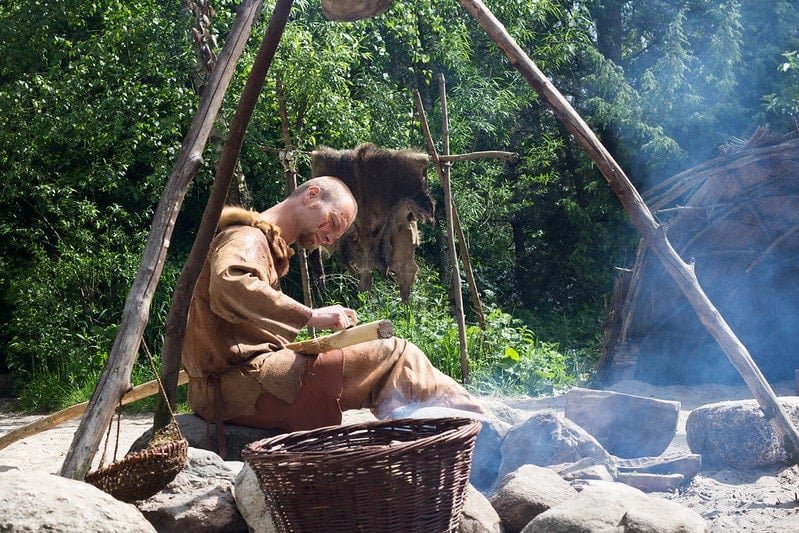

Ancient DNA evidence indicates that hunter-gatherer communities in certain parts of Europe persisted for thousands of years after farming arrived on the continent. The findings challenge the long-held view that early farmers from Anatolia rapidly replaced the original populations of Europe.
The research, led by scientists at the University of Huddersfield, reveals that the arrival of farming did not immediately reshape the genetic makeup of northwestern Europe. Instead, local hunter-gatherers remained dominant well into the Neolithic period.
Across most of Europe, farming spread through large population movements. New groups arrived. Older communities declined or disappeared. In this region, however, genetic continuity endured long after farming began elsewhere.
DNA traces long-term survival after Anatolian farming spread
The study draws on ancient genomes recovered from human remains dating from about 8500 to 1700 BCE. These individuals lived across what is now Belgium, Germany, and the Netherlands, a region long considered central to Europe’s prehistoric development.
This period marked a major turning point in European history. Farming spread westward from Anatolia, bringing agriculture, new tools, and settled life. In many regions, these changes caused sharp genetic and cultural shifts.
The DNA evidence shows that this was not the case everywhere. In northwestern Europe, hunter-gatherer ancestry remained high despite the presence of farming practices.
Women played a key role in transmitting farming knowledge
Genetic patterns point to a striking social dynamic behind this resilience. Most of the limited genetic input from farming groups appears to have come through women.
Researchers say women from farming communities likely married into local hunter-gatherer groups. Through these relationships, farming knowledge spread without large-scale population replacement. The process allowed local communities to adopt new practices while preserving older traditions.
Farming didn’t erase Europe’s hunter-gatherers overnight. Ancient DNA shows some communities endured for millennia after Anatolian farmers spread agriculture. pic.twitter.com/Hw6uJy3XNr
— Tom Marvolo Riddle (@tom_riddle2025) February 12, 2026
The research was part of an international collaboration led by David Reich of Harvard University, whose work focuses on reconstructing human history using ancient DNA.
Genetic evidence reveals uneven transition to agriculture
By analyzing complete genomes, researchers tracked population change over several millennia. The genetic record revealed long-term stability that archaeology alone had not fully captured.
The findings challenge the idea of a single, uniform shift to farming across Europe. Instead, they show that the transition depended heavily on local conditions and social structures.
The study was published in Nature, adding to growing evidence that Europe’s prehistoric past followed multiple paths.
Wetlands and rivers slowed population replacement
The research shows that farming reached the region around 4500 BCE. Yet its genetic impact remained limited, especially in river valleys, wetlands, and coastal zones.
These environments offered abundant food through fishing, foraging, and hunting. With resources readily available, communities faced less pressure to fully abandon hunter-gatherer lifeways.
As a result, people adopted farming selectively. They blended new techniques with older practices, preserving much of their ancestral identity.
Hunter-gatherer ancestry persisted until the late Neolithic period
High levels of hunter-gatherer ancestry remained in the region until around 2500 BCE. This includes areas that are now Belgium and the Netherlands.
Only toward the end of the Neolithic did a new wave of people spread across Europe and mix fully with local populations. At that point, the region’s genetic profile began to align with neighboring areas.
A new wave of migration reshaped the region after 2500 BCE
Unlike earlier arrivals, these later groups integrated extensively with local communities. The genetic record shows widespread intermarriage and population blending.
This marked a clear turning point. After thousands of years of relative continuity, the region finally followed the broader European pattern shaped by large-scale migration.
Researchers say Europe’s farming transition was not uniform
Paleoecologist John Stewart said the findings were unexpected. Researchers had anticipated a sharp genetic divide between hunter-gatherers and early farmers. Instead, change unfolded slowly in lowland and river-rich areas. He said water-rich landscapes supported long-term stability and delayed social transformation.
Geneticist Maria Pala said the study shows how ancient DNA continues to reveal overlooked histories, even in Europe’s core regions. She also highlighted the role of women in shaping cultural transmission during major transitions.
The findings show that Europe’s shift from hunting and gathering to farming was not a single story. In some regions, change came quickly. In others, hunter-gatherer societies endured for centuries, adapting on their own terms long after Anatolian farmers arrived.