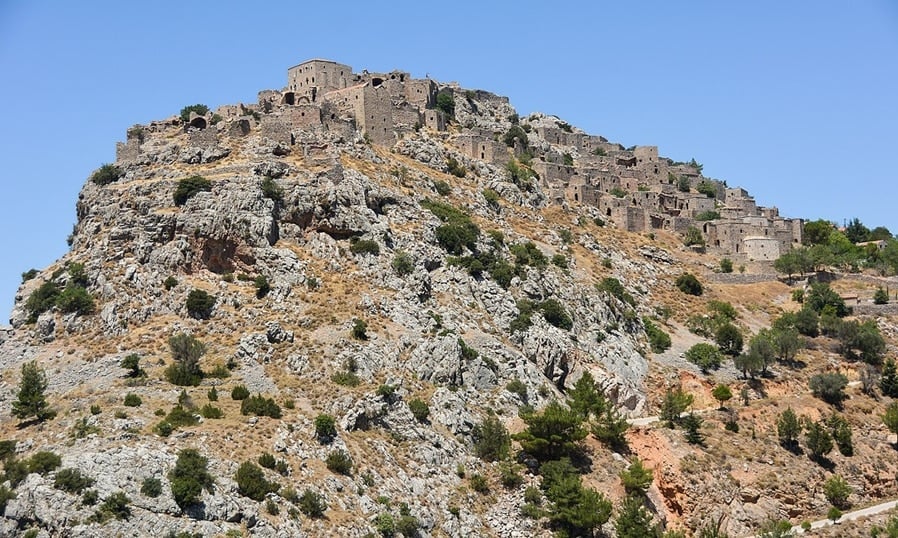
Perched atop a 450-meter granite peak, the village of Anavatos on Chios stands as one of the most haunting and evocative historical monuments in the Aegean.
Often referred to as the “Mystras of the Aegean,” this medieval settlement is a ghost town that whispers the turbulent history of the Greek island through its crumbling stone walls and narrow, winding alleys. Its name, literally meaning “inaccessible,” is a testament to its strategic design—a fortress born of necessity during an era of constant maritime peril.
Origins of Anavatos and its architectural ingenuity

The roots of Anavatos stretch back to the mid-11th century. Tradition holds that the village was founded by the workers who constructed the nearby Nea Moni, a UNESCO World Heritage monastery. Seeking a refuge that offered both vantage points and defense, they chose a location that was naturally fortified: a steep conical rock with sheer precipices on three sides.
The architecture of Anavatos is a masterclass in camouflage and defense. The houses were built using the same grey stone as the mountain, rendering the village nearly invisible to pirates scanning the coastline from the sea. The structures were packed tightly together, with the outer walls forming a continuous defensive perimeter.

Most dwellings were two-story “tower houses”; the lower level housed livestock and supplies, while the upper floor served as the living area, accessible by removable wooden ladders or high stone stairs for added security.
A history of tragedy and resilience

Under Genoese rule (1346–1566), the village flourished as a vital watchtower. However, the fate of Anavatos was forever sealed during the Chios Massacre of 1822. As Ottoman forces swept through the island, the “inaccessible” village became a final stand for hundreds of Greeks. The fall of the village was catastrophic; many locals reportedly threw themselves from the cliffs to avoid capture—a somber parallel to the legendary sacrifices at Zalongo.
Though some survivors returned and others resettled during the interwar period—including refugees from Asia Minor who cultivated tobacco in the surrounding valleys—the village never fully recovered.
The devastating earthquake of 1881 shattered much of the remaining infrastructure, and the post-war trend of urbanization eventually emptied the village of its youth. By the late 20th century, the harsh living conditions and lack of modern amenities turned Anavatos into a silent museum of the past.
Anavatos today: A living monument
Today, Anavatos is a protected national monument. Walking through its gate today is like stepping back in time. The most prominent surviving structure is the Church of the Taxiarchis (the Archangel), which stands as a beacon amidst the ruins. While the 2021 census recorded only ten permanent residents, the village is far from forgotten.
For the modern traveler, Anavatos offers a profound sense of solitude and historical weight. It stands in stark contrast to the ornate, “painted” Mastic villages of southern Chios. Here, there is no decoration—only the raw, rugged beauty of stone and sky. It remains a powerful symbol of Greek resilience, a stone sentinel that continues to keep watch over the Aegean, centuries after its primary mission ended.