

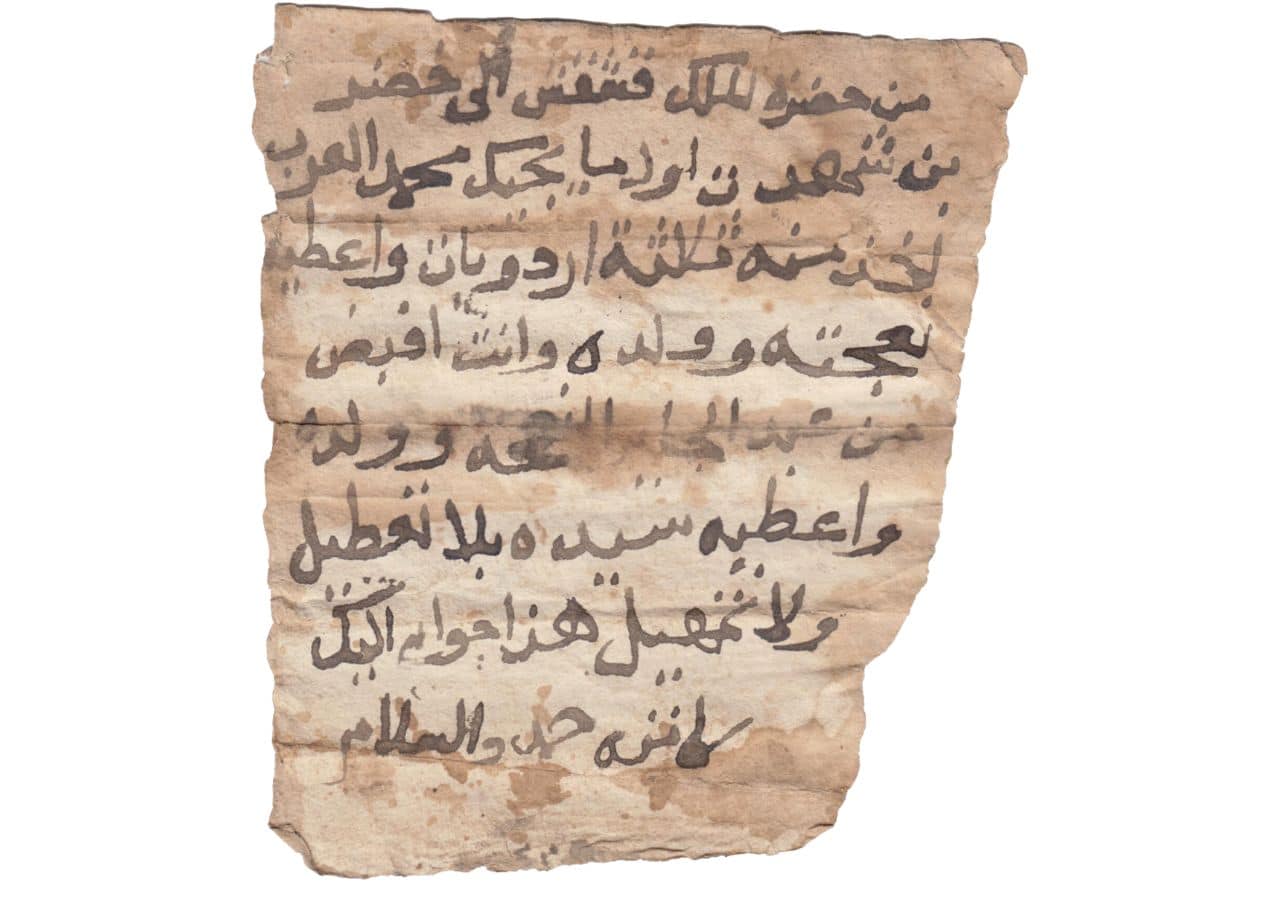
A king long dismissed as myth, often compared to an ancient African ‘King Arthur,’ has been confirmed as a real historical figure after archaeologists in northern Sudan uncovered a royal decree bearing his name.
The document was found by a Polish team from the University of Warsaw at Old Dongola, an archaeological site along the Nile. It carries the name of King Qashqash, a ruler previously known only through later religious writings. Researchers dated it to the late 16th or early 17th century, making it the earliest known physical proof of his actual reign.
The discovery provides firm historical grounding for King Qashqash, linking the once-legendary figure to a surviving royal order bearing his name. Written in Arabic by a royal scribe named Hamad, the decree instructs a man named Khidr to exchange textiles for livestock and deliver the goods to their rightful owner, concluding with a direct order to act without delay.
African ‘King Arthur’ proven real by royal decree
Researchers said the text sheds light on governance during a period of Sudanese history that remains among the most poorly recorded. The study described it as showing a Nubian ruler engaged in practical administration rather than military campaigns.

Archaeologists recovered the page from inside the House of the Mekk, a complex near the eastern bank of the Nile whose name translates to House of the King. It was excavated from accumulated layers of medieval waste material.
Old Dongola once served as the capital of Makuria, a Christian kingdom that later grew into a trade hub. The city sat along routes connecting the Ottoman Empire in the north with the Funj Sultanate in the south.
Silk, gold and gunpowder found alongside the historic document
The excavation also turned up other items, including a gold ring, a dagger handle fashioned from ivory or rhino horn, and document fragments. Researchers also found pieces of silk, linen and blue-dyed cloth, along with objects identified as probable musket balls and a gunpowder flask.
The study noted that firearms in that era functioned mainly as markers of rank and closeness to power rather than tools of active combat.
The findings were published in Azania: Archaeological Research in Africa. Researchers said the discovery moves Qashqash from the boundaries of oral tradition into the verified historical record as a working monarch.


