A petrified trunk can preserve more than the outline of a tree. On Greece’s island of Lesvos, also known as Lesbos, roots still fixed in ancient ground help distinguish a forest buried where it grew from wood carried elsewhere. That difference makes the island’s fossils a record of a landscape, as well as a collection of individual specimens.
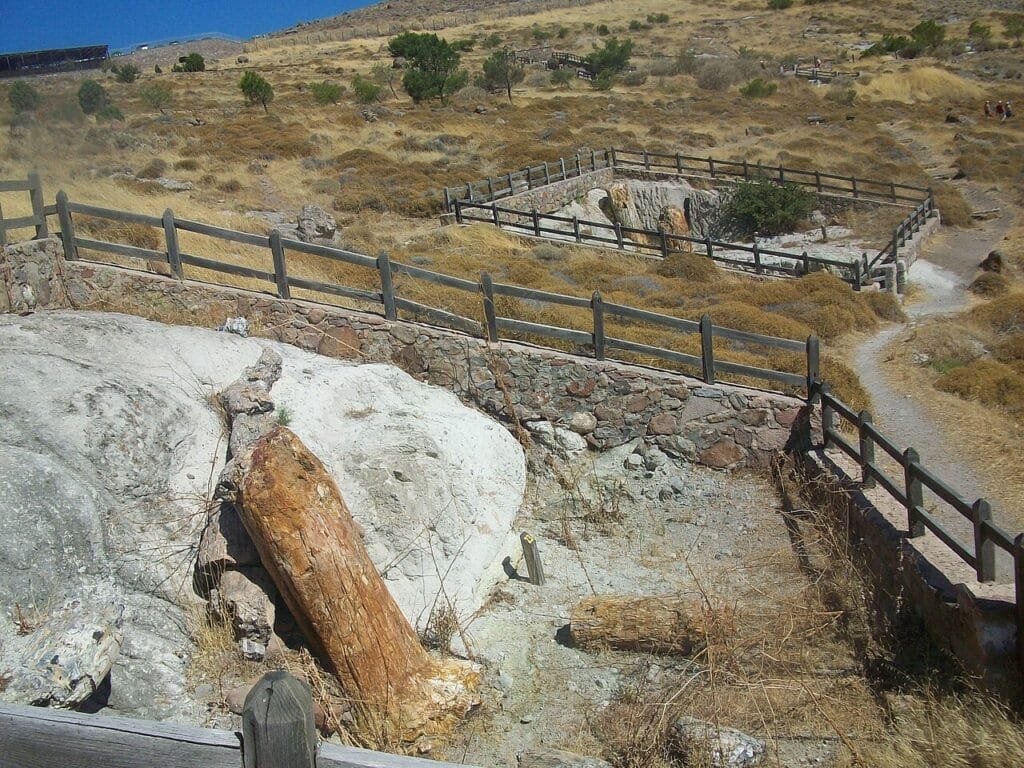
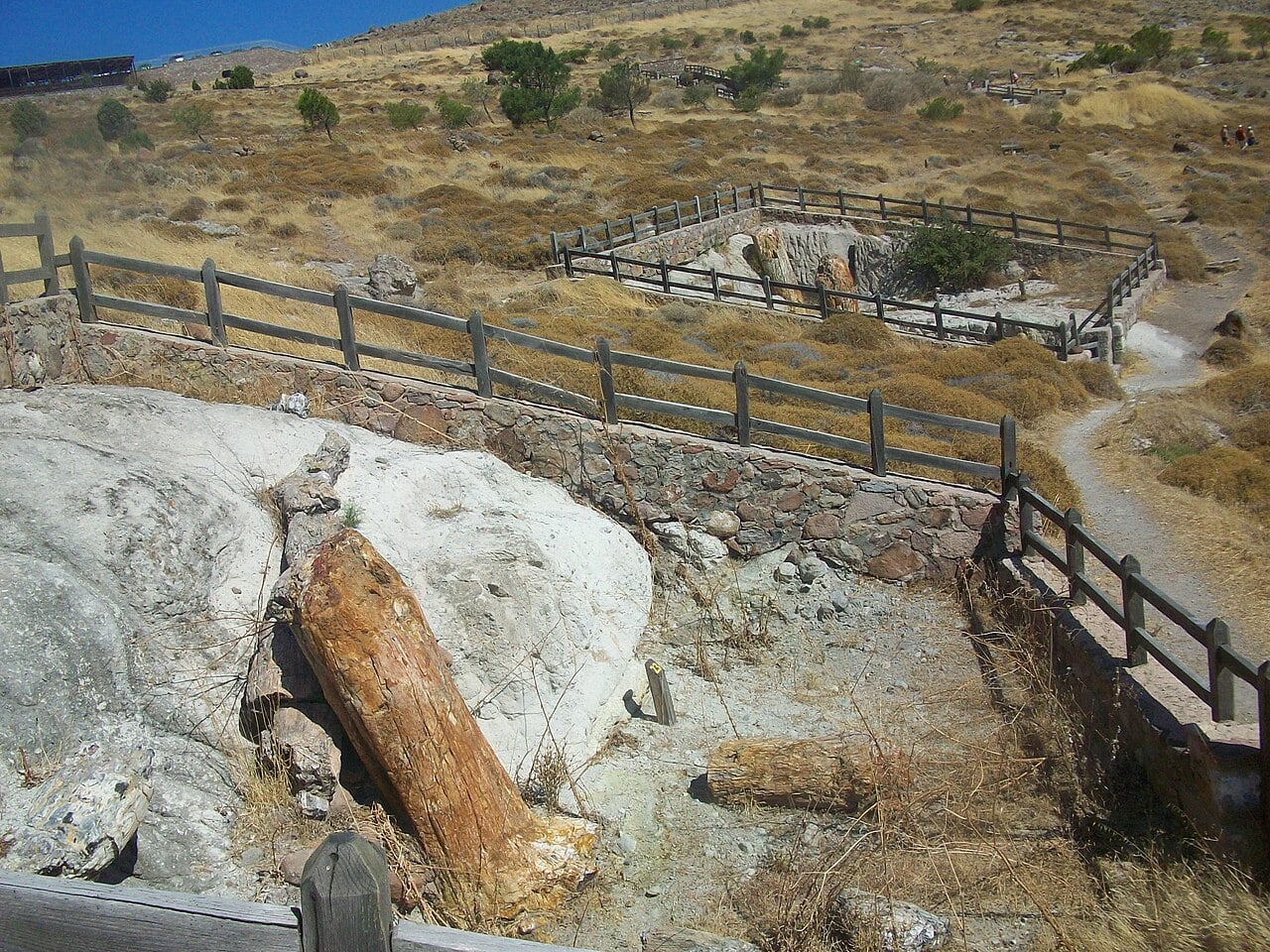
At Sigri Petrified Forest Park, beside the island’s Natural History Museum, upright trunks emerge from volcanic ash and fossilized roots remain in the ground where the trees grew. The park also displays large specimens brought to Sigri for safekeeping. Excavation records establish where those fossils were found and where they fit into the story of the ancient forest.
Reading the Lesvos petrified forest from the roots upward
Western Lesvos preserves remains of forests that grew during the Early Miocene, roughly 20 million years ago. Volcanic eruptions buried vegetation beneath ash and other material. Greece’s description of the site on UNESCO’s Tentative List explains that burial and the circulation of silica-rich fluids created conditions for mineral replacement while retaining the plants’ structures.
The evidence includes branches, leaves, fruits and roots, alongside the better-known trunks. Growth rings and internal wood anatomy can survive the process.
At Bali Alonia, the museum’s account of individual fossils makes the importance of position concrete. The lower part of trunk 54 remains with its root system, which the museum identifies as evidence of preservation in its original growing place. Nearby examples combine upright bases with broken branches or fallen sections.
Position also helps avoid a misleading impression of completeness. A trunk displayed upright is not automatically a whole tree, while an exposed section may continue into surrounding material.
Color is another part of the geological story
In its fossil descriptions, the museum connects the colors to trace elements and oxides carried in the fluids involved in silicification. The preserved grain and the minerals producing its appearance answer different questions: one concerns the plant, the other the process that preserved it.
That combination is particularly useful in a place where a damaged tree can retain detailed internal features. Broken surfaces, roots and growth rings offer evidence at different scales. The museum’s examples include separate trunks branching from one root system and reconstructed pieces matched during conservation.
A road exposed a larger record
Construction of the Kalloni–Sigri road revealed further fossil-bearing sites. The museum’s exhibition, “The Forest under the Road,” follows the work from excavation to cleaning, transport, conservation and documentation. Its account includes roots and trunks preserved in their growing positions, as well as wood broken or displaced during volcanic activity.
The challenge becomes especially clear when a find has to move. In January 2021, a fossilized tree about 19 meters long was recovered on Lesvos with its branches and roots still preserved. To move the specimen, the team braced it with a splint and transported it on a metal platform.
The island belongs to UNESCO’s Global Geoparks network; the petrified forest’s entry on Greece’s World Heritage Tentative List is a separate designation. The latter records a possible future nomination, not an inscription on the World Heritage List.
On Lesvos, fossilized roots still embedded in ancient soil show where trees once stood. The surrounding volcanic ash, fallen wood and excavation records help researchers reconstruct the forest and trace how it was buried and preserved.