They lead the heavenly hosts, battle the forces of evil, and deliver messages that change the course of biblical history. Archangels Michael and Gabriel occupy a special place in Orthodox Christianity, where believers honor them every November 8 alongside the other heavenly powers.
Michael is known as the commander of God’s angelic army, while Gabriel announced the coming birth of Jesus Christ to the Virgin Mary. Their stories reveal two distinct roles in Christian tradition and offer a glimpse into the rich world of Orthodox belief about the angels.
Michael, the commander of the heavenly hosts
The name Michael is commonly interpreted as “Who is like God?” The Archangel also bears the title Archistrategos, meaning chief commander of the heavenly forces.
The Bible presents Michael in several important passages. In the Book of Daniel, he appears as a great prince who protects God’s people. The Letter of Jude calls him “Michael the archangel” and describes his dispute with the devil over the body of Moses.
In the Book of Revelation, Michael and his angels fight against the dragon and its angels. This passage helped establish his place in Christian tradition as a defender against evil.
Orthodox hymns invoke Michael as the leader of the heavenly hosts and ask for his protection. Other stories about his interventions developed through Church tradition. These accounts remain important in Orthodox devotion, but they should be distinguished from events explicitly recorded in the Bible.
Gabriel, the messenger of God
Gabriel’s best-known biblical appearance takes place in the Gospel of Luke. God sends him to Nazareth to tell Mary that she will give birth to Jesus, the Son of the Most High. Christians celebrate this encounter as the Annunciation, one of the most important feasts in the Church calendar.
Gabriel also visits the priest Zechariah and announces that his wife, Elizabeth, will have a son: John the Baptist. When Zechariah questions the message, Gabriel identifies himself as one who stands in the presence of God.
The Archangel also appears in the Book of Daniel, where he helps the prophet understand his visions. These passages establish Gabriel as a messenger who brings divine revelations at decisive moments.
His role in Orthodox worship reflects this mission. Gabriel is closely associated with the Annunciation and the Incarnation, the Christian belief that the Son of God took human nature.
The other Archangels in Orthodox tradition
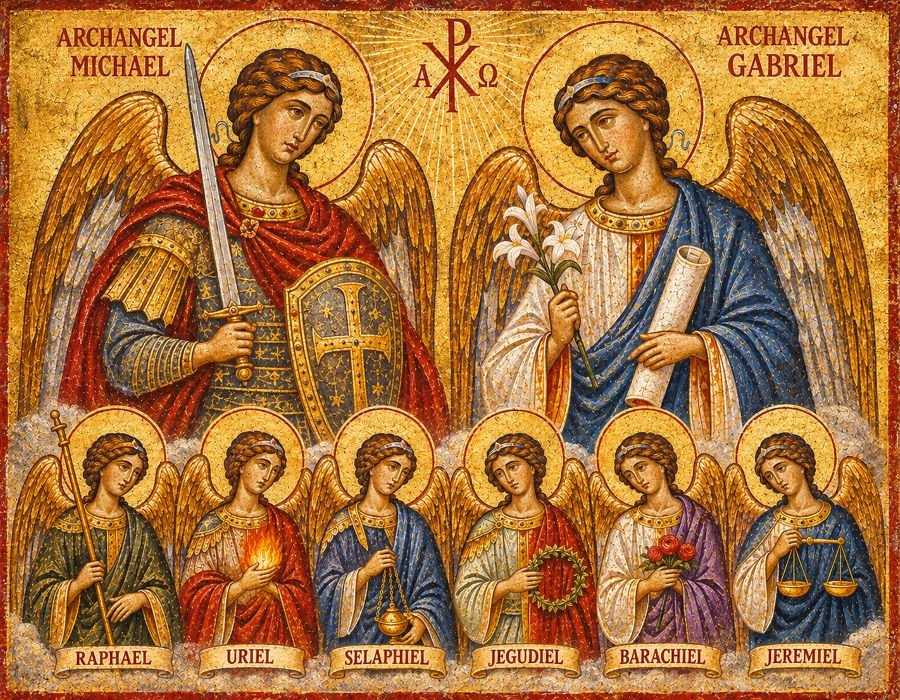
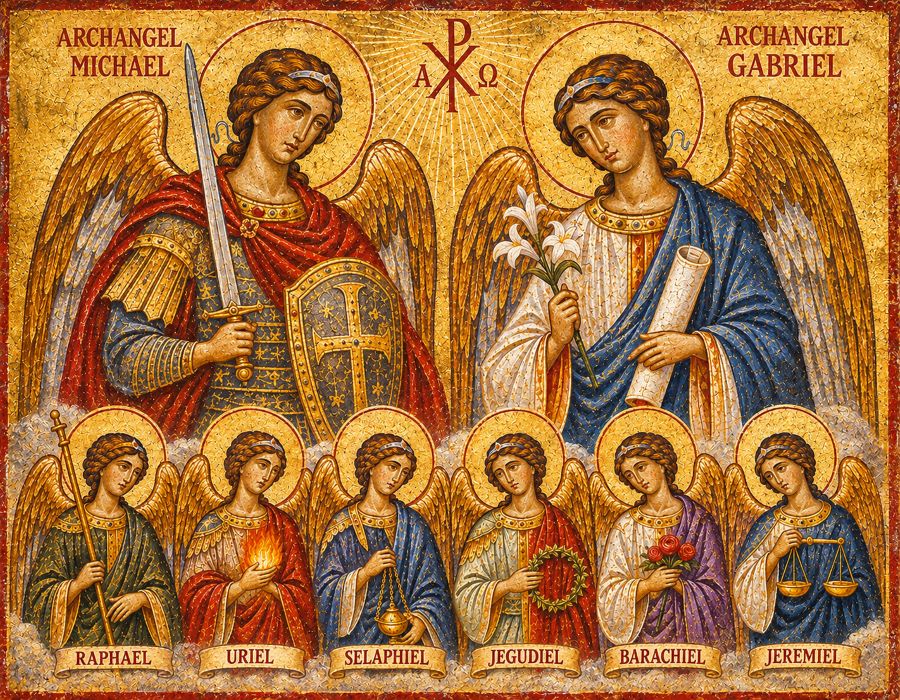
Orthodox tradition also preserves the names of other Archangels, although lists vary between sources. One traditional list includes Raphael, Uriel, Selaphiel, Jegudiel, Barachiel and Jeremiel alongside Michael and Gabriel.
Raphael is associated with healing and protection. In the Book of Tobit, he guides Tobias and helps restore his father’s sight. Uriel is linked with divine light and understanding. Selaphiel is associated with prayer, while Jegudiel represents faithful service to God. Barachiel is connected with divine blessings, and Jeremiel appears in some lists as a figure associated with spiritual reflection.
These roles come from different strands of Christian tradition and do not all have the same biblical basis. Some names appear in certain Orthodox lists but not in others. The Church of Greece’s Synaxarion for November 8 places Michael and Gabriel at the center of the feast while also honoring all the heavenly orders.
The nine orders of angels
The November 8 feast honors more than individual Archangels. Its liturgical name includes all the other bodiless and heavenly powers.
Orthodox tradition describes nine angelic orders, arranged in three groups. The first comprises the Seraphim, Cherubim and Thrones. The second includes Dominions, Virtues and Powers. The third consists of Principalities, Archangels and Angels.
This classification belongs to the Church’s theological tradition and its interpretation of biblical references to heavenly powers. The Bible mentions several of these orders, but it does not present the complete ninefold arrangement in one passage.
The nine orders are not the same as a list of individual Archangels. Some Orthodox sources speak of seven Archangels, while others include Jeremiel as an eighth. There is no single list of eight names accepted universally across all Orthodox sources.
Why the Archangels remain important
For Orthodox Christians, the feast expresses the belief that creation extends beyond the visible world and that angels serve God in ways people cannot fully see.
Michael represents the defense of God’s people and the struggle against evil. Gabriel represents the announcement of divine messages and the fulfillment of a promise central to Christianity. The other Archangels, according to different traditions, reflect further aspects of prayer, healing, blessing and faithful service.
Together with all the heavenly orders, they hold an enduring place in Orthodox prayer, iconography and devotion. The November 8 feast brings these traditions together in a celebration of the heavenly powers and their service to God.