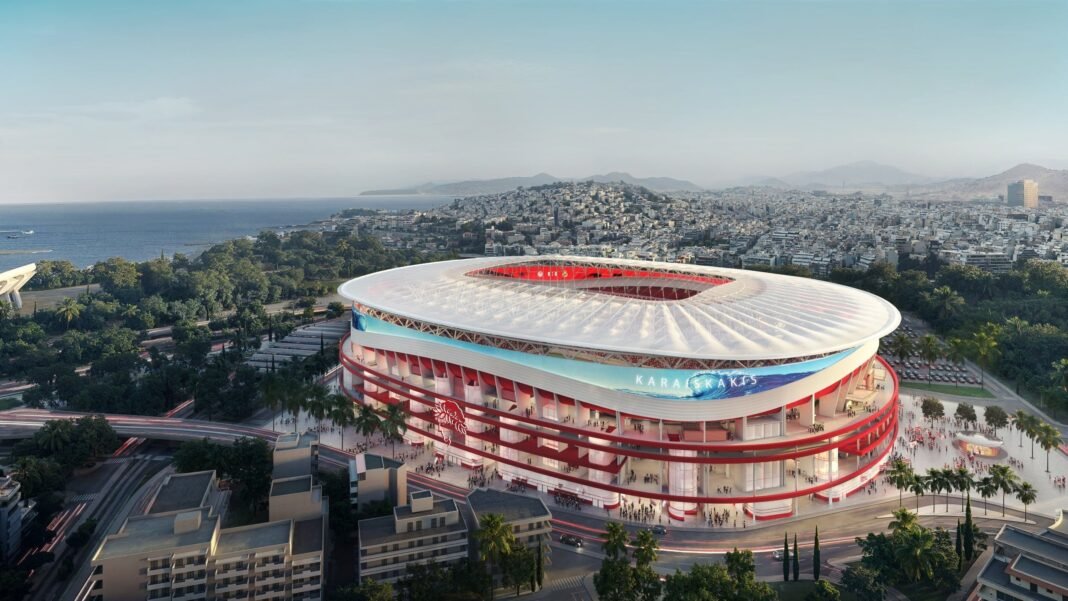
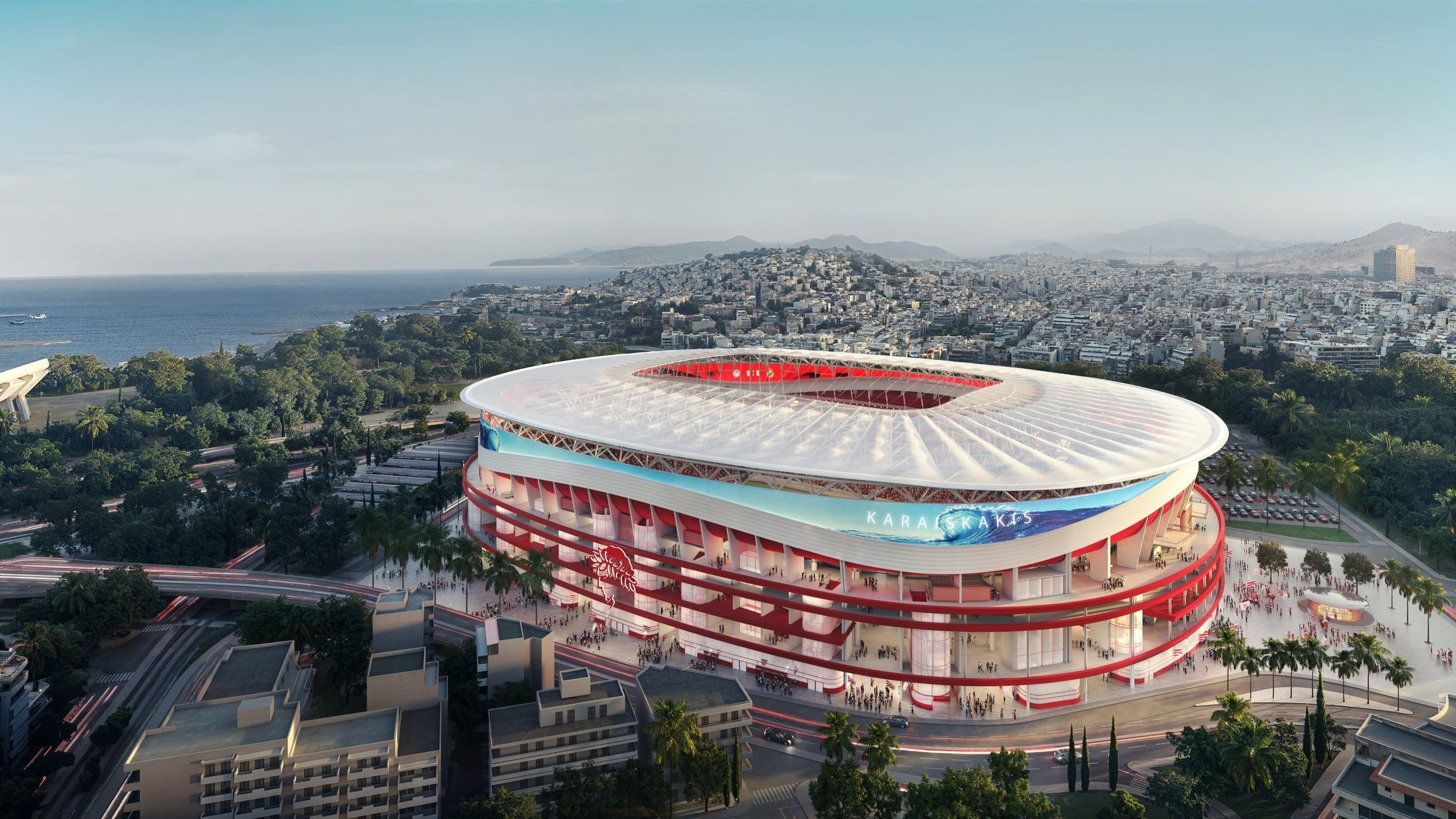
Olympiacos has unveiled plans for a new Georgios Karaiskakis Stadium in Piraeus, a privately funded project worth more than €250 million ($286 million) that would create the largest football stadium in Greece.
The proposal, presented Thursday at the Piraeus Municipal Theatre, would transform the club’s historic home into a state-of-the-art venue with capacity for more than 53,000 spectators. The figure exceeds earlier references to a 50,000-seat stadium and reflects Olympiacos’ effort to meet growing demand from supporters.
The new Karaiskakis Stadium would rise across four levels to more than 52 meters (170 ft) and feature expanded seating, modern hospitality areas, advanced technology, and infrastructure capable of hosting major sporting and cultural events.
Olympiacos’ privately funded stadium project in Greece
Olympiacos FC and its owner will finance the stadium entirely without public funding. The investment will exceed €250 million ($286 million), making it one of the most ambitious private sports infrastructure projects proposed in Greece.
The plan also forms part of a broader upgrade for Piraeus. In addition to the stadium reconstruction, the project includes transport and access improvements around the waterfront, traffic-management measures, and thousands of parking spaces designed to ease movement before and after matches.
Οι πρώτες εικόνες του «Νέου Σταδίου Γ. Καραϊσκάκης»!
The first images of the “New G. Karaiskakis Stadium”!
#OlympiacosFC #Marinakis #Piraeus #Greece pic.twitter.com/4BQGNaeZfE— Olympiacos FC (@olympiacosfc) July 2, 2026
What the new Karaiskakis stadium will include
The proposed venue will have more than 53,000 seats, making it Greece’s largest football stadium. It will also include a 30,000-square-meter bioclimatic roof, more than one hundred luxury suites, over 5,000 square meters of premium hospitality areas, and another 5,000 square meters for restaurants, cafes, concessions, and fan-service spaces.
The design places strong emphasis on movement inside the stadium. The four-level venue would include 32 escalators, 60 elevators, 20 double staircases, and 70 access gates to improve spectator circulation and reduce congestion. The project also includes a 2,000-square-meter media center with a 320-seat auditorium, along with 1,000 square meters of dedicated workspace for media and event operations.
One of the stadium’s most prominent technological features would be 10,000 square meters of LED displays. Olympiacos has described the structure as Europe’s largest multi-faceted screen for football and cultural events. The venue would also feature upgraded broadcasting infrastructure, advanced sound and lighting systems, renewable energy installations, and two high-tech control rooms.
Olympiacos awaits approval in Greece before stadium construction begins
The main issue still pending involves a legislative adjustment that would allow the stadium to reach a height of roughly 52 to 53 meters. Olympiacos says this approval remains the key step before construction can begin.
According to the club’s presentation, construction could have started in May if the legal framework had already been in place. If the remaining regulatory issues move forward soon, the stadium could open by August 2028.
During construction, Olympiacos expects to play its home matches at the Athens Olympic Stadium, known as OAKA, for approximately two seasons. The club considers OAKA the only suitable temporary venue because of its capacity and ability to accommodate the team’s supporters.
Marinakis says stadium marks a historic moment
Evangelos Marinakis described the presentation as a historic day for Olympiacos, Piraeus, and Greece, saying the new stadium reflects his long-term goal of making the club financially self-sufficient and competitive among Europe’s elite.
He pointed to Olympiacos’ recent UEFA Europa Conference League triumph, the club’s UEFA Youth League title, and what he described as 300 trophies across all sports over the past 16 years.
He also praised the club’s academy, citing captain Panagiotis Retsos as a homegrown player who moved to Bayer Leverkusen before returning to help Olympiacos win its first European trophy.
Marinakis said he hopes the club’s “next meeting” with fans will take place inside the new Georgios Karaiskakis Stadium within the next three years. He described the project as “our own theater of dreams”.