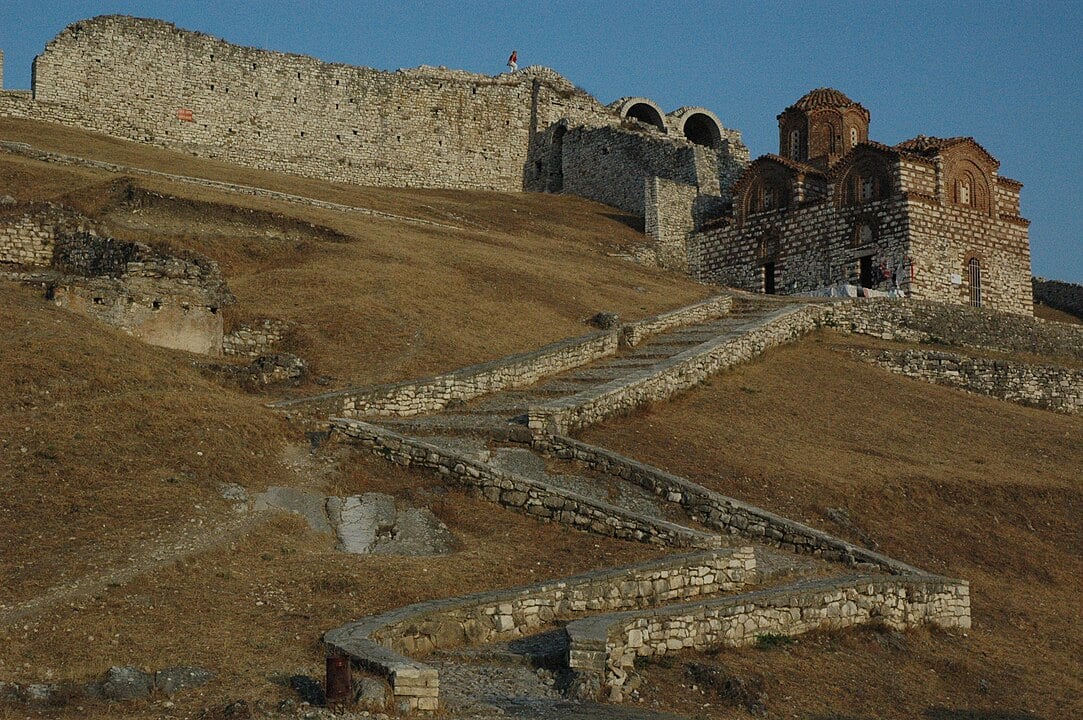
Archaeologists have uncovered new evidence of early Christian churches beneath the historic city of Berat in central Albania. Two Late Antique mosaic floors discovered under parts of the modern city are shedding new light on the religious life of the ancient Greek city of Antipatrea (Greek: Ἀντιπάτρεια).
Antipatrea once stood at an important crossroads in the Balkans. The settlement was founded during the Hellenistic period and later became part of the Roman and Byzantine worlds. Today, much of the ancient city lies buried beneath Berat, which is widely known for its Ottoman-era architecture and its status as a UNESCO World Heritage Site.
Researchers say the mosaic discoveries reveal that Antipatrea hosted an active Christian community during Late Antiquity, when churches and basilicas spread across the region.
Ancient Antipatrea beneath modern Berat
The site of Antipatrea occupies a strategic position near the Osum River in what is now central Albania. The location connected the mountainous interior with trade routes across the Balkans and the Mediterranean.
Archaeological evidence shows that people have lived in the region since the Bronze Age. Over time, the settlement developed into an important urban center. Like many cities in the Balkans, Antipatrea experienced repeated destruction and rebuilding during Roman, Byzantine, and later Ottoman periods.
Archaeologists have uncovered ancient mosaics beneath Berat, Albania, revealing early Christian churches in the ancient Greek city of Antipatrea.
The discoveries date to the 5th–6th centuries AD and show the city once hosted a thriving Christian community. pic.twitter.com/m1beUsJ8Bd
— Tom Marvolo Riddle (@tom_riddle2025) March 9, 2026
These layers of history buried many ancient buildings beneath later construction. As a result, large parts of the ancient city remain hidden beneath modern Berat.
For decades, archaeologists had only limited evidence about Antipatrea’s religious life during the Roman and Late Antique periods. The discovery of two mosaic floors is now helping researchers fill that gap.
Mosaic discoveries point to early Christian basilicas
The first mosaic was uncovered in 2012 during infrastructure work inside Berat’s medieval castle. Workers installing a water system discovered the decorated floor about 1.8 meters below the modern ground level.
Archaeologists later identified the mosaic as part of a larger floor decoration that likely belonged to an early Christian basilica. Such decorated floors were common in churches during Late Antiquity.
Hidden beneath the streets of Berat, Albania, archaeologists discovered ancient mosaics from early Christian churches of the Greek city of Antipatrea. pic.twitter.com/uK3MK1F1lJ
— Tom Marvolo Riddle (@tom_riddle2025) March 9, 2026
A second mosaic appeared in 2018 during drainage construction in the lower town. The remains were found partly beneath the foundations of a mosque. Although only a small section has been excavated, archaeologists believe it also belonged to a Christian church that once stood outside the ancient city walls.
Together, the discoveries suggest that Antipatrea hosted several churches during the Late Antique period.
Coins and inscriptions help date the mosaics
Researchers say several clues help estimate when the mosaics were created. Coins discovered above the mosaic layers include one linked to Roman Emperor Justin II. Such finds often help archaeologists determine the approximate age of a structure.
Another important clue comes from an inscription referring to “Theotokos,” a Greek title meaning “Mother of God.” The term became central to Christian theology after the Council of Ephesus in 431 AD.
Because of this reference, researchers believe the mosaic was created sometime after the council. Taken together, the evidence suggests a date in the late 5th or early 6th century AD.
Regional artistic traditions appear in the mosaics
The decorative motifs found in Berat resemble patterns seen in early Christian mosaics across the Balkans and the Mediterranean. Similar designs appear in churches from Italy to North Macedonia.
However, researchers believe the mosaics were likely created by local craftsmen rather than imported artists. The materials used—limestone and terracotta—match resources found in the region.
The style closely resembles mosaics discovered at nearby sites such as Byllis and Butrint, both known for their early Christian basilicas.
These similarities suggest that skilled artisans moved between cities in the Balkans, decorating churches and spreading artistic traditions across the region.
Hidden churches may still lie beneath the city
Despite their importance, both mosaics remain only partly excavated. One floor has even been temporarily reburied under protective sand layers to preserve it until further research can continue.
Archaeologists believe systematic excavations in Berat could reveal additional churches, buildings, and artifacts from the Roman and Late Antique periods. Much of ancient Antipatrea still lies hidden beneath the streets and houses of the modern city.
For now, the mosaics provide a rare glimpse into the early Christian history of the ancient Greek city of Antipatrea. Beneath the white stone houses of Berat, traces of a vibrant religious community continue to emerge from the past.