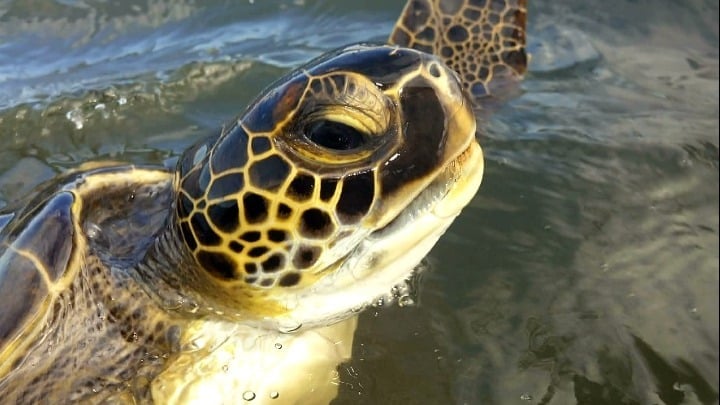
The green sea turtle (Chelonia mydas) is an uncommon sight in Greek waters, where the loggerhead sea turtle (Caretta caretta) is much more prevalent.
However, an environmental excursion organized by the “Aitoliko” Cultural and Educational Association recently led to a remarkable discovery in the Messolonghi lagoon: members of the group, led by diver Lambros Charelos, observed and documented six green sea turtles.
According to Charelos, spotting a group of green turtles in the central Messolonghi lagoon is an exceptionally rare phenomenon. While these turtles are migratory and widespread across the Atlantic, Pacific, and Indian Oceans, they are sighted only sporadically in Greek seas. In the Mediterranean, they are primarily known to nest on the coasts of Cyprus and Turkey, where females bury their eggs for an incubation period of approximately seven weeks.
The green sea turtle
While often admired for their size, it is worth noting that the green sea turtle is not actually the largest of all sea turtles—that title belongs to the leatherback sea turtle. However, the green sea turtle remains a significant and impressive marine species.
Scientific Name: Chelonia mydas.
The Name: They are called “green” turtles not because of their shell, but because of the color of the fat found beneath their carapace, which is a result of their diet of seagrass and algae.
Appearance: Their shells display a mottled mix of brown, yellow, and gray.
Size & Lifespan: They can reach a length of approximately 120 cm (about 4 feet) and can live for up to 80 years.
Conservation Status: As an endangered species, their protection is vital.
Recognizing the importance of the sighting, Charelos and the association immediately alerted the relevant authorities. Documenting these sightings is crucial for scientists tracking the migratory patterns and populations of these endangered creatures, especially as environmental shifts continue to affect their habitats.