A newly studied Greek inscription linked to the Temple of the Sun, discovered inside a historic mosque in Homs, Syria, may offer new clues about the lost sanctuary in ancient Emesa (Greek: Ἔμεσα). The research, led by Maamoun Saleh Abdulkarim of the University of Sharjah and published in Shedet, connects the text to Emesa’s long history of solar worship and later religious transformation.
Emesa sat on the eastern bank of the Orontes River, at a crossroads between the Syrian coast and the inner desert. That location helped it grow into a major commercial and strategic hub. Under Roman rule, the city also became one of Syria’s most influential religious centers.
Emesa’s sun cult shaped civic power
During the Roman era, the city’s religious life focused on Elagabalus, a local sun god. Ancient accounts describe his temple as a major sanctuary in Roman Syria. Worship centered on a black sacred stone, described as conical and believed to have “fallen from the heavens.”
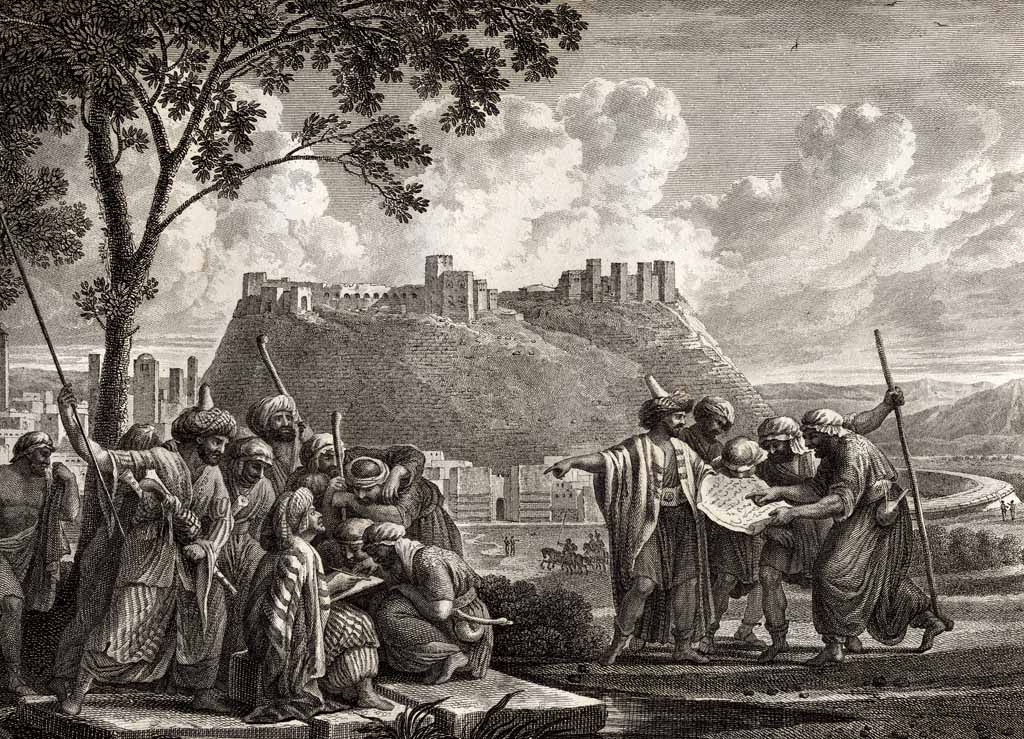
Emesa Castle overlooking ancient Homs. The 18th–19th century illustration captures the citadel rising above Emesa, home to the powerful sun cult of Elagabalus and later layers of Christian and Islamic history. pic.twitter.com/WzMJLRyxya
— Tom Marvolo Riddle (@tom_riddle2025) February 23, 2026
Priests held a strong influence in Emesa. They ran ceremonies, managed temple lands, and shaped local politics. Some reached the highest levels of imperial power. The best-known case was Marcus Aurelius Antoninus, later Emperor Elagabalus, who served as a priest before taking the Roman throne in 218 AD and trying to promote Emesa’s solar worship in Rome.
The temple’s location remains disputed
Researchers have long argued over where the Temple of the Sun once stood. Some scholars have suggested it was located at or near the site of the Great Mosque of al-Nuri, based on traces of earlier construction and medieval accounts describing a church that later became a mosque.
Other researchers have proposed that the temple stood on the hill of Emesa, pointing to finds such as a small altar with a Greek inscription and a stone lion head discovered in the 1970s. Abdulkarim notes that the small size of that altar makes it difficult to match with historical descriptions of a large temple complex.
The mausoleum that stood in Homs until 1911, when it was demolished. It held the remains of Emesa’s ruling family, closely tied to the powerful sun cult of Elagabalus. pic.twitter.com/Im165Dwlag
— Tom Marvolo Riddle (@tom_riddle2025) February 23, 2026
The debate has continued in part because archaeological excavation beneath the mosque is not possible for religious reasons. A Syrian-British team also excavated at Tell Emesa between 1995 and 1999, but did not confirm the temple’s remains.
Restoration work uncovered Greek texts inside the mosque
The study highlights a key discovery made during restoration work in 2016 at the Great Mosque of al-Nuri in Homs. Researchers found a Greek inscription carved on the eastern end of a column base overlooking the mosque’s inner courtyard.
Greek inscription discovered on the base of the column, photograph by Al-Najjar.#Greekinscription #Emesa pic.twitter.com/w5BrZPisT7
— Tom Marvolo Riddle (@tom_riddle2025) February 23, 2026
That was not the only text on the column. An earlier two-line Greek inscription had been recorded on another side of the same base. Its translation referred to a king described as “the round image of the universe,” a phrase earlier scholars linked to solar symbolism and dedication.
A new translation describes power, war, and sky imagery
A second inscription from the same column base later drew attention after it was translated and shared publicly in May 2024. The text describes a ruler who soars in the sky, crushes enemies, and attacks with force. It also refers to transformation into a tiger and mentions a hill, which the study links to the citadel of Homs.
Abdulkarim argues that the language strengthens the case that the site held symbolic meaning tied to royal power and divine authority. The imagery also fits with earlier readings that connect the column’s inscriptions to the sun god and related cult ideas.
The inscription adds to the evidence of a layered sacred space
The research places the mosque inscription within a longer timeline of religious change in Emesa. Historical sources suggest the temple may have been converted into a church, and later into a mosque. Medieval writers described a period when a church was divided between Muslim and Christian worship during the early Islamic conquest.
The inscription does not prove the temple’s exact location. But Abdulkarim says it strengthens the argument that the mosque site preserves traces of earlier sacred phases, even if most Roman architecture has vanished due to upheaval, rebuilding, and earthquakes.
Emesa’s shift from paganism to Christianity was gradual
Beyond the inscription, the study describes Emesa as a city shaped by religious plurality. Pagan worship remained dominant for centuries, but Christianity began to grow in the third century, first among groups with less connection to the pagan priesthood.
A mask of a person believed to be from the royal family, discovered in the Abu Saboun cemetery in Homs (Emesa). pic.twitter.com/IoGu73uByz
— Tom Marvolo Riddle (@tom_riddle2025) February 23, 2026
For a long period, Christians and pagans coexisted in daily life. The balance shifted after the Edict of Milan in 313 AD gave Christians legal freedom, and later laws under Theodosius I restricted pagan worship. Over time, pagan symbols faded from public space and Christian markers became more common.
Why one Greek text matters today
Abdulkarim concludes that Emesa offers a strong case study of how religions overlap rather than simply replace one another. The Greek inscription inside the mosque stands out because it is a rare surviving piece of physical evidence in a city where many ancient structures were lost.
For now, the Temple of the Sun remains elusive. But the inscription gives researchers a sharper tool to connect Emesa’s ancient sun cult, its Byzantine layers, and its Islamic architecture into one long, continuous story.