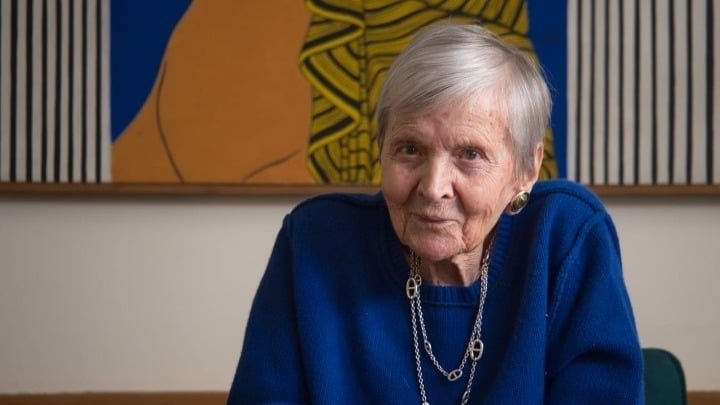
The academic world mourns the passing of eminent Byzantine scholar Hélène Glykatzi-Ahrweiler, who died at the age of 99. A formidable intellectual and a trailblazer for women in education, her death was announced this Monday.
Glykatzi-Ahrweiler: A career of historic “firsts”
Glykatzi-Ahrweiler was a titan of the Sorbonne, breaking centuries of tradition to become:
1967: The first woman elected President of the Sorbonne’s History Department.
1976: The first woman to serve as Rector of the University of Paris (Sorbonne) in its storied 700-year history.
Beyond the ivory tower, she served as a UNICEF Goodwill Ambassador for Greece, bridging the gap between high academia and global humanitarianism.
Influence extended beyond France and Greece
Born in Athens in 1926, Eleni Glykatzi began her journey at the University of Athens (History and Archaeology). She later moved to France to study at the École des Hautes Études, earning a Doctorate in History (1960) followed by a Doctorate of Arts (1966).
She joined the French National Center for Scientific Research (CNRS) in 1955, rising to Head of Research by 1964. Her deep expertise in Byzantine history led to her appointment as a Professor at the Sorbonne in 1967, a role that paved the way for her eventual leadership of the entire institution.
Her influence extended far beyond France and Greece. Her honors included:
- Memberships: The Academy of Athens and several other prestigious international academies.
- Honorary Doctorates: Awarded by institutions including Harvard, London, New York, Belgrade, and Haifa.
- Leadership: Presided over numerous museums, cultural foundations, and international associations throughout her long career.
She is survived by her daughter, from her marriage to the late Jacques Ahrweiler.
Glykatzi-Ahrweiler was “a great Greek woman”
Greek Prime Minister Kyriakos Mitsotakis expressed his deep sorrow over the loss, highlighting her unique blend of global intellect and Greek identity. In a personal tribute, he stated:
“Our homeland and the global academic community bid an emotional farewell to Hélène Glykatzi-Ahrweiler—a cosmopolitan of thought and culture with a Greek heart. Personally, I have lost a singular friend and an invaluable advisor who taught me the importance of action and results. She was the one who showed me how to turn ‘if’ into ‘do.’”
The Greek Minister of Culture, Lina Mendoni, expressed her profound sorrow, emphasizing Glykatzi-Ahrweiler’s role in redefining Greek history:
“It is with deep pain and immense emotion that I learned of the loss of Hélène Ahrweiler—a great Greek woman whose work bridged the gap between Byzantium and both Ancient and Modern Greek history. She was an intellectual with a decisive influence on science and public affairs, and one of the most prominent and complete figures of modern Greece.”
Minister Mendoni specifically highlighted how Ahrweiler’s creative life and prolific authorship—most notably her seminal works Byzantium and the Sea and The Political Ideology of the Byzantine Empire—revitalized Byzantine studies in the West.
“Her work recontextualized Byzantium on a European scale as the vital link between antiquity and the modern era,” Mendoni added, noting that her long and creative life makes this loss even more significant for the global community.