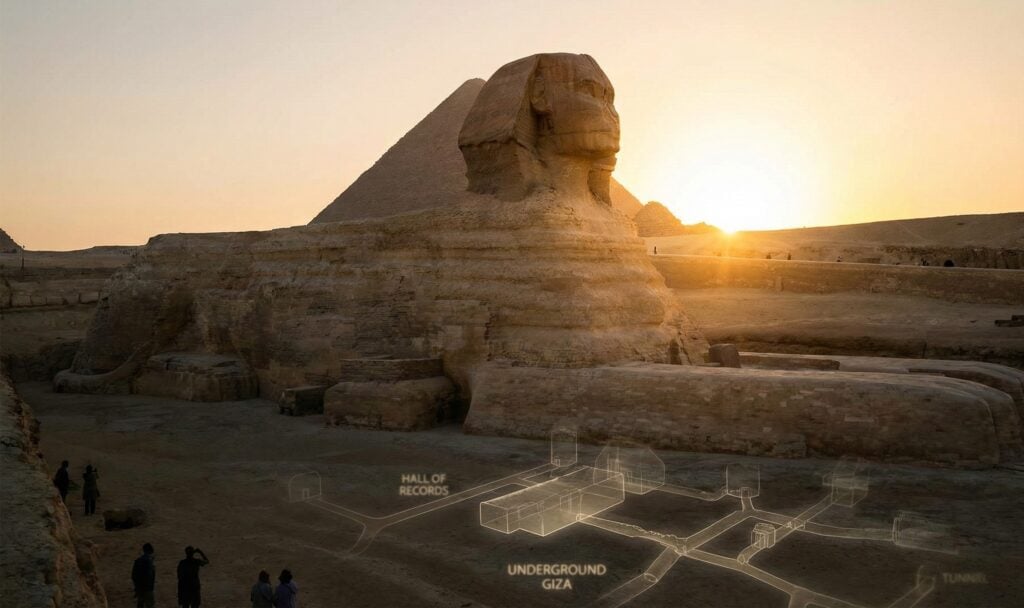
At sunrise, the tunnels around the Sphinx do what they have always done: they make people slow down and start imagining what might be hidden just out of sight. There are real holes, shafts, and odd little voids around the monument, but the leap from “there is an opening” to “there’s a vast underground maze” is where the story usually outruns the evidence and where alternative theories begin to flourish.
The Great Sphinx of Giza and what “tunnels” usually means
When people talk about tunnels underneath the Sphinx, they are usually referring to several very different features lumped together under one word. A narrow shaft—often vertical—does not equate to a walkable passage, and a cavity is not automatically a chamber. In many cases, it is simply limestone behaving as limestone does: cracking, weathering, and forming openings over time that might resemble tunnels.
The phrase “under the Sphinx” can also refer to at least three distinct locations: inside the statue itself, beneath the floor of the surrounding ditch, or somewhere in the nearby bedrock. Dramatic photographs that remove scale and context can make a tight probe hole or a natural geological pocket look like the entrance to a cinematic underground world.
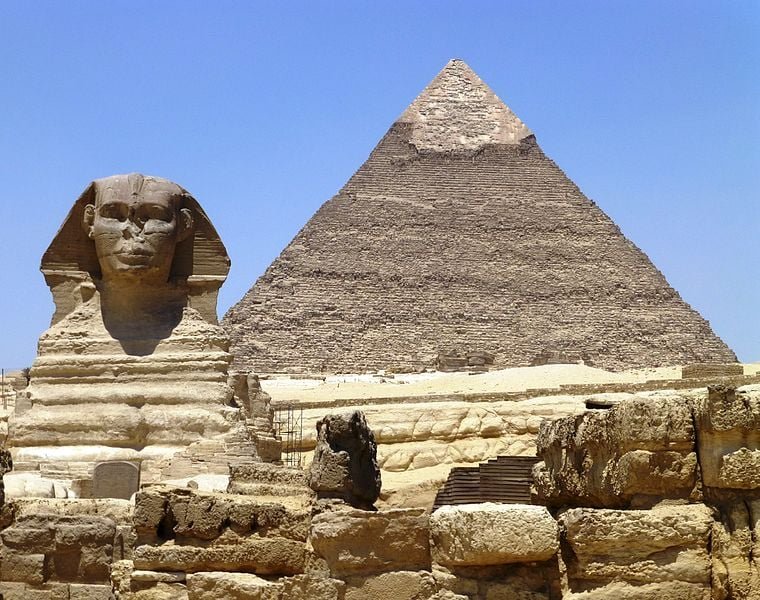
The Sphinx rests in a cut-rock ditch, commonly called the Sphinx enclosure. This area is already a landscape shaped by quarrying, carving, and later cleanup. Researchers with the Giza Plateau Mapping Project note that quarrying carved a U-shaped ditch and left a core of rock that became the Sphinx. This helps explain why the “stage” around the monument is full of cut surfaces and irregular edges that do not automatically indicate secret chambers or tunnels.
Add in groundwater, soft limestone layers, and centuries of sand burying and re-burying the site, and there are plenty of natural reasons for small voids to appear—or for existing spaces to be altered—without any hidden plan behind them. In other words, the mystery often lies in geology and time rather than a concealed blueprint.
Openings that are actually documented
Yes, openings around the Sphinx do exist, and some are well-known for good reason. The most famous is “Perring’s Hole,” a drilled shaft in the Sphinx’s back created during Howard Vyse’s 1837 work, when John Shae Perring was instructed to bore into the monument. The drilling reportedly reached about 8.2 meters (27 feet) before the tools became stuck, and the hole was later cleared in 1978.
Other cut features in and around the enclosure have been described as descending toward groundwater and ending in dead ends, rather than continuing as intended corridors—behavior very different from what one would expect in a deliberate, walkable tunnel system. Another detail often overlooked is that some “ancient-looking” access points are actually remnants of modern clearing and restoration efforts. These were practical cuttings made so workers could measure, brace, and repair the monument. These were later sealed for safety.
What alternative theories suggest about the tunnels underneath the Sphinx
According to this theory, the tunnels are not simply dead ends or restoration probes but part of a sophisticated architectural blueprint that predates conventional Egyptian history and tells a completely different story about the beginnings of our civilization. Beyond the documented shafts and natural voids, some alternative theories propose that the Sphinx serves as a literal gateway to a lost era of human history.
The most famous of these ideas is the “Hall of Records” theory, popularized by the clairvoyant Edgar Cayce. He claimed that a secret library containing the accumulated knowledge of the lost civilization of Atlantis lies buried beneath the Sphinx’s front paws. Proponents often point to seismic surveys conducted in the late 20th century, which identified a rectangular anomaly in that area. To these theorists, the anomaly represents a deliberate, man-made chamber intended to preserve humanity’s origins and the “true” history of the Nile Valley before the rise of the dynastic Pharaohs—or at least a space that served some unknown purpose.
Other theories envision a vast, interconnected “Underground Giza,” with the Sphinx functioning as a primary access point or ventilation hub for a subterranean city. Some researchers go further, suggesting that the monument was constructed by a “pre-cataclysmic” society that lived underground to survive global disasters, leaving behind a network of tunnels connecting the Sphinx to the Great Pyramid and the nearby “Osiris Shaft.” According to this perspective, these tunnels are not mere dead ends or modern probes but part of a sophisticated architectural plan predating conventional Egyptian history, offering an entirely different view of the origins of civilization.
Such theories often portray the official archaeological stance as a “cover-up,” asserting that the tunnels remain unexplored because their contents could fundamentally alter our understanding of human history and the antiquity of civilization.
Real or imagined, one truth remains: the Sphinx continues to astonish, its presence inspiring awe and speculation for millennia.