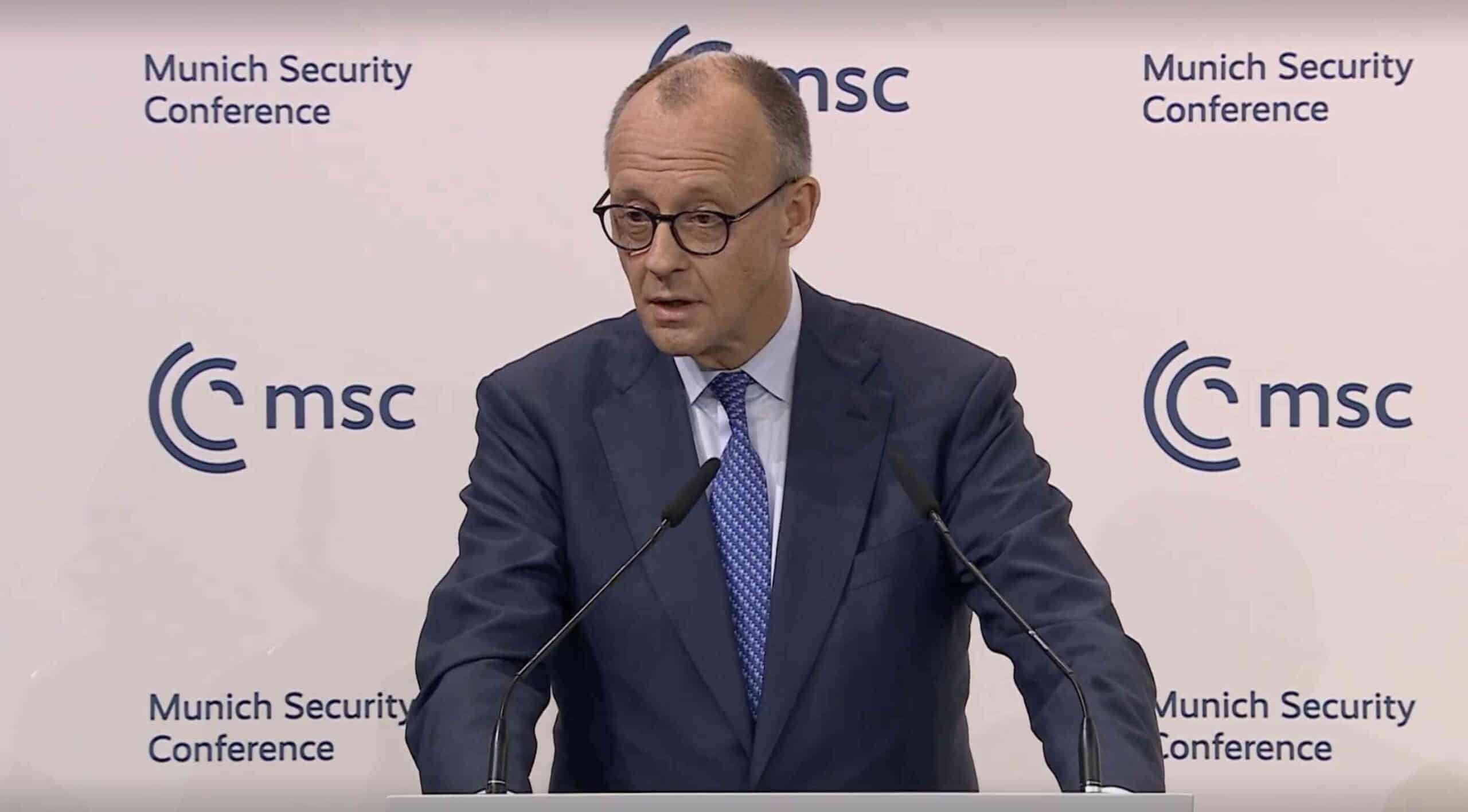
German Chancellor Friedrich Merz told the Munich Security Conference that the decades-old world order “no longer exists,” warning that the United States cannot address global security challenges alone in an era of rising great-power competition.
Addressing global leaders, he said freedom cannot be taken for granted and that European nations must be prepared to make sacrifices to safeguard their stability. He described the traditional system of international rules as having eroded and no longer existing in its previous form.
Merz also pointed to what he described as a deepening divide between Europe and the United States, referencing political tensions that first surfaced publicly when U.S. Vice President JD Vance criticized Europe during the same conference last year. He added that the cultural battles shaping US politics do not align with European values and stressed that Europe supports free trade rather than tariffs or protectionist measures.
Shifting dynamics in the US-led world order
This year’s gathering comes at a moment of intensified strain between Washington and several European capitals. US President Donald Trump has repeatedly voiced interest in taking control of Greenland, a Danish territory, and has imposed tariffs on European goods.
Many European leaders view the Greenland dispute as a turning point that has weakened transatlantic trust. Trump told reporters that the United States is negotiating over Greenland and claimed it plays a key role in national security.
In my meeting earlier today with German Chancellor Friedrich Merz, we discussed our shared efforts to secure supply chains, advance efforts to end the Russia–Ukraine war, and strengthen the partnership between the United States and Europe. pic.twitter.com/VdaAvWp2PE
— Secretary Marco Rubio (@SecRubio) February 13, 2026
Around 50 world leaders are attending the conference, where discussions are centered on European defense and the shifting transatlantic relationship.
The agenda also includes the war in Ukraine, growing tensions between Western governments and China, and the possibility of a renewed nuclear agreement between the United States and Iran.
Europe confronts a new security moment
French President Emmanuel Macron told attendees that Europe must strengthen its geopolitical influence.
He said the continent has already begun to rebuild its defense capabilities after Russia’s 2022 invasion of Ukraine, but must move faster and work collectively.
Macron called the conflict an existential test for Europe and urged leaders not to yield to Russian demands, saying pressure on Moscow is necessary to reach a fair settlement.
US Secretary of State Marco Rubio described the moment as a rapidly changing period in global politics. He said nations must reassess their roles as geopolitical conditions shift. Ahead of the conference, he warned that the pace of global change requires closer examination of how alliances should function.
Danish Prime Minister Mette Frederiksen said she planned to meet Rubio to discuss US statements about seizing Greenland from its NATO partner.