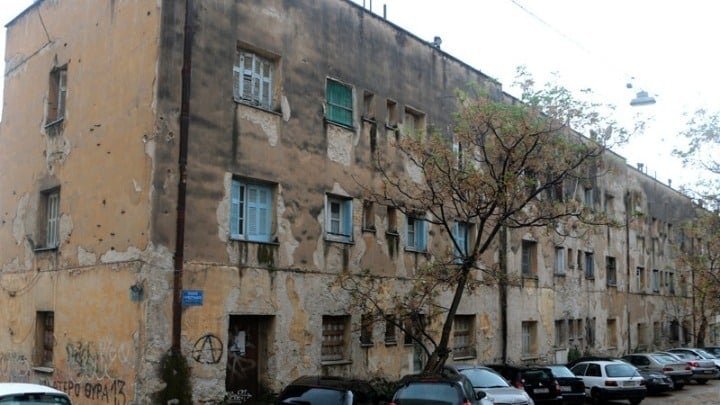
A major redevelopment project is finally moving forward for one of Athens’ most debated landmarks: the Prosfygika refugee apartment blocks on Alexandra’s Avenue.
The Attica Region has officially initiated the tender process to restore a significant portion of this nearly century-old complex.
The plan for Prosfygika: Social housing and patient care
After years of financial and legal stagnation, the project has reached maturity. The first phase focuses on four of the eight historic blocks to restore 108 apartments.
- Social Housing: The units will provide affordable housing for vulnerable citizens.
- Medical Hospitality: A portion of the apartments will accommodate the families of patients being treated at the adjacent “Agios Savvas” Oncology Hospital.
A complex urban challenge in Athens
The project is far from simple. Built starting in 1933, the complex contains a total of 228 apartments across eight blocks. Over the last several decades, the site has been the center of intense social and political friction.
Most of the apartments, including those in the first phase of restoration, have been squatted for years by various activist groups and collectives.
When asked about the current residents, Attica Region officials noted that “the issue of evacuation is a matter for the competent authorities,” specifically the Ministries of Justice and Citizen Protection.
Architectural and historical significance of the Prosfygika
Designed in the spirit of German Functionalism (Bauhaus style) by engineers Dimitris Kyriakou and Kimon Laskaris, these buildings were originally constructed to house Greek refugees from Asia Minor and Pontus.
The buildings are strictly utilitarian, made of reinforced concrete with no ornamentation. Today, the only “decoration” visible on their weathered facades is the bullet holes from the “Dekemvriana” (the 1944 Battle of Athens), making them a literal physical record of Greek history.
From demolition threats to protected monuments
The survival of the Prosfygika is a miracle of civic activism.
Ahead of the 2004 Olympics, the government announced plans to demolish the blocks to create a park. This sparked a massive legal battle and public outcry.
In 2003 and 2009, the Council of State designated the entire complex as a protected monument, recognizing it as one of the few surviving examples of interwar social housing in Europe.
Despite their protected status, the buildings fell into decay and “decay by neglect” as ownership shifted between the state and private residents, leading to the current mixed-ownership status and widespread squats.