The Greek victory over the Persian Empire (499–449 BC) remains one of history’s greatest “David vs. Goliath” scenarios.
While the Persians possessed a massive, multi-ethnic army and vast resources, the Greeks utilized a combination of geography, technology, and ideology to prevail.
10 key reasons the Greeks defeated the Persians
1. The Phalanx and the Hoplite “Tank”
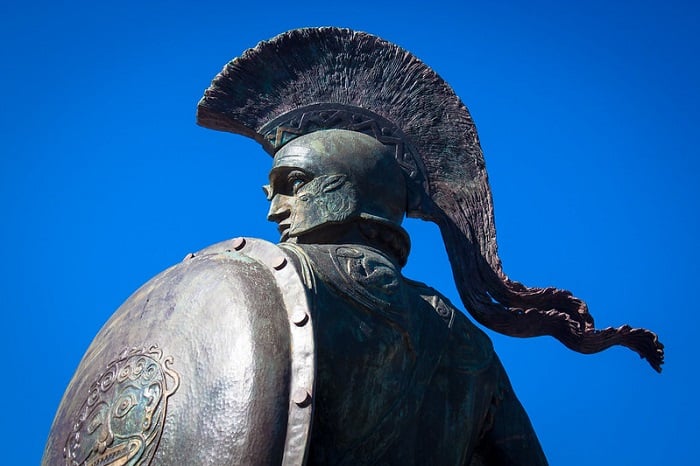
The primary Greek foot soldier, the hoplite, was significantly better armored than his Persian counterpart. Greeks wore bronze breastplates, greaves, and large circular shields (the aspis). When locked together in a phalanx formation, they created a nearly impenetrable wall of bronze. Persian infantry, such as the “Immortals,” typically wore wicker shields and linen tunics, which were ineffective against Greek spears.
2. Superior Naval Technology (The Trireme)
At the Battle of Salamis, the Greek trireme proved superior in the narrow straits. These ships were designed as “manned missiles,” equipped with bronze-sheathed rams at the bow. They were faster and more maneuverable in tight spaces than the heavy, high-sided Persian vessels, which became crowded and collided with one another.
3. “Home Court” Advantage
The Greeks fought on their own rugged, mountainous terrain. In places like Marathon and Thermopylae, the narrow passages neutralized the Persians’ greatest advantage: their sheer numbers. The Persians could not deploy their massive cavalry or flank the Greeks because the mountains on one side and the sea on the other funneled them into a “killing zone.”
4. Strategic Brilliance: Themistocles and Miltiades
The Greeks benefited from exceptional leadership. Miltiades at Marathon utilized a “double envelopment” (thinning the center to wrap around the wings), while Themistocles famously tricked Xerxes into fighting in the narrow waters of Salamis by sending a “double agent” to tell the Persian King the Greeks were fleeing.
5. Ideology: Freedom vs. Conscription
Greek soldiers were citizen-soldiers fighting for their homes, families, and the concept of eleutheria (freedom). The Persian army, by contrast, was largely composed of conscripts from conquered nations who often fought under the threat of the lash. The Greeks’ personal stake in the outcome led to higher morale and “last stand” determination.
6. Logistic Nightmares for Persia
The Persian Empire had to maintain a supply line thousands of miles long. Feeding hundreds of thousands of soldiers and horses in the barren, rocky terrain of Greece was nearly impossible. When the Greek fleet destroyed the Persian supply ships at Salamis, Xerxes was forced to retreat with a large portion of his army to avoid starvation.
7. Unity (The Hellenic League)
Though the Greek city-states were famously fractious and often at war with each other, the existential threat of Persia forced an unprecedented level of cooperation. The Hellenic League brought together the naval power of Athens and the legendary land-discipline of Sparta, creating a balanced and formidable combined force.
8. The Failure of Persian Cavalry
The Persian cavalry was the elite “strike force” of their empire, but it was largely useless in the major battles in Greece. At Marathon, the horses were reportedly away being watered; at Thermopylae and Salamis, the terrain and sea made them irrelevant. Without their cavalry to break the Greek lines, the Persians were forced into a frontal infantry slugfest they couldn’t win.
9. Professionalism of the Spartans
While most Greeks were farmers who trained part-time, the Spartans were a professional warrior class. Their presence at the heart of the Greek line provided a psychological “anchor.” Their legendary stand at Thermopylae, though a defeat, served as a massive propaganda victory that galvanized the rest of Greece.
10. Miscalculation by Xerxes
King Xerxes’ own hubris played a role. His decision to sit on a throne on Mt. Aegaleo to watch the Battle of Salamis was indicative of his overconfidence. By forcing a decisive battle in a location chosen by his enemies, he gambled his entire fleet—and lost.