The historic visual archive, “Mount Athos and Meteora 1929: Princeton’s Hidden Treasure”, lost for nearly 90 years in a storage basement, is making its way to St. Augustine, Florida. The exhibition bridges the spiritual legacy of Greece with the earliest roots of Greek-American history.
The exhibition is a collaborative effort between the Mount Athos Center of Thessaloniki, Princeton University’s Department of Art and Archaeology, the Mount Athos Foundation of America (MAFA), and the St. Photios Greek Orthodox National Shrine.
The miraculous rediscovery of the 1929 files
The story of this exhibition is as compelling as the images themselves. In late 2017, while clearing out the “Expedition Room” in Princeton’s McCormick Hall, staff members discovered a forgotten wooden barrel tucked away in a corner.
Inside were nine rusted canisters of nitrate film. Despite decades of neglect, research revealed the film was the record of an unofficial 1929 journey to Greece. This discovery acted as a “skeleton key,” allowing researchers to finally identify 254 photographic prints and 81 glass lantern slides that had sat unidentified in Princeton’s archives for nearly a century. Together, they form the earliest known American cinematographic record of the Holy Mountain.
The three adventurers at Mount Athos

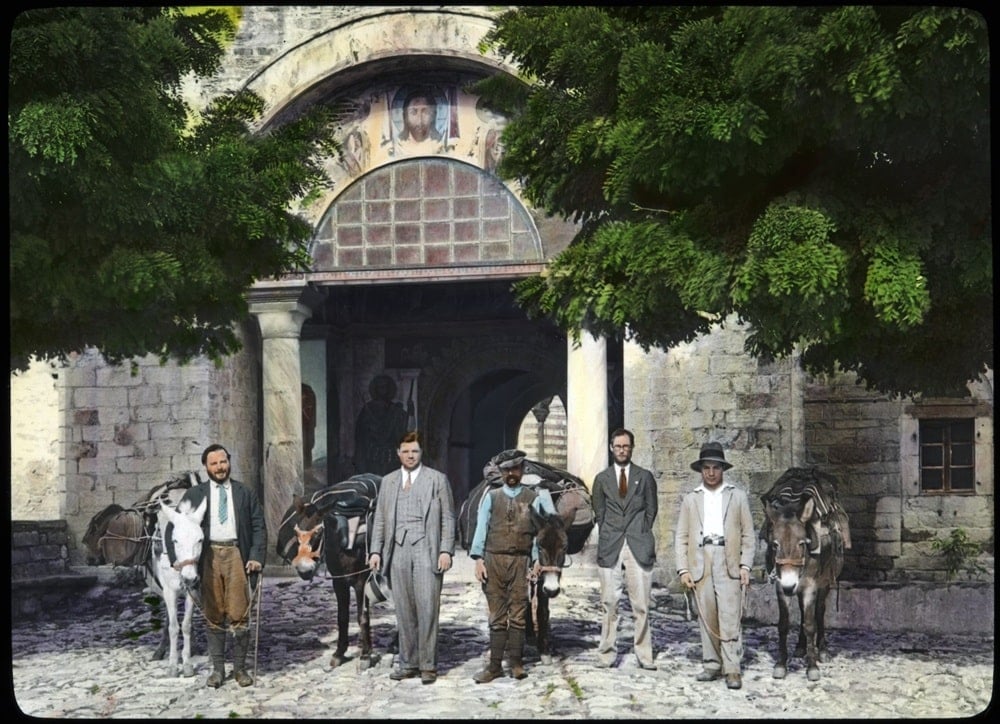
The 1929 expedition was the work of three “traveller-artists” who set out to capture a world they believed was timeless and mysterious. They titled their project “No Woman’s Land,” a reference to the thousand-year-old Avaton (the rule forbidding women from entering Mount Athos).
- Vladimir “Vovo” Perfilieff: A charismatic Russian émigré, painter, and explorer who served as the group’s leader and “gifted communicator.”
- Floyd Crosby: A young, talented cinematographer who would go on to win an Academy Award for the film Tabu (1931) and shoot the legendary Western High Noon.
- Gordon McCormick: A Princeton alumnus and architect who funded the mission and provided the architectural eye for their documentation.
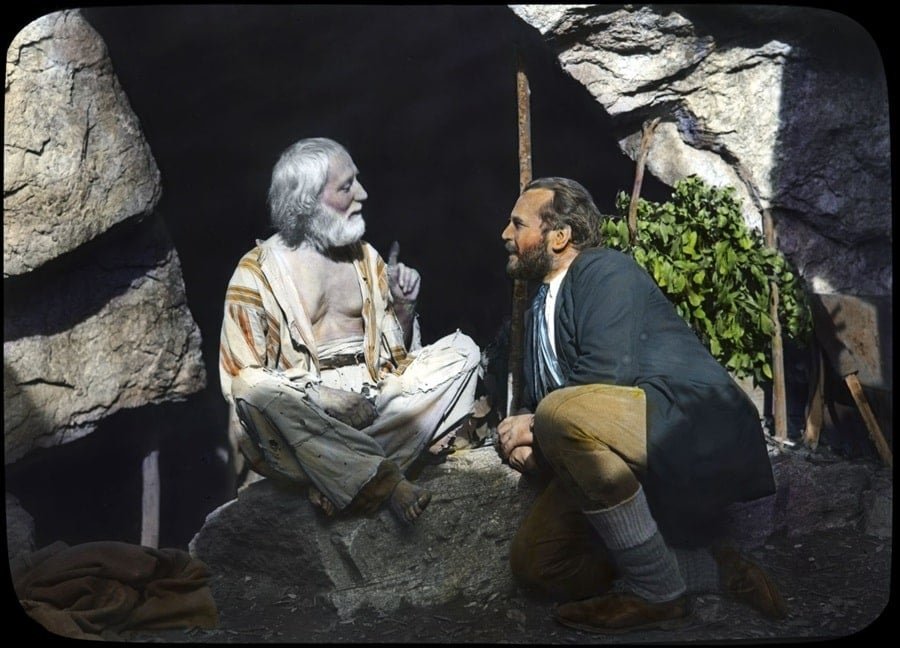
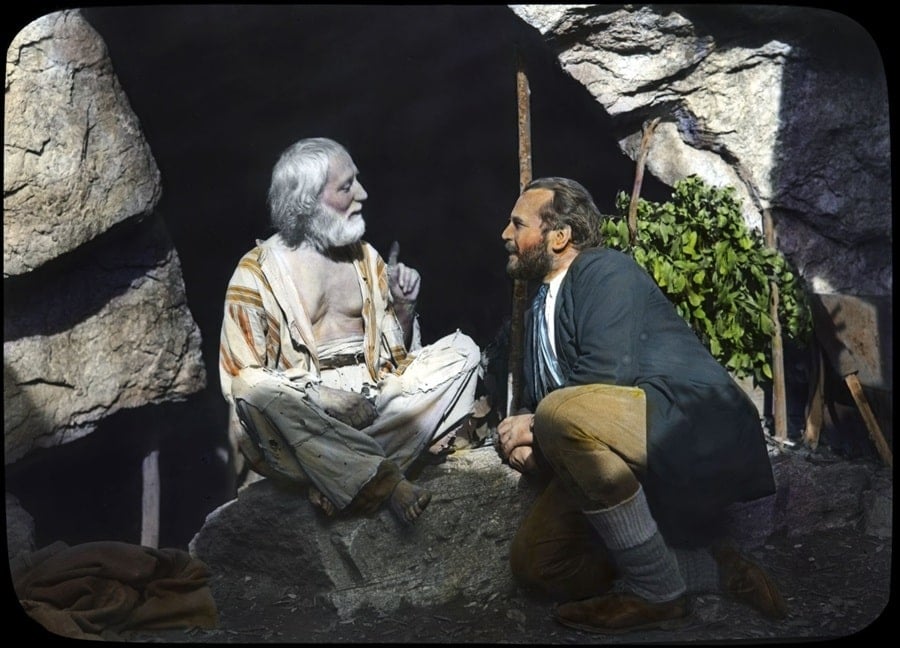
Accompanied by a young interpreter from Thessaloniki, Anastasios Chatzimitsos, the team gained unprecedented access, capturing interior shots of caves and monasteries—such as those of the hermit Ilya—that had rarely been seen by the outside world.
St. Augustine: A sacred site for the Greek Diaspora

The exhibition opens in St. Augustine, Florida—the oldest continuously inhabited European city in the U.S. For the Greek community, the location is a “living memorial” to their own survival:
The 1768 Pioneers: The first Greek immigrants—from Mani, Crete, and the Aegean—arrived in Florida to found the colony of New Smyrna. After years of hardship and disease, the survivors fled in 1777 to St. Augustine.
The St. Photios Shrine: The exhibition will be hosted at the St. Photios Greek Orthodox National Shrine, the only national shrine of its kind in the U.S., dedicated to the memory of those first Greek pioneers.
Exhibition Details
The exhibition features the restored 33-minute silent film alongside the rare photographs and hand-colored slides.
Opening: Friday, February 6, 2026 (Feast of St. Photios)
Venue: St. Photios Greek Orthodox National Shrine, St. Augustine, FL
Duration: Through March 7, 2026
Stelios Angeloudis, Mayor of Thessaloniki and Chairman of the Mount Athos Center, stated:
“We are deeply proud to bring this ‘hidden treasure’ to the United States. To see these images displayed in St. Augustine—a city so profoundly linked to the first Greek pioneers—is a powerful tribute to our shared cultural and spiritual heritage.”