The ancient Greek god Momus (Μώμος) was the personification of mockery and sharp criticism, provoking Zeus to the point of kicking him out of Olympus.
Some direct literary references to Momus in ancient texts come from Hesiod’s “Theogony,” where he is mentioned as a deity of mockery and satire, and Lucian’s dialogues, which portray him as a sharp-tongued critic among the gods.
According to Greek mythology, Momus took it to the extreme when criticizing Zeus’ lustful character and violent whims. He also mocked all the other gods for their creations. The gods in question vary depending on the tale. His criticism and insolence infuriated the king of the deities and he kicked the rude god out of Mount Olympus.
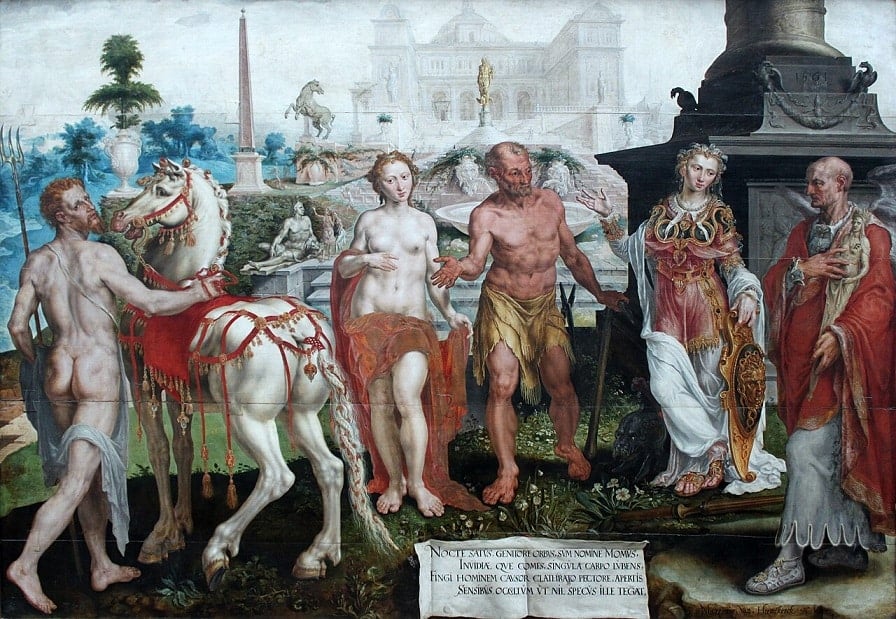
There is a famous fable of Momus and his notorious satirical wit that is illustrated in the painting above, made by Dutch painter Maarten van Heemskerck, depicting Zeus, Prometheus, Athena and Momus:
Zeus had created a bull, Prometheus a man, and Athena a house, and they selected Momus as a judge of their handiwork. Momus was jealous of their creations and began by saying that Zeus had made a mistake in not putting a bull’s eyes on the ends of his horns so that he could see where he was striking, and he said that Prometheus was wrong in not hanging man’s heart on the outside so that scoundrels could be detected and so that it would be evident what everyone had on his mind. Finally, he said that Athena should have put wheels on her house so that a man could easily move if he had a bad neighbor.
Zeus lost his temper with Momus over this spitefulness and threw him out of Olympus.
Momus, born of mother Night
An ancient Greek myth has Momus born spontaneously from Nyx (Νύχτα—night in Greek), the goddess and personification of the night, with no father. He was the twin to Oizys, the goddess of misery, anxiety and depression. Another version has Momus’ father being Erebus, the god of darkness and Nyx’s consort.
Momus first appears in Hesiod’s writings, especially in “Theogony.” He is talked about briefly as a child of Night. This denotes a connection between darkness and his tendency to criticize.
Momus did not live near his mother, but instead resided upon Mount Olympus with the other gods. Hesiod says that Momus’ job is to tell truths to gods, always ready to laugh at them, even if it means creating tensions in Olympus.
But soon the god of ridicule and scorn was expelled from Olympus by Zeus, after he had made fun of the other gods and criticized Zeus as well.
He was always looking for fault in the other gods and reasons to ridicule them. He also found fault with humans, claiming there is no way to look into their hearts to discern their true thoughts and intentions.
Sometimes the ancient Greek god’s criticism verged on the absurd. For instance, he found fault with homes because they don’t have wheels so one could roll them away to avoid noisy neighbors. Or bulls, because they don’t have eyes on their horns to guide their charge. Given these complaints, it is no surprise that his twin was the personification of misery.
How did the ancient Greeks perceive satire through Momus?
The ancient Greeks considered Momus to be the personification of satire and mockery. They perceived satire through the myth of Momus as a vivid expression of wit and criticism. His mockery served both as a form of entertainment and a means of reflection on societal and divine imperfections.
Although Momus’ mockery and criticism was often annoying, it was funny. So it served the purpose of comedy. It is said that he aided in the incitement of the Trojan War as a means to reduce the human population.
In later years Momus’ sharp wit served as a mouthpiece to criticize authority and tyranny, as well as the faults of society at large. He evolved from a bitter critic to a witty satirist.
Lucian, who also wrote satire, describes the ancient Greek god of mockery as funny and with good command of language. He often uses Momus to find weaknesses and expose the silly ways of both gods and people.
In Lucian’s texts we see Momus not as a bad character but an important one, bringing out the flaws that are in everyone. Like the jesters of old times, he used humor to tell truths to rulers. Though Momus’ voice often contained ridicule, it also did something important: it spoke the truth others did not want to face.
This point of view is important for knowing how satire worked in ancient Greek life. Satire was like a way for gods to see and admit shortcomings. Momus’ lasting worth is in these changing views, where he was both a showman and a cautious voice. He kept gods in line through his constant critiques.
Momus symbols
In myths, symbols play an important role as they give a way to understand deeper parts of a god’s personality and impact. The symbols linked to the ancient Greek god of mockery depict his critical and thoughtful nature and his playful truth-telling character.
The two symbols of Momus, respectively, are the mirror and the mask of the joker. The mirror means thinking and awareness. Looking into the mirror, one sees deep into themselves and becomes aware of who they are. The mirror tells the truth, it exposes the faults one has but others don’t see.
The mask, once happy, once sad, is that of the joke maker. He makes jokes to laugh and celebrate life. Yet, he also makes jokes to forget the sad, tragic side of life.