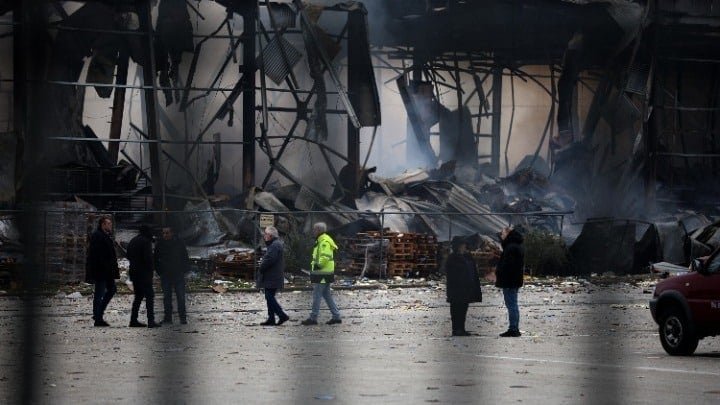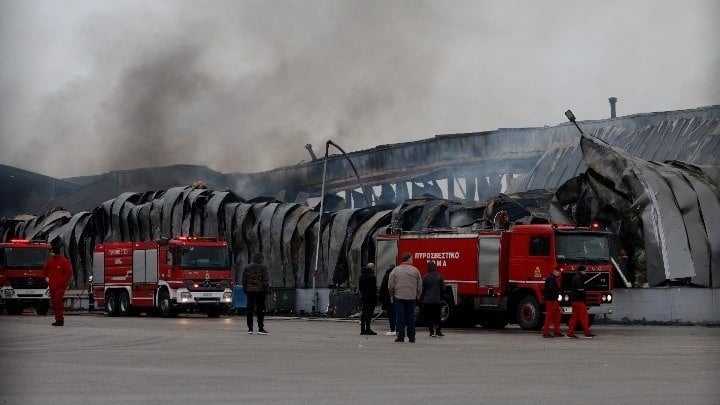
The horrific explosion at the Violanta biscuit factory in Trikala, which claimed the lives of five women during their night shift, has reignited a painful debate over labor accidents in Greece.
This tragedy is not an isolated incident; rather, it is the latest entry in an increasingly long and bloody catalogue of workplace disasters.
A dramatic surge in fatalities
This incident follows the preliminary release of the 2025 annual report by the Federation of Greek Technical Enterprise Employee Associations (OSYTEE). The findings reveal a staggering escalation in workplace accidents, reaching a peak in 2025.
According to OSYTEE’s data:
- 2025 Fatalities: At least 201 people lost their lives on the job.
- Severe Injuries: 332 workers suffered life-altering injuries.
- The Trend: Fatalities have nearly doubled since 2022, when 104 deaths were recorded. Serious injuries have followed a similar trajectory, skyrocketing from 140 in 2022 to over 330 today.
The Federation notes that final figures, expected in late February, may be even higher as they continue to verify incidents that were either not reported by authorities or kept out of the public eye.
High-risk sectors: Where the danger lies
The 201 recorded deaths in 2025 are concentrated in specific, high-risk industries:
- Construction & Technical Trades: Accounted for 24.88% (50 deaths). More than one in four fatalities occur on construction sites and infrastructure projects.
- Agriculture, Forestry, and Fishing: Accounted for 23.88% (48 deaths). OSYTEE warns that this sector is prone to significant under-reporting due to uninsured labor and a lack of official declarations.
- Transport & Logistics: 17 deaths (8.46%).
- Tourism & Hospitality: 15 deaths (7.46%).
- Shipyards & Maritime: 11 deaths (5.47%).
The systematic absence of prevention
For OSYTEE, the Trikala disaster highlights a systemic failure. President Andreas Stoimenidis describes the situation as a “humanitarian crisis” fueled by dysfunctional labor policies.
“The picture of workplace deaths for 2025 is terrifying but entirely expected,” Stoimenidis stated. “It is defined by anti-labor policies—most notably the 13-hour workday and the lack of collective bargaining agreements. This is exacerbated by the dismantling of inspection mechanisms and a total lack of social dialogue.”
Stoimenidis suggests that for every fatal accident, there are hundreds of smaller warning signs. In Trikala, those signs were reportedly ignored: management had allegedly been warned of a persistent gas smell for days before the blast.
The paper trail of negligence
Questions regarding prior inspections at the Violanta facility have already yielded troubling answers. Deputy Labor Minister Kostas Karagounis confirmed that two official complaints had been filed with the Labor Inspectorate months before the explosion:
July 2024: A complaint regarding thermal stress during a mandatory work stoppage due to heat.
November 2024: A complaint regarding equipment safety and missing “CE” certifications.
While the Ministry initially downplayed the connection between these specific violations and the blast, labor advocates argue that they point to a broader culture of non-compliance.
The data Gap: OSYTEE vs. ELSTAT
A significant point of contention remains the discrepancy between independent research and official government figures.
In 2022, ELSTAT (Hellenic Statistical Authority) recorded only 35 deaths, while OSYTEE recorded 104.
In 2023, the gap widened: 51 deaths (ELSTAT) versus 179 (OSYTEE).
OSYTEE attributes this to structural limitations: official state data often excludes contractors, the self-employed, and the uninsured. Furthermore, the Federation cites data from EUROGIP, suggesting that under-reporting of labor accidents in Greece may reach as high as 91%. They argue that the state maintains “artificially low” numbers to protect a political “success story” that does not reflect reality.
As Trikala buries its dead, OSYTEE has vowed to resubmit dozens of safety proposals that were rejected by the Ministry of Labor last October.
For the families of the victims, these statistics are no longer just numbers—they are proof of a system that prioritized production speed over the lives of those on the assembly line.