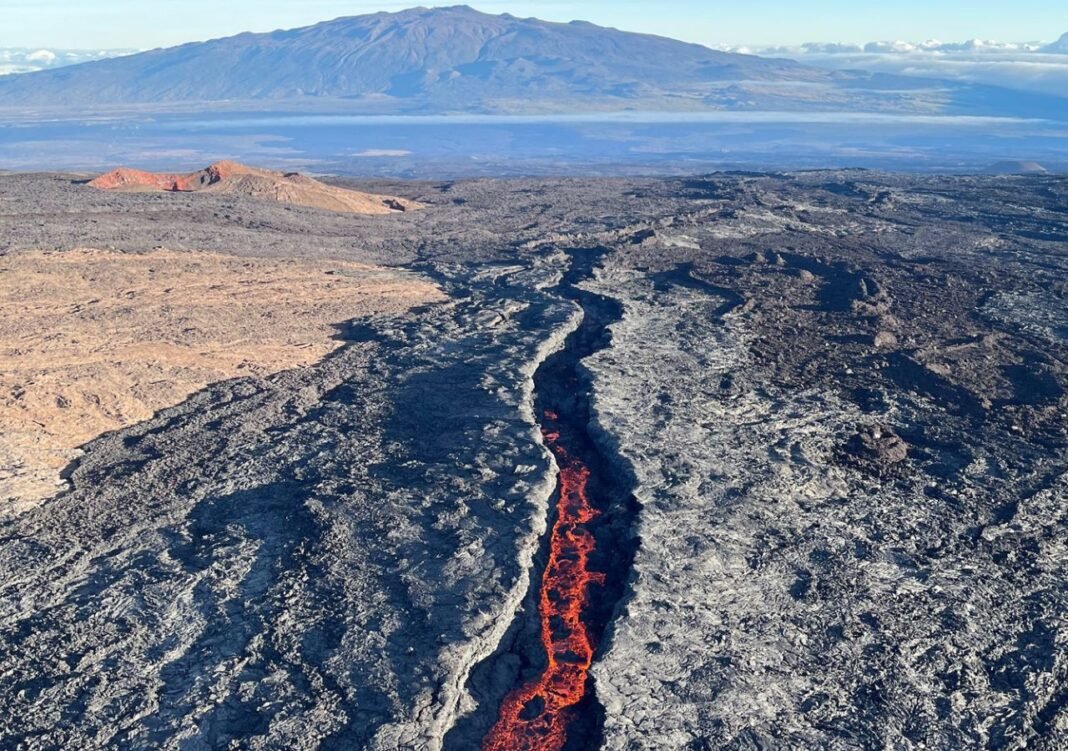
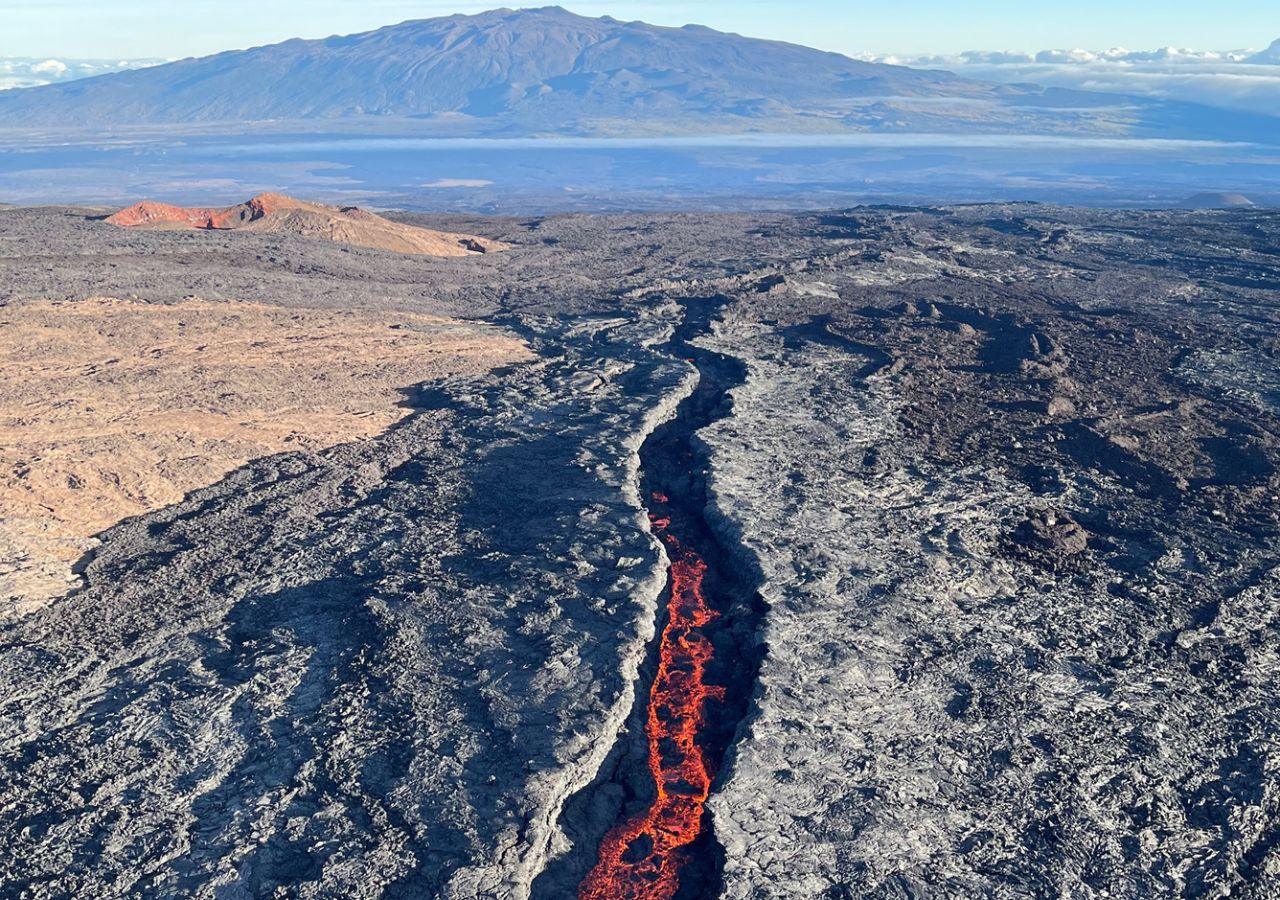
On the Big Island of Hawaii, two neighboring volcanoes, Mauna Loa and Mauna Kea, are telling geologists a story of hidden complexity. Though they rise side by side and draw energy from the same deep mantle plume, the lava they produce carries distinct chemical signatures. Scientists now believe that Hawaii’s volcanoes may be tapping into different parts of Earth’s deep interior, separated by a dramatic split over a thousand miles below the surface.
A recent study led by Jiashun Hu, a geodynamicist at the Southern University of Science and Technology, proposes that a deep plume rising beneath Hawaii divides into two separate branches.
Each one pulls material from a different source within the mantle. This could explain why Mauna Loa’s lava reflects older, more primitive rock, while Mauna Kea’s lava resembles typical mantle material. These chemical differences are not limited to one island but appear along the early stretch of the Hawaiian chain.
Hawaii’s volcanoes reveal different Earths deep underground
The team built a computer model tracing mantle activity over the last 250 million years. It successfully matched known tectonic plate movements and subduction zones.
Around 120 million years ago, the model showed a plume forming beneath the region now marked by the Hawaiian hot spot. Hu said this is the first simulation to accurately reflect Hawaii’s geologic evolution.
Lava from Hawaii’s Mauna Loa volcano (foreground) is chemically distinct from Mauna Kea’s (background peak). A new model suggests a split in a deep plume of hot rock could be responsible. pic.twitter.com/4sVet26hgr
— Tom Marvolo Riddle (@tom_riddle2025) January 27, 2026
Further validation came from a separate study in 2025. The same model traced the movement of the plume in a way that aligned with the bend seen in the Hawaiian-Emperor chain, reinforcing its credibility.
Looking further back, the model identified a key event about 125 million years ago. A sinking tectonic slab collided with a massive structure near Earth’s core known as a large low-shear-velocity province. This collision formed a ridge and triggered the plume’s initial rise.
Model tracks plume split and chemical divide
Around 50 million years ago, the plume began splitting, with one branch drawing from the center of the structure and the other from its edge. By 10 million years ago, this chemical divide likely reached the surface, shaping the contrasting lavas seen in Hawaii’s volcanoes today.
Not all experts agree with the explanation. Dominique Weis, a geochemist at the University of British Columbia, believes the idea has merit but says it does not fully align with geochemical data from Mauna Kea.
Dietmar Müller, a geophysicist at the University of Sydney, finds the model compelling for showing how deep mantle structures may be active and changing over time.
The model forecasts that the split may continue rising over the next 50 million years, potentially forming two parallel island chains. Hu noted that future seismic studies could confirm the split, though current technology does not offer a detailed enough view beneath Hawaii.