
Historians and international relations scholars frequently look back to ancient Greece for lessons on the geopolitics of the present and future. For example, the American political scientist Graham T. Allison famously drew from Thucydides’s work to explain the nature of great power competition.
Following this trend of inquiry, ancient Greek history may offer valuable insights into the realm of military alliances in foreign affairs. Military alliances have played a crucial role throughout history, often proving decisive in determining the balance of power between major players on the world stage.
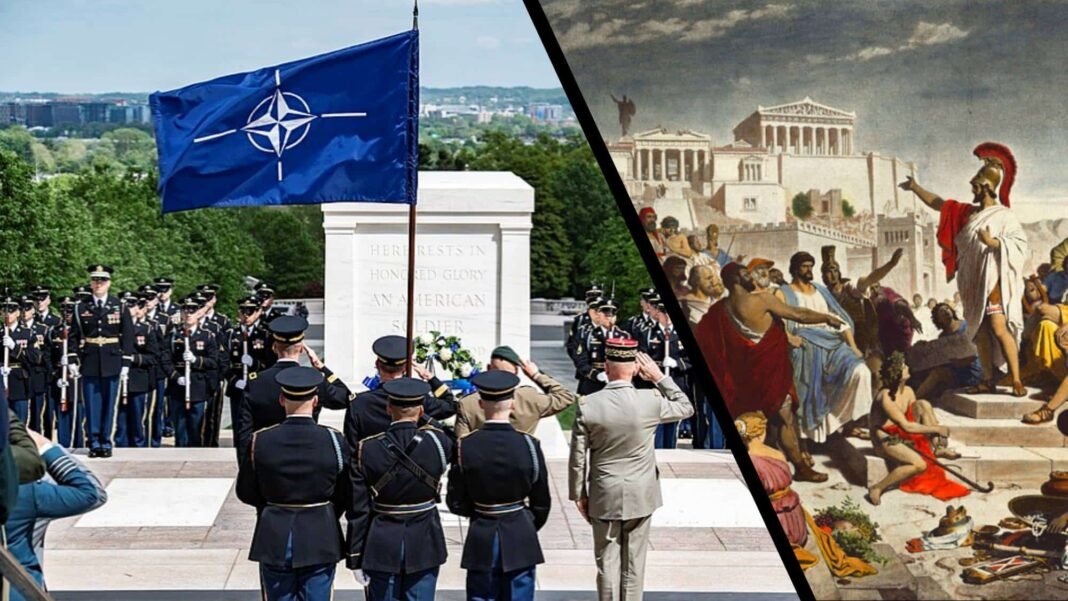
Today, the North Atlantic Treaty Organization (NATO) is the world’s most powerful military alliance. Formed in 1949, NATO is a defense-focused alliance of 32 nations, fostering mutual security through coordinated military commitments. NATO shares interesting parallels with the Delian League, an Athenian-led alliance, founded in 478 BC, initially to provide collective defense for the city-states of Greece against the expansionist Persian Empire.
Parallels between the two alliances
Both NATO and the Delian League were founded to provide collective security against a powerful external threat. In the latter case, the Persian Empire under the leadership of Darius and later his son Xerxes, threatened the freedom and political autonomy of the ancient Greek city-states. The League’s modern name comes from its meeting place on the island of Delos, though the ancient Greeks themselves simply referred to it as “the Athenians and their Allies.”
NATO arose in the aftermath of the Second World War to confront the threat posed to the West by the Soviet Union and its military alliance, the Warsaw Pact. The reliance remained intact after the end of the Cold War and the fall of the Soviet Union and continues to be characterized by the concept of mutual defense, enshrined in Article 5 of the North Atlantic Treaty.
NATO triggered Article 5 for the first and only time in its history following the 9/11 terrorist attacks on the United States. Today, policymakers in NATO member-states again perceive the greatest threat to the alliance as coming from Moscow. Since Russia invaded Ukraine in February 2022, the focus of the alliance has been on countering the military threat posed by Russia.
Another similarity is that both the Delian League and NATO include powerful members—Athens in the Delian League and the United States in NATO—whose military and political strength greatly exceed that of the other member states.
Athens was unambiguously the leader of the Delian League, composed of about 150 to 330 other members. In fact, many historians argue that when the alliance’s treasury was moved from Athens to Delos in 454 BC, the Delian League essentially became the Athenian Empire.
Although the United States is unquestionably NATO’s most powerful member and arguably exercises the greatest influence, the alliance is not led by a single country. Instead, NATO’s leadership and structure are centered around a collective decision-making process, with key roles held by the Secretary General, the North Atlantic Council, and military commanders, while decisions are made by consensus among member states.
What lessons can the Delian League teach NATO?
At its peak, the Delian League was Greece’s most powerful military alliance, rivaling the Spartan-led Peloponnesian League. Following Athens’ defeat in the Peloponnesian War (404 BC), the league dissolved but was revived in 377 BC as the Second Athenian League although it never regained its former strength. Many scholars now ponder how contemporary strategists might avoid leading NATO down a similar road.
According to Professor Tim Wass, the history of the Delian League “underscores the importance of maintaining a balanced distribution of power within the alliance, as internal conflicts and power imbalances contributed to the disintegration of the Delian League.”
Indeed, the Athenians had to put down a number of rebellions, as their hegemony over the league inspired fear from their allies. For example, Naxos rebelled in 457 BC, as did Thasos in 465 BC. Both rebellions were eventually crushed, but they demonstrated the growing discontent brewing amongst Athens’ allies.
Professor Wass advises, “Ensuring that no single member state dominates the alliance can help prevent the emergence of internal tensions and foster greater unity among member states.”
Matthew Goodwin similarly asserts, “The Delian League teaches us that such an alliance is at its strongest when members are aligned, but autonomous.”
These lessons suggest that balance and mutual respect are key to sustaining successful alliances. Drawing on Wass’ and Goodwin’s interpretations of history, the United States should adopt a more measured approach in its dealings with NATO allies, emphasizing multilateral decision-making despite its clear preeminence within the alliance.