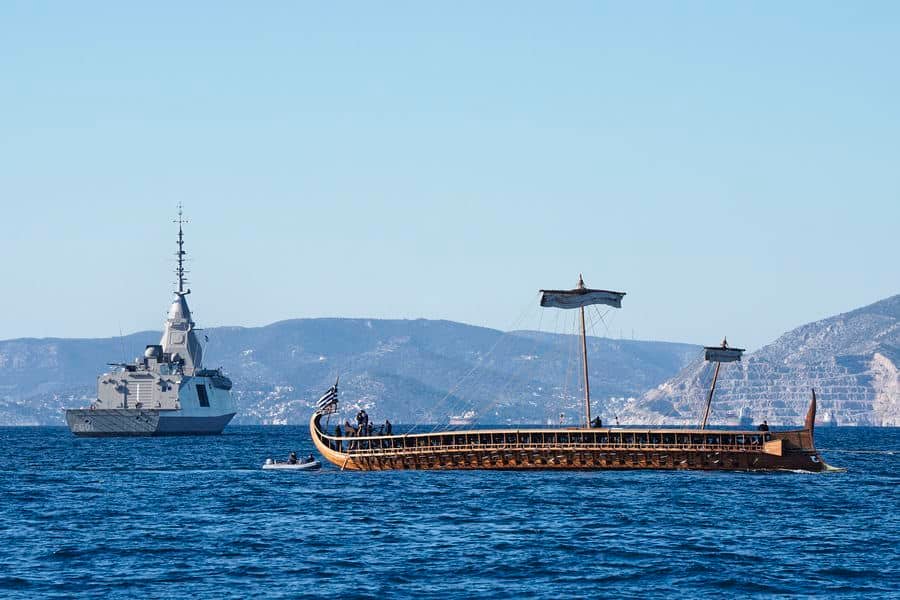
If you’ve ever spent time on a Greek ferry, especially the old-school boats where you can stand on deck and enjoy the scent of the salt and sea, you begin to understand why Greece, shaped by a long history of thalassocracy, has such a profound connection to the sea.
The land of Greece is undeniably beautiful, but it is also relentlessly Mediterranean—rocky, dry, and essentially one vast mountain range that seems to have sunk into the surrounding waters. For the people who have lived there for millennia, the sea was not just a route but a necessity; it was their means of survival and their gateway to the wider world.
Greece and the origins of thalassocracy
This isn’t new, of course—its roots go back almost forever. Even thousands of years ago, the Minoans on Crete acted as if they owned both the land and the surrounding seas. They didn’t rely on massive land armies because they understood early on that controlling the shipping lanes meant controlling the world. They turned the Aegean and the wider Mediterranean into a vast naval highway, where goods and ideas flowed with remarkable speed and efficiency.
It’s astonishing to consider, but these people were effectively running the ancient world from the deck of a wooden ship. The Ancient Greeks even had a term for it: thalassocracy, a sophisticated way of saying “rule by the sea.” To them, however, it was simply common sense.
Plato once joked that the Greeks were like “frogs around a pond,” huddled along the water’s edges. He was right. The rugged, jagged terrain of the Greek mainland made overland travel difficult, so the Greeks looked outward, toward the horizon, rather than to one another.
This outward gaze fostered curiosity and openness to new ideas. Every arriving ship brought not just olives, wine, and other goods but stories, mathematics, and novel ways of thinking about the world. You don’t invent democracy and philosophy by staying confined to a farm. You do it by exploring what lies on the next island, and the Greeks demonstrated this over 2,500 years ago.
The sea also served as a formidable shield against enemies. When the Persians attempted to conquer Greece, the Greeks didn’t hide behind city walls—they wagered everything on their ships at Salamis.
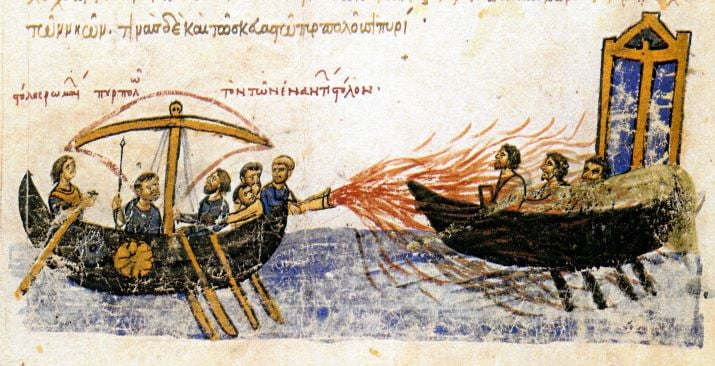
A few centuries later, the Byzantines continued this naval tradition, famously using Greek Fire to defend themselves. This secret weapon, an early form of napalm, could burn on the water’s surface, striking fear into enemy fleets. Those who challenged the Byzantine Empire quickly learned a brutal lesson: cross them, and you might find the sea itself turned against you.
It was this relentless naval focus that sustained the empire for a millennium and cemented the Greeks’ reputation as masters of the seas.
A long history of fire and water
Even under Ottoman occupation, the Greeks never lost their instinct for the sea. With control of land-based governance denied, they turned their focus to the merchant lanes, becoming the world’s delivery network and amassing private fortunes that later helped the nation rise from its ashes.
By the time they launched the fight for independence in 1821, Greece lacked a formal navy, yet its resilient merchant sailors simply strapped cannons to their trading brigs and went to war. The funding and logistics for the entire revolution flowed from the sea, making them a formidable force that seemed to appear out of nowhere.
That same spirit persists in modern Greece. Remarkably, a country representing just 0.12% of the global population controls over 20% of the world’s merchant fleet. This is no accident—it is a collective national muscle memory, passed down for thirty centuries, placing Greeks at the forefront of global shipping. Whether it is a billionaire magnate in Athens or a fisherman navigating the Cyclades, there remains a profound almost spiritual understanding of the sea.
From the legendary voyages of Odysseus to the massive tankers docked today in Piraeus, the story remains consistent: if you can master the waves, you can master anything.