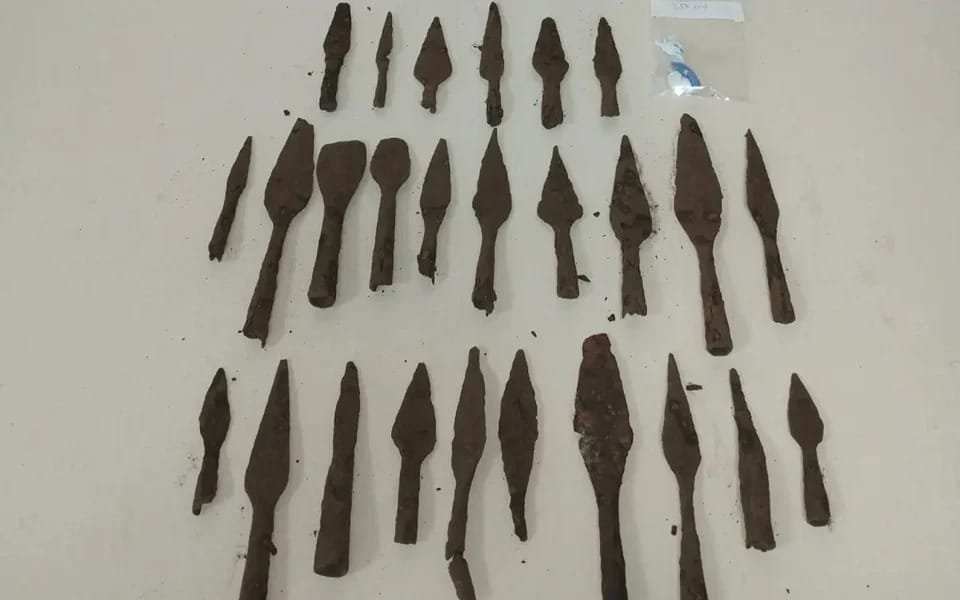
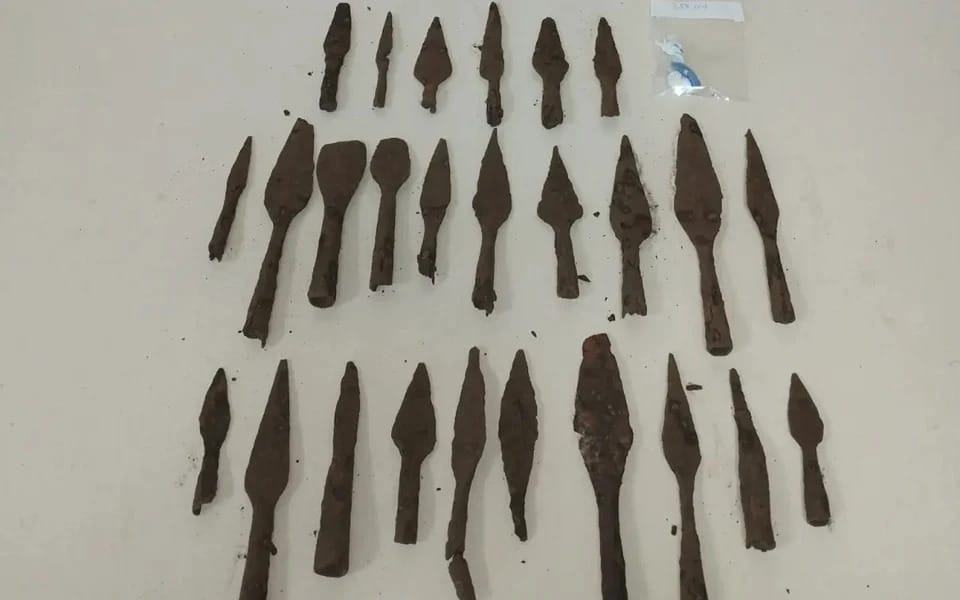
Police in Greece seized 26 Hellenistic spearheads during a raid in Northern Greece, highlighting a case of major historical significance.
The spearheads were recovered from the home of a 44-year-old foreign national, who had been arrested a day earlier in Thessaloniki for unrelated offenses. Acting on instructions from the Subdirectorate for Tackling Organized Crime in Northern Greece, authorities conducted the search and confiscated the antiquities from the residence.
Additional items seized by police in Greece along with Hellenistic spearheads
Along with the 26 Hellenistic spearheads, police in Greece confiscated several other items during the raid, including five rings, 22 watches, and a camera.
Officers also discovered a white powdery substance weighing 3.6 grams (0.127 ounces), which was sent for laboratory analysis. All seized items were secured as evidence, and authorities confirmed that the case will be forwarded to the Kozani public prosecutor.
About the Hellenistic period
The Hellenistic Age spans roughly three centuries of Greek history from the death of Alexander the Great in 323 BC to the rise of Augustus in Rome in 31 BC. During this era, Greek language and culture spread across a vast region stretching from the Mediterranean into parts of Asia, reshaping the Ancient Greek world and giving it a distinctly international character.
After Alexander’s death, his empire lacked a clear successor. His most powerful generals divided his territories into major kingdoms, establishing new political centers and rival governments that defined the period. As these kingdoms expanded and competed, they carried Greek ideas, customs, and institutions across distant regions, including areas as far away as India, and helped connect societies that had once developed independently.
Cultural exchange and military innovation
The Hellenistic period also saw intense cultural exchange and the rise of cosmopolitan life. Greek art, religion, and everyday customs had long absorbed outside influences, but Alexander’s conquests dramatically expanded contact across borders. As travel and movement became easier, many people embraced diversity and personal identity while navigating rapidly changing societies.
At the same time, Macedonia strengthened its reputation for military innovation. The Macedonian army relied on disciplined battlefield organization and long weapons such as the sarissa—the spear used by the Macedonian phalanx and introduced by Philip II, Alexander’s father. As warfare evolved across the Hellenistic kingdoms, armies adapted their weapons and tactics, leaving behind artifacts like spearheads that continue to provide valuable insight into the era’s military history.