

A decisive step has been taken toward the largest architectural and museological upgrade in the history of the National Archaeological Museum (NAM).
The two supreme advisory bodies of the Ministry of Culture—the Central Archaeological Council (KAS) and the Central Council of Modern Monuments (KSMN)—have unanimously approved the preliminary studies (architectural, structural, and electromechanical) for the expansion and comprehensive renovation of the country’s leading museum.
Project scope and vision for the National Archaeological Museum in Athens
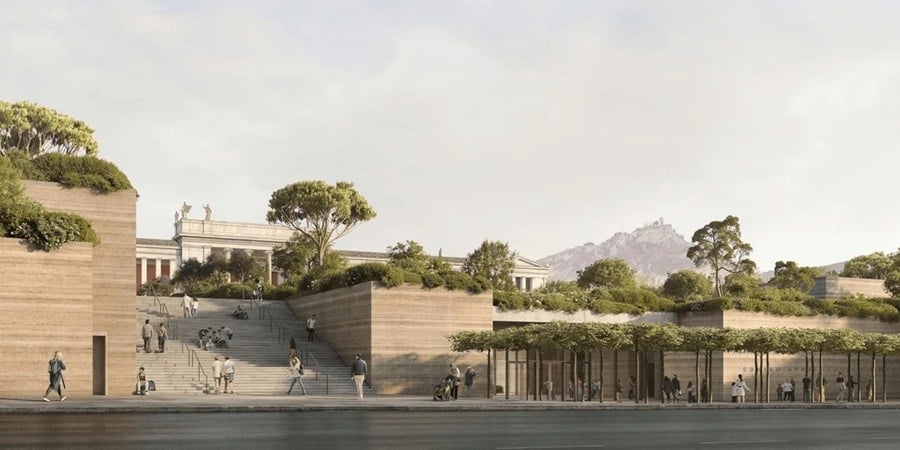
The project encompasses the entire city block and the museum complex, including the Epigraphical Museum. It aims to transform the National Archaeological Museum into a modern, world-class cultural organization, befitting the unique collection of ancient Greek art it houses.
The architectural design is being handled by the renowned firms Chipperfield – Tombazis. The goal is to create a unified, coherent complex that respects the historic character of the monument while simultaneously meeting the demands of a contemporary museum.
Greece is acquiring the National Archaeological Museum it deserves

In her statement, Minister of Culture Lina Mendoni emphasized that “Greece is acquiring the National Archaeological Museum it deserves.”
The expansion and upgrade will resolve the inconsistency and disjointedness resulting from past, fragmented interventions, restoring a unified compositional character to the monument. The existing exhibition spaces, originally designed in the 19th century, are no longer adequate for the more than doubled visitor numbers or for modern museological concepts.
The new proposal addresses several long-standing structural issues, including:
Remediation: Addressing chronic issues such as dampness and water ingress.
Safety & Energy: Enhancing seismic protection and achieving energy efficiency.
Accessibility: Ensuring universal accessibility throughout the complex.
Museological enhancements and space allocation

Special importance is given, for the first time, to ensuring stable and suitable environmental conditions—humidity, lighting, and temperature—for the proper display and protection of the antiquities in both the expansion and the historic building.
The plan involves a significant increase and modernization of the museum’s exhibition and support spaces:
Approximately 17,000 antiquities will be exhibited across two main thematic areas, comprising 13 sections and dozens of sub-sections.
Prehistoric Collections: The space for the three Prehistoric Collections (Neolithic, Cycladic, and Mycenaean) will increase from 1,100 sq.m. to 2,500 sq.m.
Temporary Exhibitions: The space for temporary exhibitions will more than double, from 429 sq.m. to approximately 1,033 sq.m., complete with separate storage and logistics areas.
Educational Programs: New spaces for educational programs will be created, expanding from 50 sq.m. today to 178 sq.m.
Antiquities and General Storage: Storage areas will be modernized and increased from 3,367 sq.m. to 4,296 sq.m.
Conservation Laboratories: The labs will nearly double in size, from 856 sq.m. to 1,707 sq.m.
Library and Archives: The library space will expand from 201 sq.m. to 289 sq.m. The historic photographic archive will grow from 39 sq.m. to 91 sq.m. with new storage of 142 sq.m.
Courtyards: The internal courtyards will also be utilized, creating a modern, functional, and educationally rich environment.
The National Archaeological Museum of Athens is the largest archaeological museum in Greece. It was founded at the end of the 19th century to house and protect antiquities from all over Greece, thus displaying their historical, cultural, and artistic value.


