
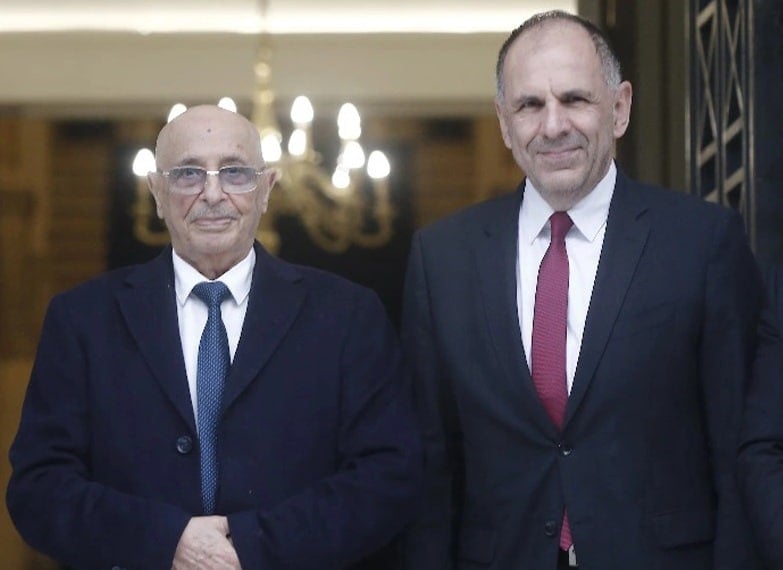
Akila Saleh, the Speaker of the Libyan House of Representatives (HoR) based in Benghazi, publicly declared the 2019 Turkey-Libya Memorandum of Understanding (MoU) on maritime boundaries “null and void.” This marks the first such public statement since 2019 by Saleh, who recently visited Athens.
In an interview with the Libyan News Agency (LANA), Speaker Saleh stated that the MoU is invalid and, concurrently, opens the door for negotiations with Greece, Egypt, and Turkey concerning the delimitation of maritime zones.
Key developments and legal stance
Invalidity Reaffirmed: Operating in full coordination with Field Marshal Khalifa Haftar, Saleh’s insistence on the MoU’s invalidity is highly significant, effectively closing the door on any potential ratification by the Libyan Parliament.
De-Legitimization: This declaration is a crucial development, as it de-legitimizes any practical attempt by Ankara to implement the Turkey-Libya MoU.
Context of Diplomacy: The statement follows Saleh’s visit to Athens, where he met with Greek Foreign Minister George Gerapetritis, and a separate visit by Haftar to Cairo, where he discussed delimitations with President Abdel Fattah el-Sisi.
HoR Authority: Saleh emphasized that the House of Representatives is the sole competent authority empowered to ratify international agreements. He reiterated that the “maritime agreement signed by the Fayez al-Sarraj government with Turkey was neither presented to nor approved by the House of Representatives, and is therefore legally null and void and non-binding for the Libyan state.”
Basis of Illegality: He further explained that international agreements can only be concluded by a legitimate government that has received a vote of confidence from the HoR. He noted that what the Al-Sarraj government signed did not express the will of the Libyan people, adding, “What is built upon illegality remains illegal, no matter how much time passes.”
Opportunity for redefining maritime jurisdictions
The Speaker highlighted that Libya now has a new opportunity to redefine its maritime jurisdictions in the Eastern Mediterranean through negotiations involving Egypt, Greece, and Turkey. He underscored that the next phase should be one of consensus, not confrontation, and stressed that Libyan sovereignty over its territorial waters is a red line that cannot be violated.
Regarding international reactions, Saleh stated that some countries recognize the MoU’s lack of legitimacy, while others treated it as a fait accompli for political reasons, adding that any agreement not ratified by the HoR is not binding on the Libyan state.
Views on interested parties
Greece and Egypt: Saleh noted that Greece initially adopted a firm stance due to the perceived harm to its interests but later showed a readiness for dialogue. Egypt’s rejection was clear from the outset, based on the potential regional instability the MoU could cause.
Turkey: Saleh’s reference to Turkey has raised some questions, as he stated that Ankara has expressed its readiness to enter into comprehensive negotiations with Libya, potentially paving the way for a multilateral dialogue aimed at securing Libyan rights.
Libyan reservations and negotiation plan
Saleh made it clear that his statements do not signify an acceptance of the Greek positions.
He specifically criticized Greece’s reliance on the island of Crete to determine the extension of its Exclusive Economic Zone (EEZ), which he characterized as “illogical and excessively close to the Libyan coast,” and not supported by international law.
He stressed that Libya is not obliged to choose between the Egypt-Greece axis or the Turkey axis. The Libyan state is independent, and its national interests form the basis of all negotiations to ensure balanced relations with all parties.
The Speaker explained that the dialogue with the three countries will proceed on three levels:
Technical: For boundary delimitation.
Legal: For reviewing agreements and international standards.
Political: For securing interests and balances between the states.


