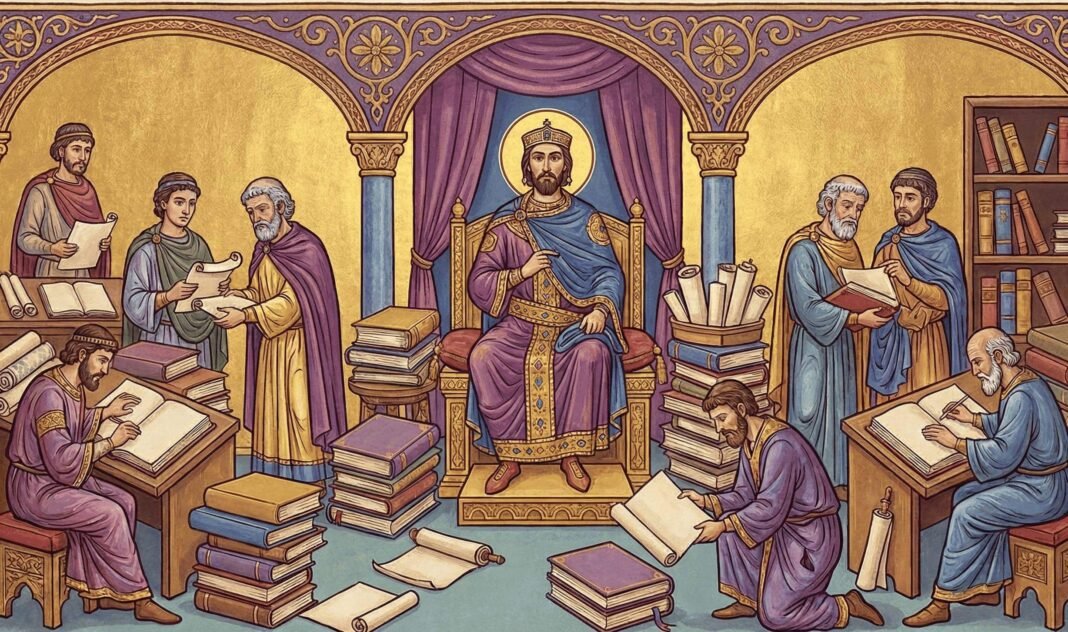
The Constantinian Excerpts represent one of the most overlooked yet ambitious efforts to categorize and standardize knowledge in medieval history. They reveal how Byzantium treated ancient texts not as forgotten relics but as living resources.
Commissioned by Constantine VII Porphyrogennetos in the mid-10th century, the project compiled passages from dozens of Greek historians into a palace library organized by themes such as power, policy, and memory. Although most of the volumes have unfortunately been lost, the surviving excerpts demonstrate a meticulous, almost forensic approach to compiling texts—reshaping the ways history could be read, referenced, and applied within a medieval European imperial court.
Byzantium, ancient texts in an emperor’s workshop
Constantine VII’s court fostered a research culture that treated historiography as a practical toolkit for governance. Scholars organized material not chronologically but by subject so that passages illustrating, for example, embassies could be retrieved quickly and easily, regardless of time. This method ensured that all content was preserved even as it was redistributed across different themes. The simple yet striking approach reflects how the Byzantines respected Classical authority while confidently exercising editorial control themselves.
Research has shown that this reorganization of ancient knowledge contributed to a biographical turn in Byzantine writing. Writers began focusing less on listing events chronologically and more on telling the lives of notable rulers and officials, using these biographies as moral and political examples. This “biographical turn” is closely linked to works such as De Administrando Imperio and De Ceremoniis, which similarly aimed to systematize and preserve practical knowledge on governing and managing the empire effectively.
The Constantinian Excerpts was a 53‑volume ”search engine”
The anthology of the Constantinian Excerpts consisted of 53 themed volumes, of which only a few survive in entirety or in significant fragments today—the Excerpta de legationibus in full and three others in substantial portions. Even this limited remnant preserves unique passages from authors otherwise lost forever.
The collection includes names ranging from Herodotus and Thucydides to Polybius, Priscus, Menander Protector, and John of Antioch, with several preserved only in this compilation. This gives modern readers access to voices that would otherwise have vanished amidst lost papyri and destroyed libraries.
Scholars have argued that the Excerpts were a deliberate information system, created by a team of court literati—individuals close to the emperor, yet driven by their own desire to preserve human knowledge. In many ways, it functioned as a tenth‑century research engine, allowing precedent events and information to be retrieved swiftly for counsel, reference, or even entertainment.
A lesser-known aspect of the project is its layered authorship and institutional organization. Recent studies reveal the role of the excerptores, who worked under imperial direction. These editors mediated between ancient texts and contemporary Byzantine agendas, providing selections, rubrics, and connective commentary that enriched the older works.
There is also evidence that entire works were occasionally rearranged rather than simply excerpted. While this complicates modern assumptions about the integrity of the surviving fragments, it clarifies Byzantine priorities in knowledge management. This editorial boldness reflects a broader Byzantine habit of epitome and synopsis, also visible in Photius’ Bibliotheca, where condensed transmissions safeguarded access to otherwise massive and obscure works.
The Constantinian Excerpts today
The Constantinian Excerpts did not merely preserve the past; they reorganized it into actionable memory that shaped how the Byzantine ruling elite thought about legitimacy, diplomacy, and the ethical consequences of leadership.
By arranging historical examples (exempla) under clear thematic headings, the Excerpts made it easy for officials and scholars to locate precedents when debating policy or planning ceremonies. This practical design turned the collection into a working reference tool for Byzantine government and court life. Later, much of this material contributed to the Suda, a vast Byzantine encyclopedia, allowing Constantine VII’s carefully selected excerpts to circulate beyond the imperial court and influence broader Byzantine learning.
Modern scholarship studies the Constantinian Excerpts to understand Byzantine attitudes toward the Classical past, debating whether such systematization preserved or distorted ancient authors. The project both shortened and preserved texts, creating tension among scholars between potential loss and the survival of invaluable material. Despite the edits, the Excerpts saved critical pieces of Greek historiography, records of Roman politics, diplomacy, and frontier life that would otherwise have disappeared.
The project reflected a Byzantine belief that ancient knowledge should be practical and instructive, used in real life rather than left on dusty shelves. By organizing history into a useful reference system, the tenth-century compilers transformed the past into a tool for decision-making—an approach that feels remarkably modern in its effort to make vast information both accessible and meaningful.