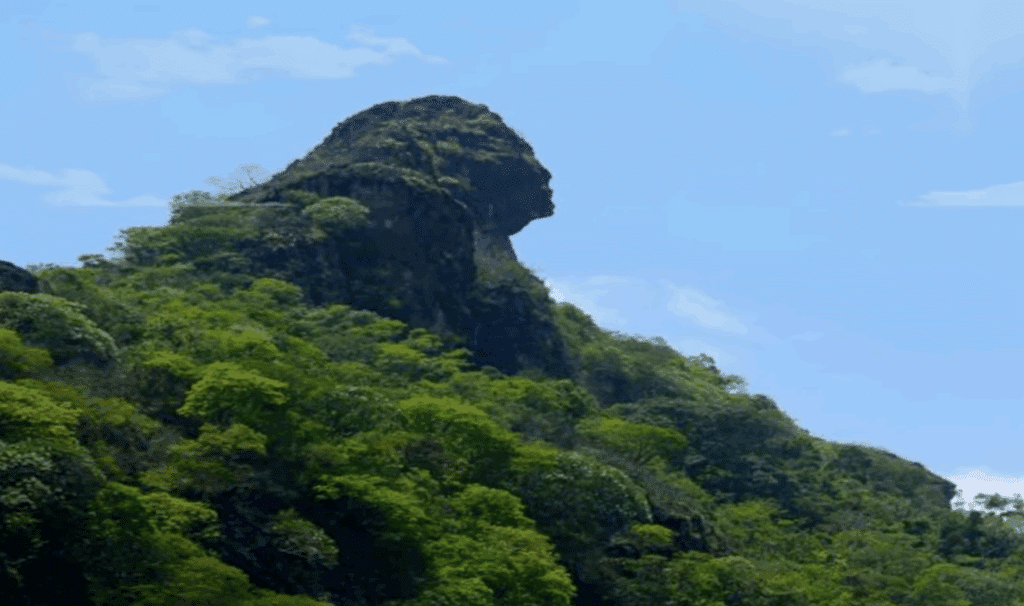
Cerro Mirandilla, or Tres Picachos, is a rugged volcanic hill near Palín in southern Guatemala whose silhouette, seen from one precise bend in the local highway, aligns to form an eerily human, sphinx-like profile. While geologists and archaeologists currently describe it as a natural landform, its striking appearance continues to make those who see it wonder: is this sphinx of South America a creation of nature, or the work of ancient hands?
Setting and first impression in Cerro Mirandilla
The hill rises from the volcanic foothills along Guatemala’s National Route 14 between Ciudad Vieja and Palín in the Escuintla region about 60 kilometers (37 miles) and roughly a couple of hours’ drive from Guatemala City. The road winds through a landscape already crowded with cones and ridges shaped by the country’s active tectonic zone.
This particular formation is not especially tall compared with nearby volcanoes, but the bulk of the hill is capped by three rocky points, the “three peaks” that inspired the name Tres Picachos.
Most of its flanks are covered in greenery, so the pale, bare rock that forms the eerie “face” stands out even more dramatically against the vegetation. What startles visitors is how, from a very specific stretch of the highway, the outline of that rock mass suddenly tightens into what looks like the reclining profile of a giant head—complete with brow, nose, lips, and chin—an impression that, unfortunately, falls apart almost as soon as one drives past the sweet spot.
Cerro Mirandilla: Many names, one hill
Over time, locals have given the hill many names, each one capturing a different side of its personality: the formal Cerro Mirandilla or Cerro Miranda as its main toponym, the descriptive Cerro de los Tres Picachos, the dramatic La Esfinge de Guatemala, and darker nicknames such as La Negra de Piedra Escuintleca, El Sacrificadero, and Puerta del Infierno.
In the last couple of decades, word of its uncanny profile and spooky reputation has turned it into a modest adventure-tourism stop thanks to viral social media posts. This continues to draw weekend hikers, campers, climbers, and rappellers who appreciate that access from the highway is open and informal, although local media often remind visitors to treat the hill respectfully and be mindful of any rituals taking place.
Many people come with a very specific mission: to park along the RN-14 highway, shuffle a few meters one way or the other, and hunt down the exact viewing angle where the slopes and ledges suddenly align into that photogenic stone “face” that circulates so widely on social media. The more ominous nicknames, especially El Sacrificadero and Puerta del Infierno, stem from deep-rooted local stories that paint Cerro Mirandilla as a threshold zone where the human world brushes up against something more dangerous and ominous.
Local legends speak of a cursed girl with the upper body of a woman and the tail of a serpent who appears to travelers begging for help, of a witch who lures wanderers with enchanted food, and of hidden fruits or treasures that can only be reached by crossing a river-like portal beneath the hill.
Obviously, all these are tales that can be found in many civilizations and simply warn against greed and naive encounters with the supernatural. Contemporary reports describe candles, incense, makeshift altars, and animal remains scattered on the slopes. These are signs that the hill remains an active ritual space within living Mayan and related traditions, in which mountains, caves, and eye-catching rock formations are normally dwelling places of spirits, ancestors, and powerful earth forces.
Is it actually a Sphinx?
Beginning around the mid-2000s, a different narrative started circulating in tourism circles, viral posts, and fringe-history videos: that a recent investigation by a researcher had supposedly demonstrated Cerro Mirandilla is not a natural hill at all but an enormous pre-Hispanic construction. The profile, several rough “structural” features and nearby rock art, were put forward as the main pieces of evidence.
These opinions usually mention cave paintings in the region, sometimes vaguely linked to Olmec or early Maya groups. According to these theories—which correctly note, based on solid archaeological proof, that the broader Escuintla area was home to the Cotzumalhuapa culture—a society that produced large, sophisticated stone sculptures and carved monuments at sites such as Bilbao and El Baúl once thrived here.
However, the rock paintings that can be seen today at places such as Casa de las Golondrinas, which likely began as decorations in a cave whose roof later collapsed, simply show that people used cliffs in the region for ritual and artistic purposes rather than providing evidence for anything more sinister or technologically exceptional. They do not, based on current evidence, show that entire hillsides like Mirandilla were carved into giant heads by humans.
From the standpoint of mainstream geology and archaeology, Cerro Mirandilla fits comfortably within the pattern of volcanic and erosional landforms created along Guatemala’s Pacific slope by the subduction of the tectonic plate beneath the Caribbean and North American plates. This is a normal process that has led to the formation of chains of volcanoes and ridges over millions of years.
Specialists note that genuine carved structures such as the Great Sphinx of Giza clearly display tool marks, integrated architectural elements, and consistent three-dimensional modeling from multiple angles, whereas Mirandilla’s human profile depends entirely on one line of sight and dissolves into a far more irregular, obviously natural shape when viewed from other directions. This is a textbook case of pareidolia, the mind’s habit of finding faces and figures in clouds, cliffs, and random patterns.
A more grounded-in-reality interpretation is that ancient inhabitants of the broader area recognized this already striking outcrop as a charged sacred place within their landscape. They may have cut trails, small platforms, or altars on and around it, incorporating it into a network of mountains and shrines that people still visit today. Meanwhile, its 21st-century fame as “the Guatemalan Sphinx” owes as much to camera angles, viral reels, and the human brain’s love of patterns as it does to stone and time.